

Homeowner Knowledge Base
Kitchen and bathroom snagging: water, finishes and ventilation
The short answer: kitchens and bathrooms bring together water supplies, drainage, appliances, fitted furniture, seals and ventilation. Check that everything works normally, look for signs of movement or leakage and record anything that appears incomplete or damaged. You should not need to dismantle fittings or remove concealed panels.
CheckSure’s Homeowner Knowledge Base draws on practical experience of building, inspecting and resolving defects in new homes. Our aim is to explain what homeowners should reasonably expect, what may require further investigation and what steps they can take next.
Why these rooms deserve careful attention
A loose fitting or poorly aligned cupboard may be inconvenient, but a continuing leak or incomplete seal can damage units, floors and rooms below. Ventilation problems can also allow moisture to remain in the home and contribute to condensation or mould.
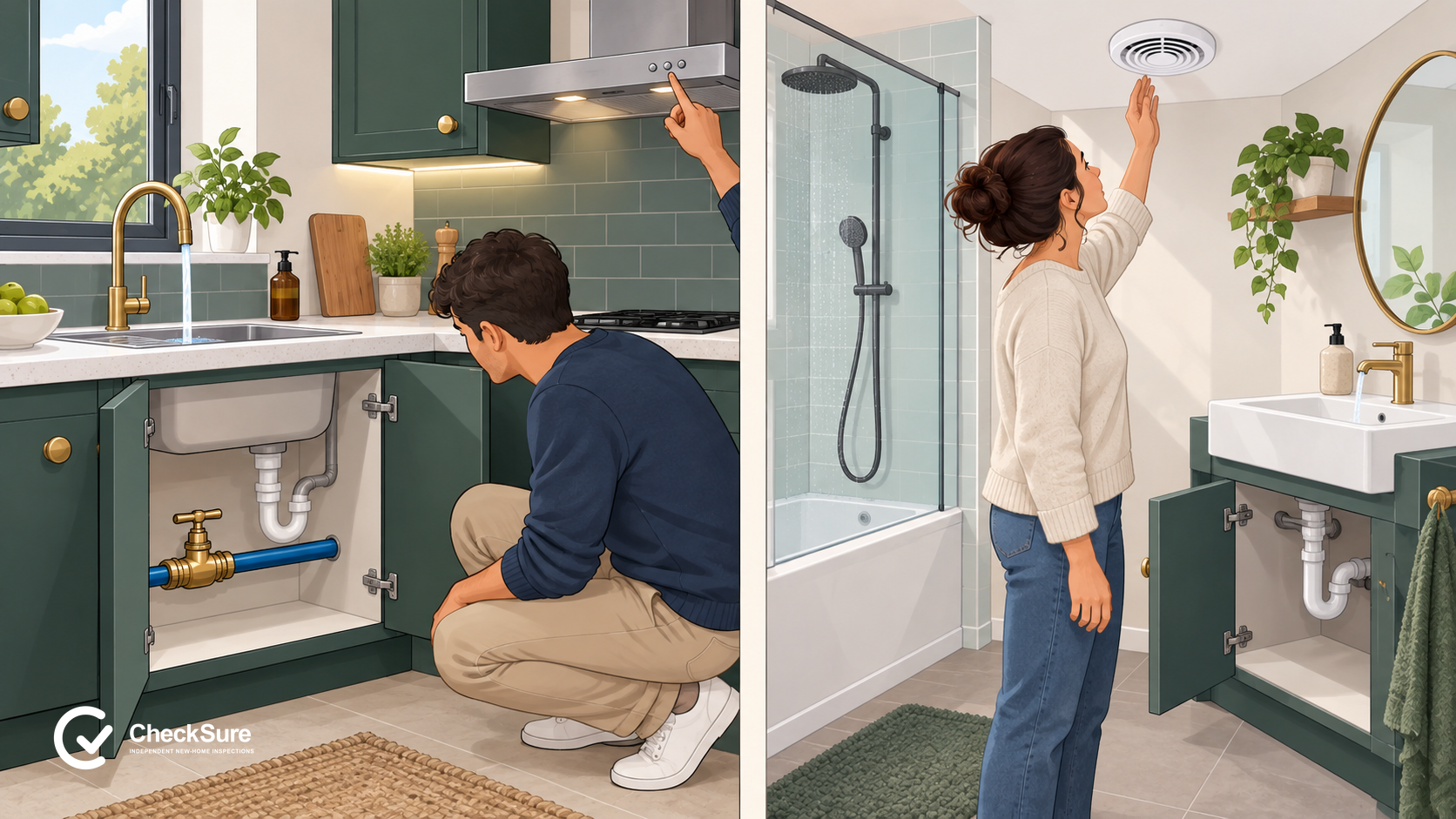
Take your time and use the rooms normally. Open doors and drawers, run taps, observe how water drains and operate the extractor fan. Photograph concerns before they are disturbed or temporarily cleaned up.
Checking kitchen units and worktops
Start by opening every accessible cupboard, drawer and fitted panel. They should move freely without striking adjacent units, appliances or handles. Look for loose hinges, unstable shelves, damaged surfaces and plinths or end panels that are not properly secured.
Worktops should be complete and undamaged. Pay particular attention to joints, edges and openings around sinks or appliances. These are locations where water can enter the units below if the joint or seal is incomplete.
Useful checks include:
- Doors and drawers opening and closing without collisions.
- Handles, shelves, plinths and fitted panels remaining secure.
- Worktop joints and edges appearing complete and undamaged.
- Sealant around sinks and worktops being continuous where required.
- Supplied appliances and their visible controls being present and undamaged.
Record any issue with a wider photograph showing its location and a closer image showing the defect.
Taps, sinks and drainage
When the water supply is available, operate each tap normally. Check that hot and cold controls are correctly identified and that water flows and drains without leaking from visible joints.
Water should not collect in the sink for an unreasonable period or rise back through another waste connection. Gurgling, persistent odours, slow drainage or water appearing inside a cupboard should be recorded. These symptoms do not prove what is wrong with the concealed pipework, but they justify further investigation.
Do not dismantle traps or pipe connections as part of a homeowner check.
Bathrooms and shower rooms
Check that the toilet, basin, bath and shower feel stable during normal use. Seats, bath panels, screens and accessories should be secure and should operate without excessive movement.
Tiles and grout should appear complete, with no conspicuous cracks or missing areas. Flexible sealant is particularly important where different surfaces meet, including around baths, shower trays and basins. It is not simply a decorative finish: it helps prevent water from passing into concealed areas.
Where it is safe to do so, use the fittings normally and observe whether:
- Water drains without obvious backing-up.
- Visible supply and waste connections remain dry.
- Shower screens or doors operate and close correctly.
- Water remains within the intended bath or shower area.
- Sealant and grout remain intact after use.
A brief observation cannot prove that concealed waterproofing has been installed correctly. Report unexplained staining, movement, recurring dampness or water appearing outside the wet area.
Ventilation and moisture
Bathrooms and kitchens produce moisture that needs to be removed from the home. Operate the extractor using its normal control and check that it responds. Depending on the system, it may continue running after the light is switched off or operate continuously at a low rate.
Make sure that extractor grilles, trickle vents and any designed gaps that allow air to move between rooms have not been blocked. Noise from a fan does not prove that it is moving the required amount of air, and a tissue test is not a formal performance measurement.
If the room remains unusually damp, condensation persists or the extractor appears ineffective, ask the developer for the ventilation commissioning information and report the concern.
Appliances
Only operate an included appliance when it has been installed, commissioned and is ready for normal use. Follow the manufacturer’s instructions and restrict the check to ordinary controls and visible connections.
A problem may relate to the appliance, its installation or the services connected to it. Record exactly what happened, including any warning light or error code, rather than attempting to diagnose or repair it yourself.
If you find a leak
Even a small continuing leak can damage cabinets, flooring and ceilings below. Photograph both the apparent source and the affected area, and contact the developer promptly.
If water is actively escaping, use the appropriate local isolation valve or main stop valve if you know where it is and can reach it safely. Keep water away from electrical equipment. A substantial or uncontrolled escape of water should be treated as an urgent matter.
What a visual check cannot confirm
An ordinary homeowner check cannot confirm the condition of concealed pipework, hidden waterproofing, electrical test results, duct routes or measured ventilation performance. These matters may require construction records, commissioning information or a suitable specialist investigation.
Do not remove panels unless they are specifically designed for normal homeowner access and can be replaced safely.
Key takeaways
- Use taps, sanitaryware, cupboards and appliances normally and observe what happens.
- Pay particular attention to leakage, drainage, movement and wet-area seals.
- Check that extractor fans respond and that ventilation openings are unobstructed.
- Photograph and report water concerns promptly.
- Do not dismantle plumbing, appliances or concealed panels.
- Ask for further investigation when symptoms continue or the cause is unclear.
Explore further
Explore the CheckSure Homeowner Knowledge Base for related guidance on buying, inspecting and looking after a new home.
Related Knowledge Base articles
- Condensation in new-build homes: causes, prevention and practical steps
- Your water supply stop cock valve
- How to report and track snags effectively
- Plumbing and heating defects: safe checks and warning signs
- Which snags need urgent attention?
Sources & References
UK Government — Approved Document F: ventilation: https://www.gov.uk/government/publications/ventilation-approved-document-f
Independent new-home inspections
Need help with your new home?
If you are approaching completion, have recently moved in or are dealing with unresolved concerns, CheckSure can help you choose the appropriate inspection for your stage.
Important information
The Knowledge Base provides general information for homeowners in the UK. It is not a substitute for advice about an individual property and should not be treated as legal, financial, insurance, structural or other specialist advice. Requirements and warranty terms can vary according to location, construction date, provider, contract and the circumstances of the particular home.
Copyright and permitted use. © 2026 CheckSure Ltd. All rights reserved. Website content may not be reproduced without permission, except as permitted by law. See our Content Use and Copyright Policy.