

Homeowner Knowledge Base
Your water supply stop cock valve
The short answer: find the internal stop valve before an emergency, confirm which supply it controls and make sure it remains accessible. It is commonly close to where the incoming main enters the home, often beneath the kitchen sink or in a utility cupboard, but there is no single mandatory room. An outside stop valve is usually near the property boundary or water meter and may belong to the water company.
CheckSure’s Homeowner Knowledge Base draws on practical experience of building, inspecting and resolving defects in new homes. Our aim is to explain what homeowners should reasonably expect, what may require further investigation and what steps they can take next.
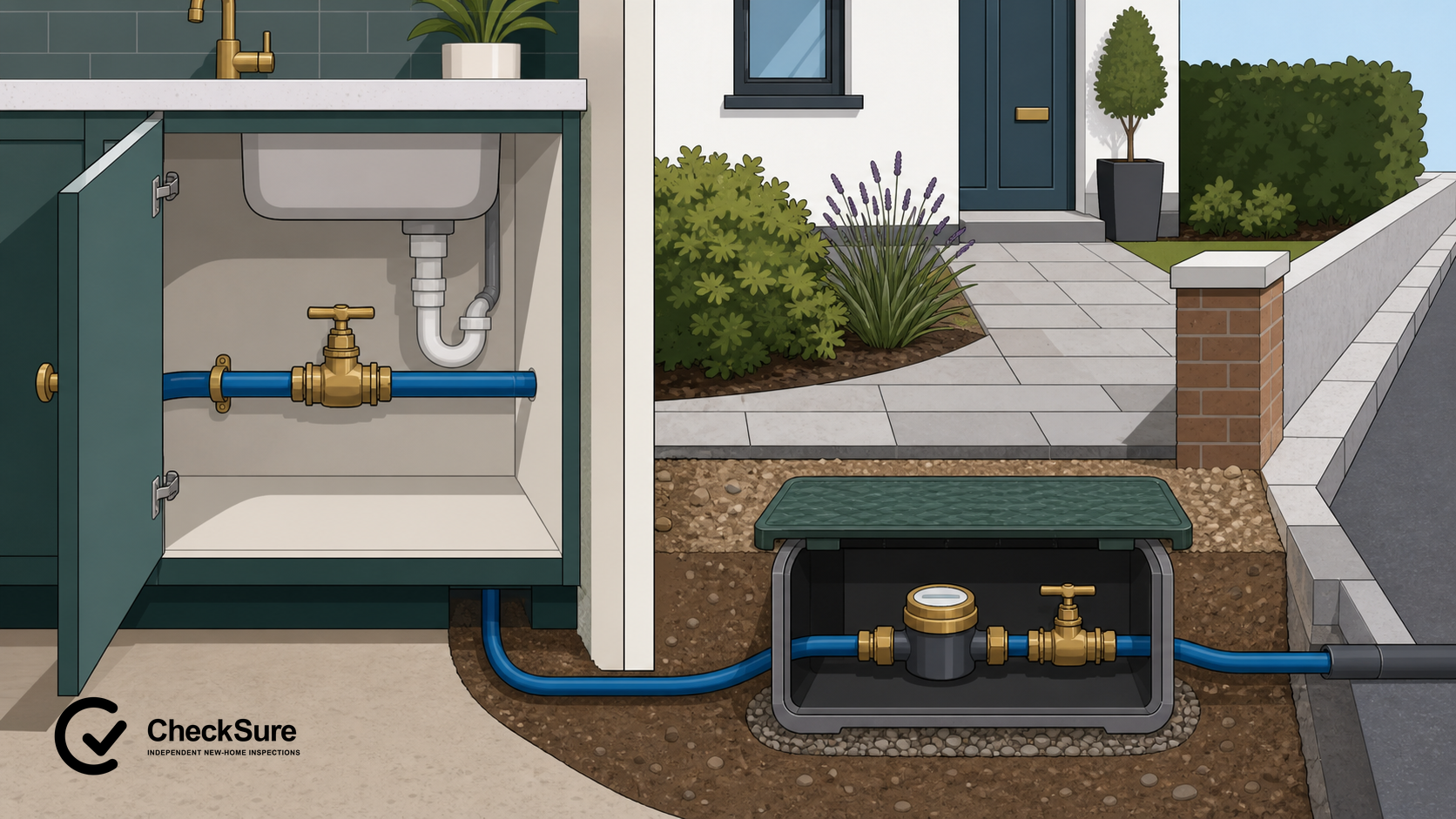
Inside and outside valves do different jobs
The internal stop valve is the one a homeowner normally uses in an emergency. The external boundary valve serves the supply network and may require the water company or an authorised person.
The internal stop valve shuts off the incoming cold-water supply within the home. The outside stop valve is normally in a small chamber at or near the boundary, pavement, path or meter. In a flat or shared development, valves may be in communal cupboards and access arrangements may differ.
Water-fittings requirements support having an accessible means of stopping the supply, but they do not create one universal “under the kitchen sink” position or a general rule that every valve must carry the same label. New-home handover information should identify services and controls. if it does not, ask the developer to confirm them in writing.
Where to look inside
- under the kitchen sink or behind an accessible kitchen plinth;
- in a utility room, service cupboard, cloakroom or downstairs toilet;
- near the front door, stairs, boiler, hot-water cylinder or water meter;
- inside a labelled riser or service cupboard in a flat.
Trace the incoming cold-water pipe if it is visible. Do not confuse the main stop valve with small isolation valves serving a tap, toilet, appliance, outside tap or heating system. Never operate an unidentified valve by force.
Where to look outside
The outside valve may be under a small cover marked for water, close to the boundary or meter. The chamber may contain a meter and more than one valve. Do not enter the road, lift unsafe covers or operate a valve that may serve neighbours. Ask the water company to identify or operate it if there is doubt.
Test the internal valve before you need it
- Tell everyone in the home and avoid testing while an appliance needs water.
- Turn the internal valve clockwise gently until closed. Do not use excessive force or tools unless the manufacturer specifies them.
- Open the cold kitchen tap. Flow should reduce and stop after water in the pipework has discharged.
- Close the tap, then reopen the stop valve slowly anti-clockwise. Once fully open, turn it back a small amount only if the valve manufacturer or water company advises this.
- Check the valve and nearby joints for leaks. Label the location and record it in your Home User Guide.
If the valve is stiff, seized, leaking or does not isolate the supply, arrange repair by a competent plumber and notify the developer if the home remains within its applicable aftercare period.
When to turn the water off
- a burst pipe or uncontrolled internal leak;
- water escaping from a fitting that cannot be isolated locally;
- plumbing work where the person doing the work requires the main supply isolated;
- leaving a property unoccupied where the insurer or system instructions recommend isolation, provided heating and other water-dependent systems are considered.
Turning off the incoming supply does not instantly empty tanks, cylinders, pipework or a heating circuit. It may not stop rainwater, drainage backflow or water from a communal system. If water is near electrics, keep clear and obtain emergency help.
If there is a leak
- Shut the internal stop valve if it is safe and accessible.
- Switch off affected appliances and use local isolation valves only if you recognise them.
- Contain water where possible and move belongings without taking risks.
- Contact the developer, emergency plumber, managing agent or water company as appropriate.
- Photograph the source and damage, and notify the insurer when required.
Make the location easy to remember
Add a durable label inside the relevant cupboard, show other occupants and include the location in moving-in information for future owners. Do not box the valve in or store items so tightly that it cannot be reached quickly.
Key takeaways
- Locate and test the internal stop valve before an emergency.
- Do not assume every new home uses the same location or labelling.
- Treat the external valve carefully because it may belong to the water company or serve more than one property.
- A main stop valve may not isolate stored water or every communal system.
Explore further
Explore the CheckSure Homeowner Knowledge Base for related guidance on buying, inspecting and looking after a new home.
Related Knowledge Base articles
- Maintaining your new-build home: a practical homeowner schedule
- Your central heating system
- Kitchen and bathroom snagging: water, finishes and ventilation
- Plumbing and heating defects: safe checks and warning signs
- New-build handover checklist and documents
Sources & References
Thames Water — Find and use your inside stop valve; Find and use your outside stop valve. Primary water-company guidance.
WaterSafe — How to turn off your water supply safely. Competent-plumber and valve-location guidance.
Water Regs UK — Why customers need their own stop valves; requirements for accessible control of supplies.
B&Q — How to turn off the water in your home. Supporting practical guidance.
Ofwat — Responsibility for supply pipes. Context on ownership up to the first fitting or stop tap.
Independent new-home inspections
Need help with your new home?
If you are approaching completion, have recently moved in or are dealing with unresolved concerns, CheckSure can help you choose the appropriate inspection for your stage.
Important information
The Knowledge Base provides general information for homeowners in the UK. It is not a substitute for advice about an individual property and should not be treated as legal, financial, insurance, structural or other specialist advice. Requirements and warranty terms can vary according to location, construction date, provider, contract and the circumstances of the particular home.
Copyright and permitted use. © 2026 CheckSure Ltd. All rights reserved. Website content may not be reproduced without permission, except as permitted by law. See our Content Use and Copyright Policy.