

Homeowner Knowledge Base
Plumbing and heating defects: safe checks and warning signs
The short answer: use ordinary controls, look for leakage and check whether heating and hot water respond as expected. Do not remove covers, alter commissioning settings or repeatedly top up a system that is losing pressure. Work involving gas, electrics, refrigerant or pressurised systems belongs with an appropriately competent person.
CheckSure’s Homeowner Knowledge Base draws on practical experience of building, inspecting and resolving defects in new homes. Our aim is to explain what homeowners should reasonably expect, what may require further investigation and what steps they can take next.
Begin with the handover information
Identify whether the home uses a boiler, heat pump, heat network, direct electric system, radiators or underfloor heating. Keep commissioning records and manufacturer instructions. Different systems warm up and operate differently, so a boiler-based expectation should not be imposed on a heat pump.
Safe functional observations
- Use the normal programmer and thermostat to request heating.
- Observe whether rooms, radiators and other accessible heat outlets begin to warm under suitable conditions.
- Run hot water normally and note delay, instability or loss of supply.
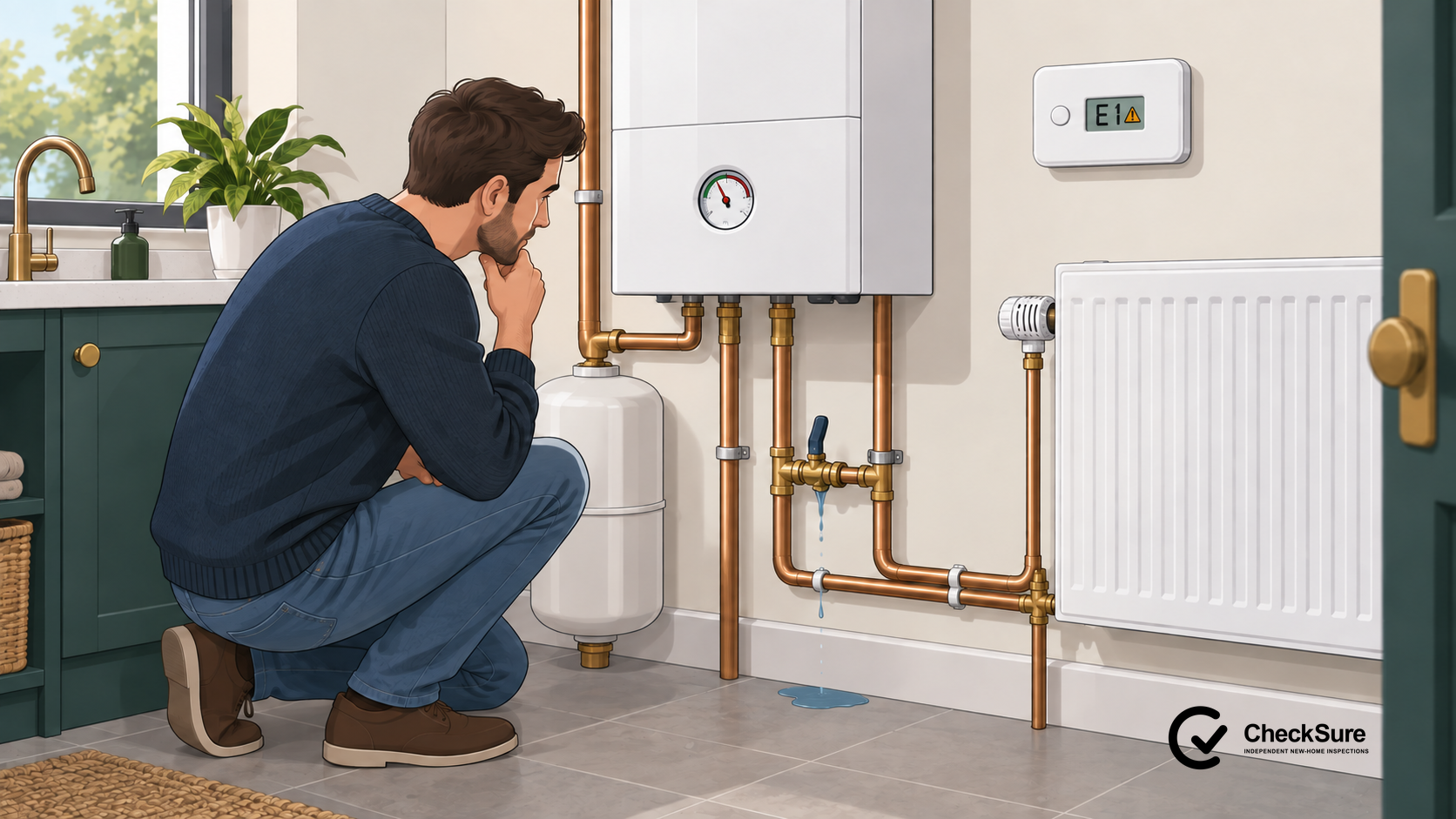
- Look for visible leakage, staining, corrosion, repeated pressure change or error codes.
- Listen for persistent unusual banging, grinding or fan noise.
- Check that accessible controls, valves and equipment are visibly secure and undamaged.
What not to do
- Do not remove a boiler, heat-pump or electrical cover.
- Do not change installer-only settings, including flow-temperature settings.
- Do not drain, chemically treat or rebalance an unfamiliar system.
- Do not bleed a radiator automatically before recording a new-home concern; the system may need commissioning or pressure checks.
- Do not repeatedly refill a sealed system with unexplained pressure loss.
Water leaks and drainage symptoms
Record the source if visible, the affected area and whether water is still escaping. Use a known accessible isolation control if safe. Slow drainage, gurgling, odour or back-up should be described as symptoms; they do not establish the location or cause of a concealed obstruction.
When is urgent action needed?
For suspected gas or carbon monoxide, leave the affected area and use the gas emergency route. In Great Britain, call the National Gas Emergency Service on 0800 111 999. Keep clear of burning smells, damaged cables or water near electrical equipment. Uncontrolled leaks and loss of essential heat for vulnerable occupants also require prompt escalation.
Commissioning and specialist investigation
A short inspection can observe how the system responds, but it cannot prove that the system is correctly sized, that water quality is suitable, that water flow is balanced throughout the system, that ventilation rates are correct or that concealed pipes are sound. Ask for commissioning evidence and use the developer or an appropriately competent specialist where performance remains in doubt.
Key takeaways
- Identify the installed system before judging its behaviour.
- Use ordinary controls and non-invasive observations.
- Repeated pressure loss, leakage and recurring error codes are not routine maintenance.
- Keep gas, electrical and sealed-system work with competent specialists.
Explore further
Explore the CheckSure Homeowner Knowledge Base for related guidance on buying, inspecting and looking after a new home.
Related Knowledge Base articles
- Your central heating system
- Your radiators
- Your water supply stop cock valve
- Which snags need urgent attention?
- Kitchen and bathroom snagging: water, finishes and ventilation
Sources & References
Gas Safe Register — Gas emergencies: https://www.gassaferegister.co.uk/gas-emergency/
MCS — Homeowner guidance and certified low-carbon installations: https://mcscertified.com/
Independent new-home inspections
Need help with your new home?
If you are approaching completion, have recently moved in or are dealing with unresolved concerns, CheckSure can help you choose the appropriate inspection for your stage.
Important information
The Knowledge Base provides general information for homeowners in the UK. It is not a substitute for advice about an individual property and should not be treated as legal, financial, insurance, structural or other specialist advice. Requirements and warranty terms can vary according to location, construction date, provider, contract and the circumstances of the particular home.
Copyright and permitted use. © 2026 CheckSure Ltd. All rights reserved. Website content may not be reproduced without permission, except as permitted by law. See our Content Use and Copyright Policy.