

Homeowner Knowledge Base
Electrical snagging: safe visual checks and documents
The short answer: limit homeowner checking to visible condition and ordinary user controls. Loose accessories, burning smells, exposed parts, repeated tripping or damaged cables need prompt attention. Plug-in indicators and switch-on checks do not replace the electrical installation certificate, formal testing or diagnosis by a competent electrician.
CheckSure’s Homeowner Knowledge Base draws on practical experience of building, inspecting and resolving defects in new homes. Our aim is to explain what homeowners should reasonably expect, what may require further investigation and what steps they can take next.
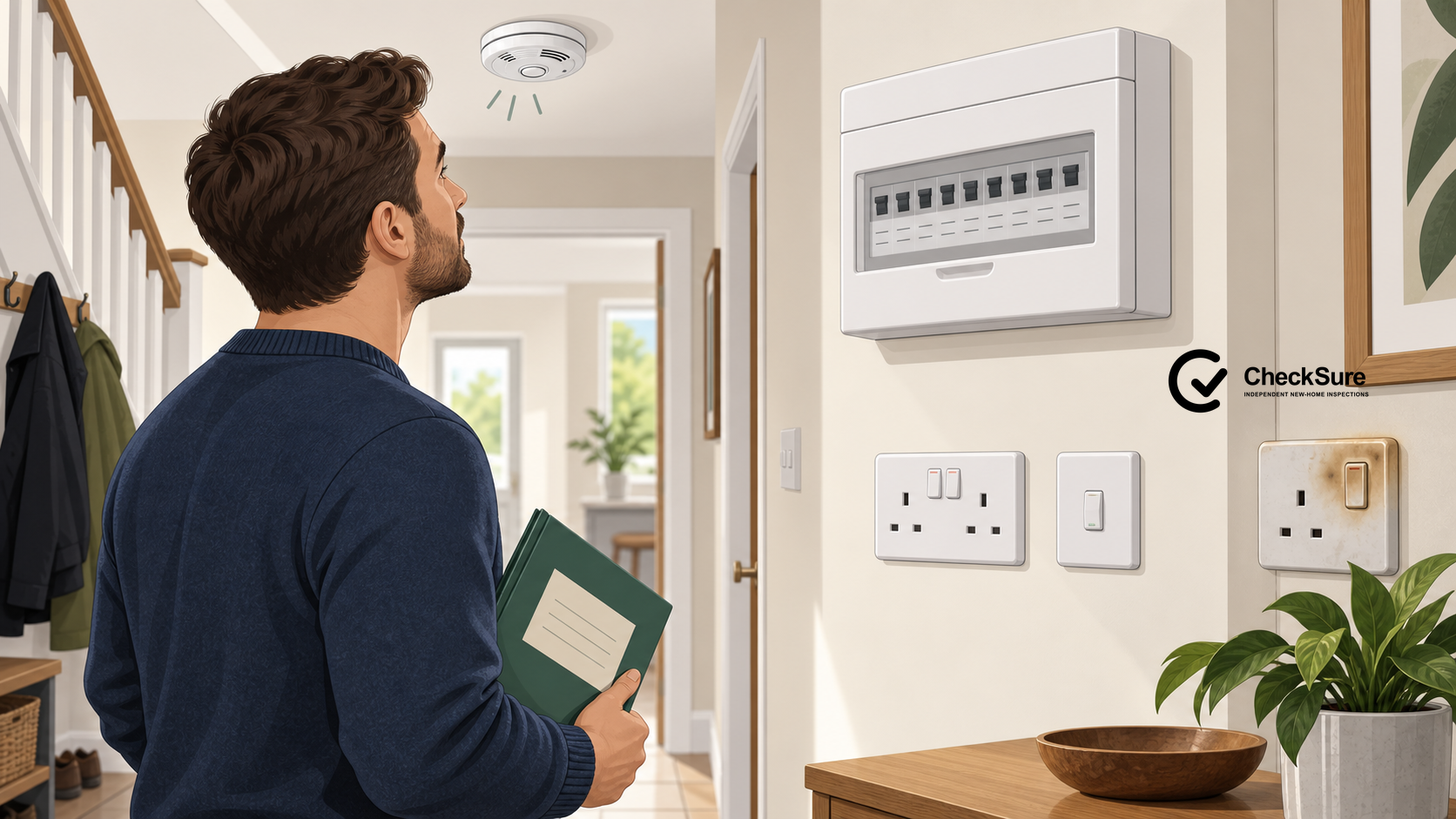
Documents to collect
- The Electrical Installation Certificate and schedules supplied for the new installation.
- Consumer-unit labels and circuit information.
- Instructions for alarms, controls, EV charging and renewable-energy equipment.
- Commissioning and registration evidence for included specialist systems.
Safe visual observations
- Socket, switch and control plates are secure, undamaged and neatly finished.
- Cables, covers and accessories do not expose live parts.
- Ordinary switches and supplied controls respond when power is available.
- The consumer unit is accessible, labelled and visibly complete.
- Smoke, heat and carbon-monoxide alarms are present as documented and respond to the approved user-test control.
What a plug-in indicator can and cannot do
Some trained inspectors use a suitable plug-in tester to obtain a limited indication at a socket. It does not prove the installation is fully safe, confirm every protective measure or replace certification. The inspection method determines whether and how socket checks are recorded. Homeowners should not try to diagnose wiring with a low-cost plug-in device.
Warning signs
Stop using affected equipment and seek prompt help for overheating, scorch marks, buzzing, burning smells, repeated tripping, electric shocks, water near electrical parts, loose accessories or visible damaged conductors. Do not repeatedly reset a protective device without understanding why it operated.
Alarms and life-safety systems
Use the manufacturer’s test control; never use flame, smoke, exhaust gas or improvised aerosol. An unusual alarm position cannot be judged from a generic diagram alone. The approved design, alarm category, home layout and manufacturer instructions matter.
Changes after completion
Do not remove accessories or alter fixed wiring to investigate a snag. In England, some electrical work is notifiable under the Building Regulations. Fixed-installation work should be designed, installed and tested by a competent person; requirements differ elsewhere in the UK. Preserve certificates for future warranty, insurance and sale records.
Key takeaways
- Collect certification and circuit information at handover.
- Restrict homeowner checks to safe visual and ordinary-control observations.
- A plug-in indicator is not an electrical safety certificate.
- Use a competent electrician for faults, testing and fixed-wiring changes.
Explore further
Explore the CheckSure Homeowner Knowledge Base for related guidance on buying, inspecting and looking after a new home.
Related Knowledge Base articles
- Extension leads and multi-socket adaptors: using them safely after moving home
- Changing light fittings in a new-build home: safety, fixings and warranties
- Smoke and carbon monoxide alarms
- Which snags need urgent attention?
- The hidden problems with new-build homes—and how to avoid them
Sources & References
Electrical Safety First — Advice for homeowners: https://www.electricalsafetyfirst.org.uk/guidance/
UK Government — Approved Document P: electrical safety: https://www.gov.uk/government/publications/electrical-safety-approved-document-p
Independent new-home inspections
Need help with your new home?
If you are approaching completion, have recently moved in or are dealing with unresolved concerns, CheckSure can help you choose the appropriate inspection for your stage.
Important information
The Knowledge Base provides general information for homeowners in the UK. It is not a substitute for advice about an individual property and should not be treated as legal, financial, insurance, structural or other specialist advice. Requirements and warranty terms can vary according to location, construction date, provider, contract and the circumstances of the particular home.
Copyright and permitted use. © 2026 CheckSure Ltd. All rights reserved. Website content may not be reproduced without permission, except as permitted by law. See our Content Use and Copyright Policy.