

Homeowner Knowledge Base
Changing light fittings in a new-build home: safety, fixings and warranties
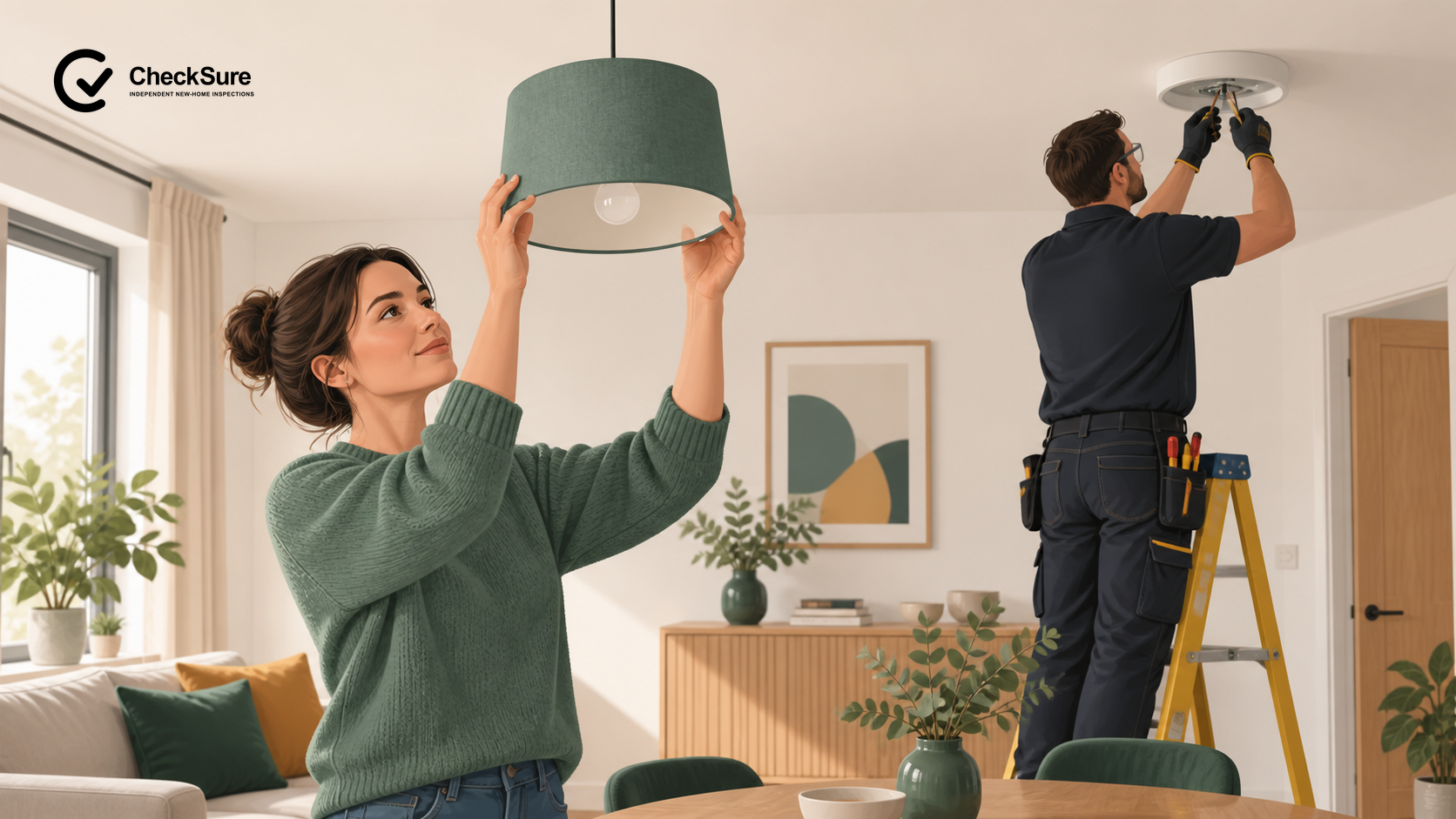
The short answer: adding a lampshade to the pendant supplied by the developer is very different from disconnecting the pendant and installing a new light fitting. A replacement may appear straightforward, but it involves the fixed electrical installation and the new fitting must also be supported safely. If you are not competent to identify, isolate, connect, test and secure the fitting correctly, use a qualified electrician.
CheckSure’s Homeowner Knowledge Base draws on practical experience of building, inspecting and resolving defects in new homes. Our aim is to explain what homeowners should reasonably expect, what may require further investigation and what steps they can take next.
Why new homes are often handed over with pendant lights
Many new-build homes are completed with a simple ceiling pendant and lamp. It is economical, provides safe basic lighting and allows the buyer to choose a decorative shade without altering the wiring. The developer cannot know the weight, dimensions or electrical requirements of every fitting a future owner may select.
A lightweight lampshade designed to attach to the existing lampholder normally leaves the electrical connection untouched. Removing the ceiling rose, exposing conductors or replacing the lampholder is electrical work. That distinction should guide both the level of care and the person chosen to do the job.
Switching the light off is not safe isolation
The wall switch controls normal use; it is not proof that the conductors are dead. Safe isolation means identifying the correct circuit, disconnecting it at the consumer unit and proving it is de-energised with suitable equipment.
The wall switch should never be treated as proof that a circuit is dead. Lighting circuits can be wired in several ways, switching arrangements may be misunderstood and neutral conductors can still present risks where faults or incorrect connections exist. Safe work requires the correct circuit to be isolated at the consumer unit, secured against inadvertent reconnection and proved dead with suitable test equipment.
Online photographs and wire colours are not a substitute for testing. New homes may contain loop connections, multiple cables, protective conductors and smart controls that do not match a simple diagram. An incorrect connection can cause electric shock, fire, nuisance tripping or leave exposed metalwork without effective earthing.
Part P applies even where notification may not be required
In England, Part P of the Building Regulations requires reasonable provision for electrical installations to protect people from fire and injury. A straightforward replacement fitting on an existing point outside a special location will commonly be non-notifiable work. Non-notifiable does not mean unregulated or automatically suitable for DIY: the work must still be safe and comply with the applicable technical requirements.
Adding a new circuit, replacing a consumer unit and certain work in the zones around a bath or shower are notifiable. The precise route depends on the location and scope. A person registered with an authorised competent person scheme can self-certify work within their scheme. otherwise building control involvement may be required. Check before work starts rather than trying to regularise it later.
Bathrooms and other demanding locations
Bathrooms require additional care because water and reduced body resistance increase the consequences of electric shock. The fitting must be suitable for its position and environmental conditions, including the relevant bathroom zone and ingress-protection rating. Do not assume that a decorative fitting sold as a bathroom light is suitable for every location.
External lights, loft spaces and fittings close to insulation can raise different issues involving weather resistance, heat, access and cable routes. Ask an electrician to assess the actual position, circuit and product instructions.
A ceiling cable is not a structural fixing
The conductors supply electricity. they must never carry the weight of the fitting. A lightweight pendant may be supported by the original ceiling rose arrangement, but a chandelier, large decorative fitting or heavy track system needs a fixing capable of transferring its load into suitable structure. Plasterboard alone may not provide adequate support.
The correct solution could involve a joist, timber noggin, proprietary support or another fixing designed for the ceiling construction and the fitting weight. The installer also needs to avoid hidden cables, pipes, engineered joists and other services. Manufacturer weight limits and fixing instructions matter. a generic plasterboard plug should not be assumed adequate.
Ask early if you know a heavy fitting is planned
If you reserve while the home is still being built, ask whether the developer can provide a suitably positioned noggin or approved support before the ceiling is closed. Supply the proposed location, fitting weight and fixing requirements in writing. Any change should be agreed through the developer’s formal extras or variation process and recorded on the drawings or handover information.
Do not rely on a verbal assurance that “there will be timber there”. Site changes, joist layouts and service routes can alter the available fixing position. If the developer will not accept the variation, wait until completion and arrange an assessment rather than asking a contractor to make an unofficial alteration during construction.
Check the fitting before it is purchased
- Confirm the fitting is intended for the UK supply and carries appropriate manufacturer and product-safety information.
- Check its weight, fixing method, dimensions and required clearances, including door and head-height conflicts.
- Confirm whether it requires an earth connection and whether the existing circuit provides one at the point.
- Check lamp type, maximum wattage, LED driver requirements and compatibility with any dimmer or smart control.
- For bathrooms or external positions, confirm the stated ingress-protection rating is appropriate for the exact location.
- Retain the instructions, receipt, product details and any electrical certification supplied after installation.
Will changing a fitting invalidate the new-home warranty?
Changing a light fitting does not automatically cancel every part of a new-home warranty. The more accurate concern is causation and scope: damage, defects or losses caused by work carried out after completion may be excluded, and the altered fitting itself is not normally treated as original builder work. Current NHBC Buildmark wording, for example, excludes work done by anyone other than the builder. Premier Guarantee wording includes exclusions for loss or damage arising from alterations unless its stated conditions are met.
The developer may also decline responsibility for a fault where later work has disturbed or obscured the original installation. Before altering anything during the builder’s initial defects period, photograph the original point, report any existing problem first and check the builder’s homeowner manual and your actual warranty policy. Use a competent installer and retain evidence so an unrelated original defect can be distinguished from alteration damage.
What documents should you receive?
The appropriate paperwork depends on the work. A simple non-notifiable replacement may not produce a Building Regulations compliance certificate, but the installer should still inspect and test the work as appropriate and record it in accordance with current electrical standards. Notifiable work completed through a competent person scheme should generate evidence of Building Regulations compliance. Ask what documentation will be provided before appointing the contractor.
Can a snagging inspection check light fittings?
A general snagging inspection can record visible damage, poor alignment, loose accessories and whether supplied lights operate. It can compare visible points with the agreed specification. It is not normally a substitute for an Electrical Installation Certificate, an Electrical Installation Condition Report or specialist testing. An inspector should not dismantle live accessories or confirm that a ceiling can support an unspecified future chandelier from appearance alone.
Common misunderstandings
“Changing a light fitting is only decoration”
It involves electrical connections and must be carried out safely and in accordance with applicable requirements.
“Any ceiling fixing can support a heavy fitting”
The load needs a suitable structural fixing or correctly positioned support.
“A warranty automatically prevents alterations”
Alterations may be permitted, but poor work and resulting damage may not be covered; records and competent installation matter.
Frequently asked questions
Can I fit a lampshade myself?
A shade designed to attach to the existing lampholder can usually be fitted without disturbing the wiring. Turn the light off, allow the lamp to cool, follow the shade instructions and ensure it does not exceed stated size, heat or weight limits.
Do I legally need an electrician to replace every ceiling light?
Not every like-for-like replacement is notifiable in England, but all work must be safe. Legal notification and personal competence are different questions. If you cannot safely isolate, identify, connect, support and test the fitting, appoint a qualified electrician.
Can a heavy fitting be fixed directly to plasterboard?
Only where a fixing system is expressly suitable for the ceiling build-up and the imposed load. Many heavy fittings require support from a joist, noggin or purpose-designed support. Obtain an installation assessment rather than relying on the ceiling finish.
Should the developer add a noggin?
It may agree to do so as a pre-completion variation if asked early enough and given the correct requirements. It is not normally a defect that every standard pendant position lacks support for an unknown future heavy fitting.
Key takeaways
- A lampshade change is not the same as replacing the electrical fitting.
- The wall switch alone does not provide safe isolation.
- Non-notifiable electrical work must still be safe and compliant.
- Heavy fittings need independent structural support; the cable must carry no load.
- Ask for a documented noggin or support early if a particular fitting is planned.
- Check bathroom zones, product suitability, earthing, controls and manufacturer instructions.
- Keep photographs, receipts, instructions and certificates to protect both safety and future warranty discussions.
Explore further
Explore the CheckSure Homeowner Knowledge Base for related guidance on buying, inspecting and looking after a new home.
Related Knowledge Base articles
- Extension leads and multi-socket adaptors: using them safely after moving home
- Electrical snagging: safe visual checks and documents
- Approved Document 7 explained: materials, workmanship and quality
- Maintaining your new-build home: a practical homeowner schedule
- New-home warranties explained: what buyers need to know
Sources & References
GOV.UK — Electrical safety: Approved Document P. Statutory guidance for electrical safety in dwellings in England.
GOV.UK — when Building Regulations approval is not required. Overview of repairs, replacements and certain changes to existing circuits.
GOV.UK — competent person schemes. How registered installers can self-certify applicable work.
NHBC — Buildmark policy booklet. Current policy documents and exclusions relevant to later work.
Premier Guarantee — home maintenance and alterations. Homeowner guidance on alterations and structural-warranty implications.
Independent new-home inspections
Need help with your new home?
If you are approaching completion, have recently moved in or are dealing with unresolved concerns, CheckSure can help you choose the appropriate inspection for your stage.
Important information
The Knowledge Base provides general information for homeowners in the UK. It is not a substitute for advice about an individual property and should not be treated as legal, financial, insurance, structural or other specialist advice. Requirements and warranty terms can vary according to location, construction date, provider, contract and the circumstances of the particular home.
Copyright and permitted use. © 2026 CheckSure Ltd. All rights reserved. Website content may not be reproduced without permission, except as permitted by law. See our Content Use and Copyright Policy.