

Homeowner Knowledge Base
Smoke and carbon monoxide alarms
The short answer: smoke, heat and carbon monoxide alarms detect different hazards. New dwellings should have a mains-powered, interlinked fire-alarm arrangement designed for the home, while a carbon monoxide alarm is normally provided with relevant fixed combustion appliances. Test and maintain every alarm exactly as its manufacturer directs, never cover or disable one, and treat an alarm signal as real until the hazard has been ruled out safely.
CheckSure’s Homeowner Knowledge Base draws on practical experience of building, inspecting and resolving defects in new homes. Our aim is to explain what homeowners should reasonably expect, what may require further investigation and what steps they can take next.
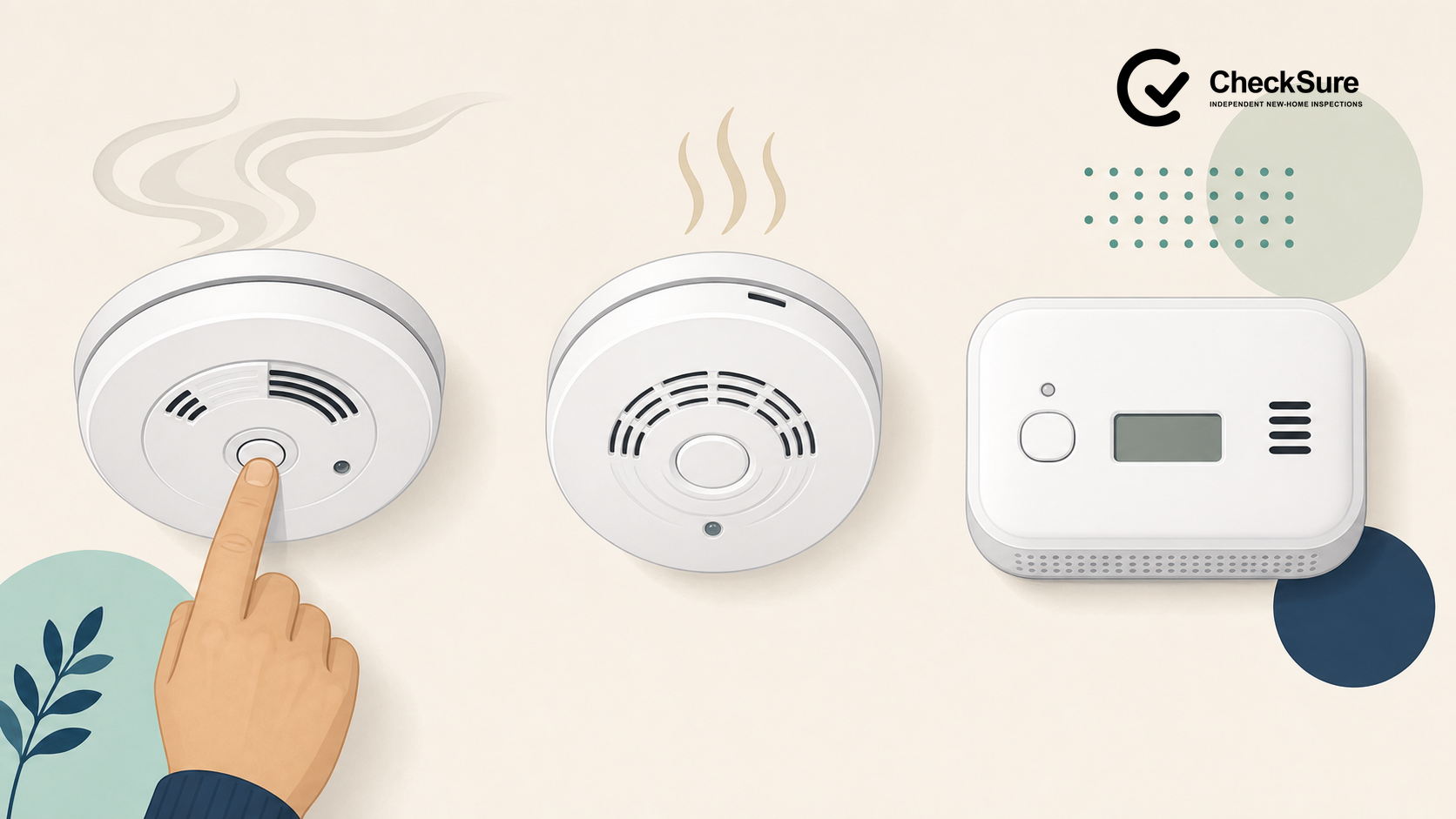
The common alarm types
Different alarms respond to different hazards. Smoke, heat and carbon-monoxide alarms are not interchangeable, so identify each unit and follow the test and replacement instructions for that model.
Smoke alarms
Smoke alarms detect particles produced by fire. Optical alarms are often used near circulation spaces and living areas; ionisation alarms are now less common. The casing usually has a test or hush button, indicator light and vents.
Heat alarms
Heat alarms respond to rising temperature rather than ordinary cooking smoke. They are commonly used in kitchens as part of an interlinked system. A heat alarm does not replace smoke detection elsewhere.
Carbon monoxide alarms
A carbon monoxide alarm detects carbon monoxide (CO), a colourless, odourless and poisonous gas created by incomplete combustion. It is not a smoke alarm and will not reliably warn of fire. The unit may be ceiling- or wall-mounted and may have a sealed lifetime battery or fixed mains supply.
What new-home rules generally require in England
Approved Document B recommends a fire detection and alarm system in every dwelling, normally at least Grade D2 Category LD3 to BS 5839-6. In plain English, this usually means mains-powered alarms with standby power, positioned to protect escape routes, with alarms linked so that one detection can sound throughout the home. Larger or higher-risk homes may need more protection.
Approved Document J says a CO alarm should be fitted when a fixed combustion appliance burning solid fuel, gas or oil is installed, except an appliance used solely for cooking. The alarm should comply with BS EN 50291 and be positioned in accordance with the appliance and alarm guidance. A fully electric home without a fixed combustion appliance may therefore have no Building Regulations reason for a CO alarm, although another risk assessment or tenure rule may still justify one.
Building Regulations and standards differ across England, Wales, Scotland and Northern Ireland, and transitional provisions matter. The equipment actually specified for the home, its fire strategy and manufacturer’s instructions remain important.
How alarm positions are decided
There is not one universal alarm position that can be confirmed from a general illustration or a checklist. A compliant arrangement can vary with the home’s layout, storeys, escape routes, open-plan areas, alarm grade and category, combustion appliances, ventilation and the manufacturer’s placement limits.
For a new home, the developer’s designers or specialist consultants should have specified the alarm arrangement. Building control and, where applicable, the warranty provider are likely to have checked relevant aspects during construction and completion, but those checks do not make a generic diagram suitable for judging an individual position.
- Smoke alarms are often used to protect circulation spaces and may also be specified in living rooms or bedrooms.
- Heat alarms are often selected for kitchens where ordinary cooking fumes could cause unwanted smoke alarms.
- CO-alarm provision and positioning depend on the combustion source, room arrangement, appliance and alarm instructions, and the applicable rules.
- Clearances from walls, lights, vents, doors and other features can matter.
- Alarms should not be moved, painted, covered or placed behind furniture.
These are general examples, not guaranteed locations. Check the home’s approved design, alarm schedule, completion or handover information and the instructions for the installed models. Ask the developer to explain any apparent omission or unusual position rather than relocating an alarm yourself.
Handover and the homeowner demonstration
During a home demonstration, the developer may have identified the alarms, explained the indicators and shown a test using the test button. It is easy to forget this information during a move. Review any handover video, Home User Guide, electrical certification and alarm manuals, and record the model and replace-by information. If the demonstration did not happen, or the documents do not identify the system clearly, ask the developer for the information.
A simple maintenance routine
- Test alarms at the interval stated by the manufacturer; monthly testing is a common homeowner routine.
- Use the test button. Do not use a naked flame, smoke, exhaust gas or improvised aerosol.
- Keep vents clear and gently vacuum dust using the manufacturer’s method.
- Check indicator lights and investigate chirps rather than removing the battery or disconnecting mains power.
- Replace user-replaceable backup batteries with the exact type specified. Many newer units have sealed batteries and the whole alarm is replaced at end of life.
- Record the installation or replace-by date and replace the unit when its end-of-life warning or manufacturer’s date is reached.
- After decorating, cleaning or building work, confirm that every alarm is uncovered, clean and operating.
If a smoke or heat alarm sounds
Warn everyone, leave the building by the planned escape route, close doors behind you if possible and call 999 from a safe place. Do not delay evacuation to investigate, collect belongings or silence the system. Follow the fire and rescue service’s advice before re-entering.
If a carbon monoxide alarm sounds
Move everyone into fresh air, leave the property and seek urgent advice. Call the National Gas Emergency Service on 0800 111 999 if gas or carbon monoxide from a gas appliance may be involved. Call 999 for anyone who is unwell or in immediate danger. Do not use the suspected appliance or return until competent advice confirms it is safe.
Chirps, nuisance alarms and faults
A periodic chirp may mean loss of mains power, a low backup battery, contamination, a fault or end of life. patterns vary by model. Read the label and manual. Repeated cooking alarms may indicate an unsuitable alarm position, weak extraction or a fault, but the answer is not to disable protection. Report a suspected design or installation issue to the developer or a competent alarm specialist.
Frequently asked questions
Why might an all-electric home have no carbon monoxide alarm?
Building Regulations guidance links CO-alarm provision to fixed combustion appliances. A home with no gas, oil, solid-fuel appliance or other combustion source may not require one on that basis. Check the home’s design and any tenure-specific requirements rather than assuming an omission.
How often should alarms be tested?
Follow the manufacturer’s instructions for the installed models. Monthly testing is a common homeowner routine, but the supplied instructions take priority. Test after a battery change, prolonged absence or work that may have disturbed an alarm.
How do I know when an alarm needs replacing?
Look for an installation date, replace-by date, model number or end-of-life signal in the instructions. Smoke, heat and CO alarms do not all have the same service life. A sealed battery does not mean the sensor lasts indefinitely.
When to report a defect
- an alarm is missing from a location shown in the handover information or approved fire design;
- interlinked alarms do not all sound during the approved test;
- a mains alarm has no power indication after checking the consumer unit safely;
- the unit is damaged, painted over, loose or repeatedly faults;
- the approved design or handover information requires a CO alarm but one cannot be found; or
- the instructions, replacement date or model information were not supplied.
Key takeaways
- Smoke, heat and carbon monoxide alarms detect different hazards.
- New-home fire alarms are normally mains-powered, interlinked and backed up, but the exact design and positions vary.
- Do not use a generic diagram to confirm compliance or move an alarm; check the approved design and handover information.
- A CO alarm may be absent from an all-electric home because no fixed combustion appliance is present.
- Test, clean and replace alarms exactly as instructed; never disable them to deal with nuisance signals.
- Leave and call for help when an alarm indicates fire or carbon monoxide.
Explore further
Explore the CheckSure Homeowner Knowledge Base for related guidance on buying, inspecting and looking after a new home.
Related Knowledge Base articles
- Maintaining your new-build home: a practical homeowner schedule
- Extension leads and multi-socket adaptors: using them safely after moving home
- Electrical snagging: safe visual checks and documents
- Which snags need urgent attention?
- New-build handover checklist and documents
Sources & References
UK Government — Approved Document B, Volume 1: Dwellings, 2019 edition incorporating 2020, 2022 and 2025 amendments; 2026 changes take effect on 30 September 2026 subject to transition.
UK Government — Approved Document J, 2022 edition. Carbon monoxide alarm provision, type and placement in England.
Independent new-home inspections
Need help with your new home?
If you are approaching completion, have recently moved in or are dealing with unresolved concerns, CheckSure can help you choose the appropriate inspection for your stage.
Important information
The Knowledge Base provides general information for homeowners in the UK. It is not a substitute for advice about an individual property and should not be treated as legal, financial, insurance, structural or other specialist advice. Requirements and warranty terms can vary according to location, construction date, provider, contract and the circumstances of the particular home.
Copyright and permitted use. © 2026 CheckSure Ltd. All rights reserved. Website content may not be reproduced without permission, except as permitted by law. See our Content Use and Copyright Policy.