

Homeowner Knowledge Base
New-home warranties explained: what buyers need to know
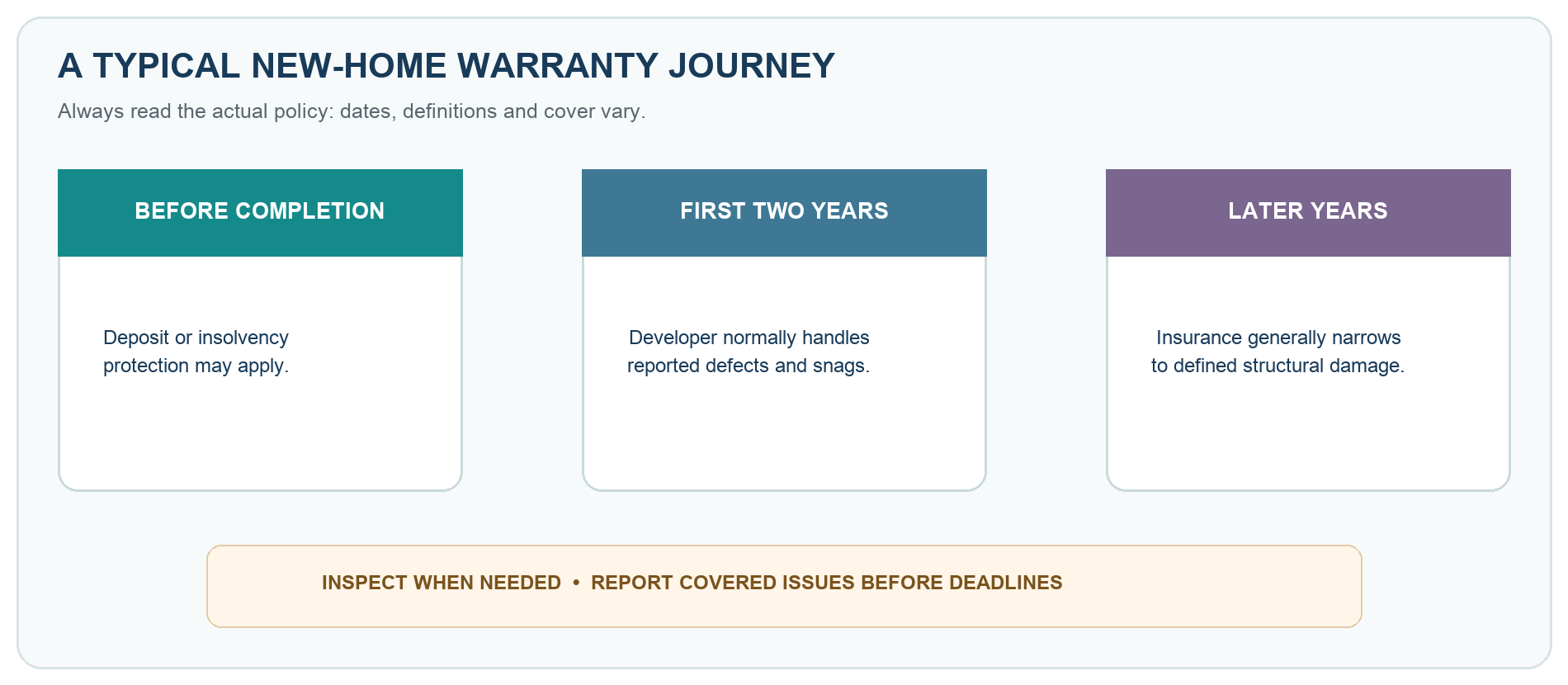
The short answer: a new-home warranty is normally a combined warranty-and-insurance arrangement with different protection at different stages. The developer usually has primary responsibility for qualifying defects reported during the first two years after completion. After that, the policy generally becomes narrower insurance against defined structural damage or other specified risks. It is not a promise that every fault, finish or maintenance issue will be corrected for ten years.
CheckSure’s Homeowner Knowledge Base draws on practical experience of building, inspecting and resolving defects in new homes. Our aim is to explain what homeowners should reasonably expect, what may require further investigation and what steps they can take next.
Why the phrase “ten-year warranty” can be misleading
Sales information often refers to a ten-year structural warranty. That description is useful, but it can make the cover sound uniform from the day the keys are collected until the policy ends. In most mainstream arrangements, it is not uniform. The responsible party, claim definition, excess or minimum value and type of damage covered can change over time.
A typical policy contains protection before completion, a developer or defects period during the early years and a later structural-insurance period. The policy booklet and certificate—not a general summary—determine the actual start date, duration, insured parties, financial limits, exclusions and claims procedure.

The three broad stages of cover
The responsible party and the test applied can change over the life of the cover. That is why the date of the problem, the policy wording and the nature of the defect matter as much as the phrase ‘ten-year warranty’.
Before legal completion
Some policies protect the first buyer’s deposit or additional cost of completing the home if the developer becomes insolvent or commits a defined fraud before completion. The exact protection and limits vary. Buyers should confirm that cover is in place, identify the provider and give the details to their conveyancer rather than relying solely on a brochure logo.
The builder warranty period—usually the first two years
This is commonly called the builder warranty period, developer liability period or defects insurance period. The developer is normally responsible for putting right qualifying defects reported within it. A “defect” is usually defined by the policy—for example, a failure to comply with the warranty provider’s technical requirements—not simply anything the homeowner dislikes or would prefer to be different.
For buyers protected by the New Homes Quality Code, the developer must also provide an accessible after-sales service for at least two years following completion. Snags and defects should be reported as soon as possible. The Code’s after-sales and complaints requirements operate alongside the warranty. they are connected but not identical.
The remaining insurance period
After the early developer period ends, the provider’s insurance usually becomes the main route. Cover generally narrows to physical damage or major damage caused by defects in specified structural parts of the home, with additional defined cover varying by provider and product. Cosmetic faults, ordinary shrinkage, maintenance, wear, appliances and minor non-structural matters are unlikely to be treated in the same way as during the early period.
A practical guide to the first two years
Check the start date
The period may run from legal completion, the policy start date shown on the certificate or another defined date. Do not calculate the deadline solely from the date you moved in.
Defects, damage and short notification periods
Cover depends on the policy definition and technical requirements. Potentially qualifying matters may include work that does not meet the provider’s standards, damage caused by that failure and certain incomplete or defective elements for which the developer is responsible. Some policies contain special notification periods for obvious cosmetic damage, so scratches, chips and marks should be recorded at handover and reported immediately rather than saved for a later inspection.
A functional defect, such as incorrectly installed pipework, is different from visible handover damage such as a chip, scratch or cracked fitting. A developer may apply a very short notification window to apparent damage while applying the main builder-warranty period to qualifying construction defects.
What may and may not be covered
The developer is not normally responsible under the warranty for damage caused by the homeowner, a contractor appointed after completion, failure to maintain the property, condensation caused by how the home is used, normal drying and shrinkage within accepted limits or simple dissatisfaction with an agreed specification. Whether an item is covered is an evidence-based question, not determined by the label “snag”.
The examples below are a practical guide, not a statement that every listed item is covered. The cause of the problem and the documents applying to the particular home remain decisive.
| Area | Potentially qualifying examples | Common limitations or exclusions |
|---|---|---|
| Heating and hot water | Defective boiler or ASHP installation, cylinder, central-heating or immersion-heater work. | Missed servicing, unqualified servicing, misuse or poor maintenance. |
| Plumbing and drainage | Defective pipework, leaks or defects in drainage serving the home. | Owner-caused damage, inappropriate items causing blockages or poor maintenance. |
| Electrical and safety systems | Defective fixed wiring, sockets, switches, alarms or supplied fixed equipment. | Consumables, maintenance failures and apparent damage reported outside a short handover window. |
| Kitchens and bathrooms | Defective supplied units, sanitaryware, taps, showers or originally supplied appliances. | Wear, impact damage, late-reported cosmetic damage or a separate manufacturer responsibility. |
| Doors, windows and finishes | Defective operation, installation, sealing, water penetration, tiling, decoration or fitted items. | Normal shrinkage, wear, owner damage and chips, scratches or breakages reported too late. |
| External works | Defective gutters, paths, driveways, landscaping, walls, outbuildings or outside taps where included. | Weather, seasonal movement, poor maintenance and items excluded by the particular policy. |
| Building fabric | Work that fails the applicable technical requirements, including insulation or weatherproofing. | Later alterations, removed or disturbed materials and damage caused by third-party work. |
| Damp and condensation | Water penetration or condensation caused by defective construction or ventilation. | Normal drying, inadequate heating or ventilation, and owner maintenance or use. |
Most issues start—and end—with the developer
During the builder warranty period, most routine snags and qualifying defects are dealt with directly by the developer’s after-sales team. Developers generally want to put matters right and keep customers satisfied, so provider involvement is not normally needed for a minor issue such as a squeaking door. Report the issue clearly and allow reasonable access and an opportunity to resolve it. Escalation is usually a fallback if the matter remains unresolved, the developer cannot or will not act, or the policy requires provider notification.
If the developer does not resolve the problem
The exact procedure depends on the warranty, developer and consumer code, but the usual practical sequence is:
- Report the issue to the developer promptly, in writing and within every applicable notification period.
- Keep evidence of the original report, correspondence, inspections, access offered and attempted repairs.
- Allow the developer a reasonable opportunity to investigate and complete qualifying work, unless urgent action is needed to protect people or property.
- Use the developer’s formal complaints procedure if ordinary after-sales contact does not resolve the matter.
- Notify the warranty provider promptly through the route stated in the applicable policy; do not assume that an unresolved developer complaint automatically counts as notification to the provider.
- Check separately whether an applicable consumer code or Ombudsman route is available.
When to contact the warranty provider
Report the problem to the developer in writing and keep the supporting evidence. If it remains unresolved, use the appropriate provider route below. These examples cover NHBC Buildmark, LABC Warranty and Premier Guarantee; other recognised structural-warranty providers may use different procedures.
| Provider | What to do first | If the problem remains unresolved |
|---|---|---|
| NHBC Buildmark | Notify the builder within the warranty period, allow reasonable access and complete its complaints process. | After the final response—or no response within 30 days of a formal complaint—request NHBC’s resolution service. |
| LABC Warranty | Check the certificate for the Defects Insurance Period and underwriter, then report the defect to the developer. | Use the claims route for the named underwriter. Dispute resolution may be available under the policy. |
| Premier Guarantee | Notify the developer promptly in writing and keep the correspondence. | If the developer is unable, unwilling, unresponsive or not progressing the work, notify Premier Guarantee. It may offer dispute resolution. |
Do not wait for the period to expire. Wherever possible, notify both the developer and provider before it ends. Reporting to the developer may not count as notification to the provider.
Three routes may overlap
A homeowner may have more than one potentially relevant route, each with its own purpose, eligibility rules and deadlines:
- The developer’s after-sales service, contractual warranty or complaints process.
- The warranty provider’s resolution service, guarantee or insurance arrangements.
- The complaint or dispute-resolution route under the consumer code applying to the purchase, including an Ombudsman route where eligible.
An issue excluded from one route is not automatically excluded from every other contractual or legal route. Equally, starting one process does not necessarily preserve a deadline under another. Serious safety concerns, substantial loss or disputed limitation periods may require prompt independent technical or legal advice.
Homeowner warranty checklist
Good records and reasonable maintenance help protect the home and make responsibility easier to establish:
- Register supplied appliances and manufacturer guarantees.
- Retain commissioning certificates, servicing records and relevant invoices.
- Follow the servicing requirements for boilers, air source heat pumps, cylinders, solar equipment and alarms.
- Maintain seals, gutters, drainage and external finishes in accordance with the homeowner guidance.
- Obtain appropriate advice before making alterations or extensions that could affect the warranty.
- Photograph and record significant evidence before it is obscured or repaired, except where urgent work is necessary to prevent injury or further damage.
Can you appoint a professional snagger during the first two years?
Yes. Once the buyer owns the home, they can appoint an independent snagging inspector, surveyor or other suitable professional to inspect it at any time. There is no rule that professional snagging is only available before completion, and missing a pre-completion inspection does not prevent the homeowner from commissioning a later one.
However, “at any time during the two years” should not be read as advice to wait until the final week. The policy or consumer code may require issues to be reported within the applicable period, and some categories—particularly obvious cosmetic damage—can have much shorter notification expectations. The NHQB Code tells customers to identify and report snags and defects as soon as possible. An inspection should therefore be timed to leave enough opportunity to report, investigate and clarify disputed items before the deadline.
A later inspection can be particularly useful near the end of the developer period. CheckSure treats this as a full End-of-Defects Period Inspection, not merely a recheck of an earlier list. It uses the complete applicable post-completion inspection sequence whether or not the homeowner previously commissioned a snagging inspection, and also records unresolved matters, failed or recurring repairs and relevant concerns that have emerged during occupation.
What does the professional add?
A competent professional can inspect systematically, distinguish an apparent defect from maintenance or normal movement, describe evidence precisely and identify matters that warrant specialist investigation. They can produce a numbered schedule with locations, photographs and recommended actions, making it easier to manage correspondence and repairs.
The report does not extend the policy period, alter the definition of a defect or force the developer or warranty provider to accept every item. The inspector should avoid presenting a personal opinion as a binding warranty decision. Where responsibility depends on concealed work, technical standards or policy wording, further records or specialist evidence may be needed.
For a qualifying customer under the New Homes Quality Code, the developer must cooperate with an appropriately qualified professional adviser appointed to help settle a complaint, subject to data-protection, confidentiality and health-and-safety processes. This supports the proper involvement of independent professionals without giving their report automatic authority.
Pre-completion inspection and later snagging are different
The NHQB pre-completion inspection uses a standard checklist before legal completion and is visual, non-invasive and focused on the finish of the new home. After completion, a CheckSure New-home Snagging Inspection provides a systematic room-by-room and component-by-component review, ideally soon after the homeowner's completion or occupation. Later in the initial developer period, the CheckSure End-of-Defects Period Inspection repeats the full applicable post-completion sequence and adds repair-history, recurrence, occupation and deadline controls. None of these services is automatically a structural survey or destructive investigation.
The two approaches complement one another. The pre-completion inspection records the condition before handover; later inspection considers how the home has performed. Buyers do not need to choose one forever, although early evidence can make later discussions clearer.
How the main providers fit into the picture
NHBC Buildmark
NHBC describes Buildmark as a ten-year warranty and insurance product, generally divided into deposit or insolvency protection before completion, a two-year builder warranty backed by NHBC arrangements and a further eight years of insurance for defined physical damage. The current certificate and policy wording determine which edition applies.
LABC Warranty
LABC Warranty provides structural-warranty products used by developers and building owners. The detailed periods, definitions and claims routes depend on the policy issued for the particular home. Buyers should obtain the certificate and full policy schedule rather than assume its terms match another provider’s product.
Premier Guarantee
Premier Guarantee describes a defects insurance period—commonly the first two years for its new-homes product—during which the developer is responsible for qualifying defects, followed by a structural-insurance period. Again, the applicable policy edition, certificate and exclusions control the cover.
Other recognised structural-warranty providers
Other recognised structural-warranty providers offer products with their own terminology, periods of cover, definitions, exclusions, notification requirements and resolution or claims routes. Always use the certificate and policy issued for the particular home, rather than assuming that the arrangements described for NHBC Buildmark, LABC Warranty or Premier Guarantee will apply.
What is not the same as a warranty?
Building Regulations approval
Building control checks compliance with legal requirements through a risk-based inspection and approval process. It does not provide an insurance promise to the homeowner and does not confirm that every part of the finished property was inspected or is free from defects.
The New Homes Quality Code
The Code sets consumer-service requirements for qualifying purchases from active registered developers, including sales information, a pre-completion inspection opportunity, after-sales service, complaints and access to the New Homes Ombudsman Service. It does not replace the structural-warranty policy.
Manufacturer guarantees and home insurance
Boilers, appliances, windows and other products may have separate manufacturer guarantees that require registration or servicing. Ordinary buildings and contents insurance covers insured events under its own terms, not defective construction simply because the home is new.
Reporting a problem properly
Report the issue through the channel stated by the developer or policy, and do it promptly. Give the plot and address, exact location, date first noticed, description, photographs and any immediate safety or damage concern. Keep proof of submission and a single numbered schedule showing appointments, responses and outcomes.
Allow reasonable access for inspection and repair, but record what is proposed and completed. If the developer disputes responsibility, ask for the reason and the relevant standard or exclusion. Use the formal complaints procedure where after-sales handling is unsatisfactory, and contact the warranty provider or Ombudsman at the appropriate stage. Emergencies should follow the emergency route and should not wait for an ordinary snagging list.
Understanding the documents in a warranty pack
A warranty pack is not one document. Using NHBC Buildmark as an example, a buyer may receive introductory information, a demands-and-needs statement, a summary or pro-forma schedule, a certificate or policy schedule and the full policy booklet. These documents perform different jobs and should be read together.
The introductory information
This explains who the provider is, the broad purpose of the product and why the buyer should consider whether the cover meets their needs. It is not personalised advice or a substitute for the policy wording. NHBC’s homeowner introduction also makes clear that the buyer should review exclusions and limits and consider other insurance for risks that Buildmark does not cover.
The policy schedule and certificate
These identify the home, builder, policy number, applicable sections, dates, limits and any endorsements. A pro-forma schedule issued before completion may describe the cover expected to become available, but it may not be the final confirmation of cover. Buyers should retain the final certificate and schedule and quote the policy number when contacting the provider.
The summary of cover
A summary helps explain the main stages and headline limits. In the NHBC example supplied to a homeowner, deposit protection runs from exchange to completion, the builder warranty begins at completion and later physical-damage insurance starts after the builder warranty period. The summary also warns that ordinary risks such as fire, flood, storm, theft and accidental damage require separate insurance. A summary is useful orientation, but it cannot override the full booklet or a plot-specific endorsement.
The full policy booklet
The booklet contains the controlling definitions, covered parts, exclusions, notification duties, resolution procedure, financial conditions and claims process. Small wording differences matter. For example, NHBC Buildmark distinguishes a defect from physical damage, describes the builder warranty separately from NHBC’s resolution service and guarantee, and applies a minimum claim value to qualifying later insurance claims rather than simply describing an excess.
Check the dates for the home and any shared parts
The different protections do not necessarily share one start date. The attached Buildmark wording also gives shared parts a different builder-warranty arrangement: for qualifying shared parts, the period can run for three years from the later of specified events linked to the first home sharing them. Apartment owners should therefore check the precise policy wording, lease responsibilities and managing-agent arrangements rather than applying the individual home’s anniversary automatically to a communal defect.
Why the policy edition matters
Warranty products change. The supplied Buildmark booklet applies to homes registered from a stated date, while the schedule may contain its own prefix, endorsements and financial figures. The relevant NHBC Standards are also normally those that applied when construction started. An online explanation published later is helpful, but the documents issued for the particular home remain the starting point for any claim or dispute.
What buyers should obtain before exchange and completion
- The warranty provider’s name and the exact product applying to the plot.
- The policy summary, full wording, certificate and confirmed start date when issued.
- The developer’s written after-sales and emergency-reporting procedures.
- Any excess, minimum claim value, financial limit or special cosmetic-damage deadline.
- Information about cover for apartments, common parts, estate structures and management companies.
- The procedure if the developer becomes insolvent or refuses to carry out accepted work.
- Manufacturer guarantees, commissioning records and maintenance requirements.
- The final certificate or policy schedule, not only a pre-completion pro-forma document.
- The insurance product information and demands-and-needs material, together with every endorsement applying to the home.
- A secure copy of the complete pack to retain for claims and pass to a future buyer.
Common misunderstandings
“Everything is covered for ten years”
No. The nature and breadth of protection normally change after the initial developer period, and exclusions and financial conditions apply throughout.
“I must use a snagger before completion or lose the opportunity”
No. A homeowner can appoint a professional after completion. The important point is to report relevant issues promptly and within the applicable deadlines.
“A professional report automatically proves a warranty claim”
No. It is evidence. Cover still depends on the policy, cause, standards, notification and any further investigation required.
“The two-year date is a deadline for completing all repairs”
It is principally important as a reporting and responsibility deadline under the applicable arrangements. Properly reported qualifying matters may remain under discussion or require work later, but buyers should check their policy and preserve evidence rather than assume an unresolved verbal report is sufficient.
Frequently asked questions
When should I arrange an end-of-defects inspection?
Arrange it early enough to receive the report, submit it through the correct channel and clarify access or disputed items before the applicable deadline. It is suitable even if no earlier snagging inspection was commissioned. The best timing depends on the home, seasons and policy. leaving it until the final days creates unnecessary risk.
Can I report issues found after two years?
You can report them, but later insurance cover is generally narrower. A matter first notified after the early period may need to meet the structural-insurance definition and other policy conditions. Seek advice promptly for serious concerns.
Does the warranty transfer when the home is sold?
Many structural-warranty policies can benefit later owners for the unexpired period, subject to their terms and any required process. The buyer’s conveyancer should verify the certificate, remaining term and claims history.
Key takeaways
- A ten-year new-home warranty normally contains different stages of protection.
- The first two years usually place primary responsibility for qualifying defects on the developer.
- Later insurance is generally narrower and focused on defined structural damage or specified risks.
- A homeowner can appoint a professional after completion; an End-of-Defects Period Inspection does not require an earlier snagging report.
- Do not delay: report concerns as soon as possible and before all applicable deadlines.
- A professional report improves evidence but does not expand cover or bind the developer.
- Read the exact policy and certificate because providers, products and editions differ.
- The warranty, Building Regulations and New Homes Quality Code perform different roles.
If you would like an independent assessment, use the CheckSure inspection-services page to choose New-home Snagging soon after completion or occupation or End-of-Defects Period later in the initial developer period.
Explore further
Explore the CheckSure Homeowner Knowledge Base for related guidance on buying, inspecting and looking after a new home.
Related Knowledge Base articles
- The New Homes Quality Code: what it means for buyers
- What is a pre-completion inspection?
- NHBC Standards and Buildmark explained: how technical requirements support warranty cover
- LABC Warranty explained: what does it mean for a new-home buyer?
- Premier Guarantee explained: what protection does a buyer receive?
- Other new-home warranty providers explained
- Getting snags fixed: developer aftercare, complaints and escalation
- End-of-Defects Inspection: what to check before the deadline
Sources & References
NHBC — What does Buildmark cover?. Official explanation of the builder warranty and later insurance stages.
Premier Guarantee — Understand your cover and New Homes policy Version 15. Official homeowner guidance and detailed notification, defects-insurance and dispute-resolution provisions.
LABC Warranty — Homeowners: how to make a claim; New Homes Warranty IPID Version 14. Official explanation of the Defects Insurance Period, developer responsibility, claims routes and policy-document requirements.
New Homes Quality Code — After-sales and complaints. Official two-year after-sales and professional-adviser requirements.
NHQB Register of Developers. Official source for Code coverage and registration dates.
NHBC — Introduction to NHBC Buildmark warranty and insurance policy (W070a 01/24). Homeowner explanation of the product, demands and needs, and broad stages of protection.
NHBC — Buildmark policy booklet (BM8/3 03/21). Detailed definitions, builder warranty, resolution service, NHBC guarantee, later insurance, exclusions and conditions.
NHBC — Buildmark pro-forma policy and summary of cover. Example of plot-specific dates, endorsements, financial limits and minimum claim value; figures must not be assumed to apply to every home.
House of Commons Library — New-build housing: construction defects—issues and solutions (England), CBP-07665 (22 August 2022). Historical policy background only; current law, Code, warranty and redress information should be checked separately. https://commonslibrary.parliament.uk/research-briefings/cbp-7665/
Independent new-home inspections
Need help with your new home?
If you are approaching completion, have recently moved in or are dealing with unresolved concerns, CheckSure can help you choose the appropriate inspection for your stage.
Important information
The Knowledge Base provides general information for homeowners in the UK. It is not a substitute for advice about an individual property and should not be treated as legal, financial, insurance, structural or other specialist advice. Requirements and warranty terms can vary according to location, construction date, provider, contract and the circumstances of the particular home.
Copyright and permitted use. © 2026 CheckSure Ltd. All rights reserved. Website content may not be reproduced without permission, except as permitted by law. See our Content Use and Copyright Policy.