

Homeowner Knowledge Base
LABC Warranty explained: what does it mean for a new-home buyer?
The short answer: an LABC Warranty policy can provide staged protection associated with a new home, but the exact cover comes from the individual policy documents. Buyers should distinguish the developer’s early obligations from later insurance and should check exclusions, limits, dates and claims procedures.
CheckSure’s Homeowner Knowledge Base draws on practical experience of building, inspecting and resolving defects in new homes. Our aim is to explain what homeowners should reasonably expect, what may require further investigation and what steps they can take next.
Buying a new-build home usually comes with some form of structural warranty. This provides protection against certain defects, particularly serious problems connected with the construction of the property.
One provider you may come across is LABC Warranty. Understanding what its warranty does—and, just as importantly, what it does not do—can help you protect yourself when buying and moving into a new home.
Who is LABC Warranty?
LABC Warranty is a provider of structural warranties for newly built and converted properties. It has been arranging warranties since 2007 and is a trading name of MD Insurance Services Limited. It is also part of HSB, a specialist insurer operating in the UK and Ireland.
LABC Warranty works in partnership with Local Authority Building Control, commonly known as LABC. This partnership allows the warranty surveyor and the local authority’s Building Control team to work alongside each other during construction.
However, the two roles should not be confused.
Building Control is concerned with whether construction complies with the Building Regulations. These are legal requirements covering matters such as structural safety, fire safety, ventilation, drainage, accessibility and energy efficiency.
LABC Warranty provides a separate insurance product. Its surveyors assess the development against the requirements of the LABC Warranty Technical Manual and consider the risk of defects that could result in a future warranty claim.
A home can therefore have both Building Control approval and an LABC structural warranty, but they are not the same thing.
Is LABC the only warranty provider?
LABC Warranty is one of several organisations providing structural warranties for new homes in the UK. NHBC is another well-known provider, alongside other recognised structural-warranty providers.
The builder or developer normally arranges the warranty before construction begins. Buyers should check which provider covers their home, when the policy started and exactly which sections of cover apply.
Most mortgage lenders require an acceptable structural warranty before they will lend on a newly built property. However, lender acceptance does not mean the policy covers every possible problem with the home.
How does an LABC warranty work?
An LABC structural warranty will commonly run for ten years from the date on the Certificate of Insurance, which may differ from the moving date. Cover changes during that period, so check when the problem occurred, which policy section applies and who must be notified.
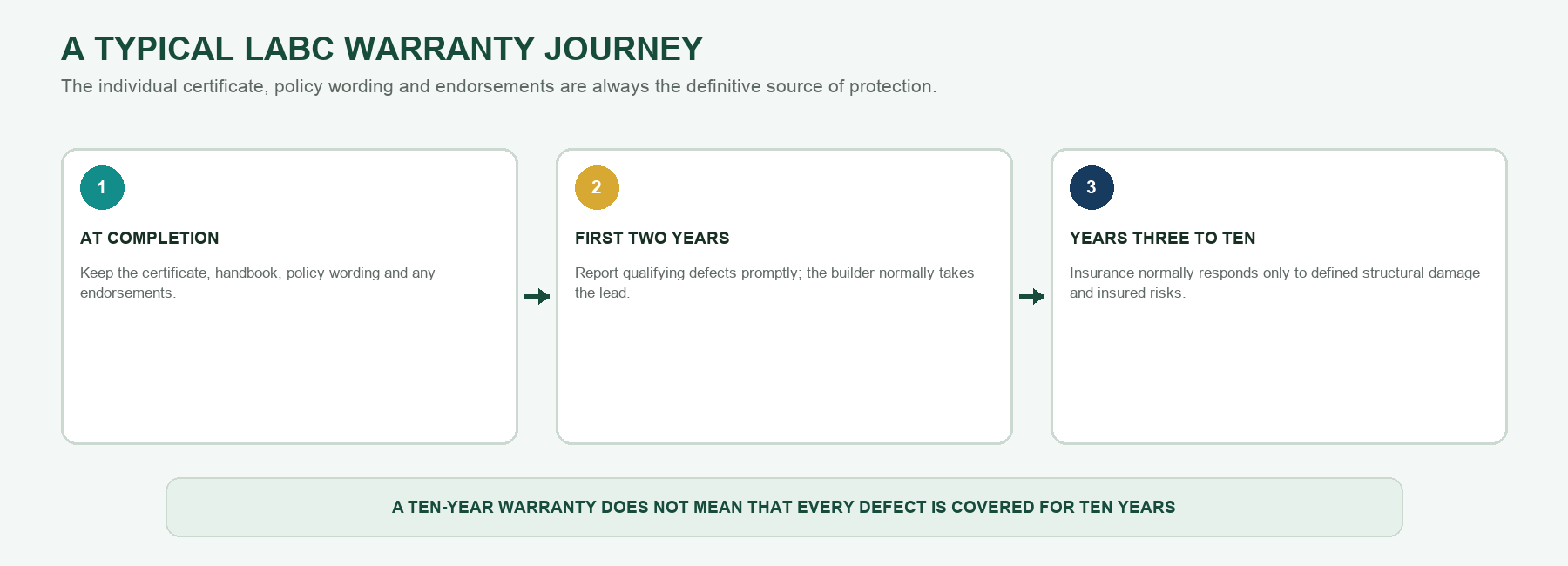
The homeowner’s handbook divides the typical ten-year warranty into two main periods.
The developer or Defects Insurance Period – typically one or two years
If the policy provides a Defects Insurance Period, it is typically one or two years. The Certificate of Insurance and policy wording determine whether it applies, its dates and its precise scope. During that period, the developer is generally responsible for putting right qualifying defects caused by a failure to comply with the applicable LABC Warranty Technical Manual.
Most routine snags and qualifying defects start – and usually end – with the developer's after-sales team. Developers generally want to resolve problems and keep customers satisfied, so warranty-provider involvement is not normally required for a minor matter while the developer is responding. Report the issue in writing as soon as possible and keep emails, letters, photographs and responses.
If the developer does not correct a qualifying defect within a reasonable period, or cannot do so, check the Certificate of Insurance for the named underwriter and use the claims or dispute-resolution route stated in the applicable policy.
This does not mean every disagreement will be resolved under the warranty. The issue must meet the applicable terms and technical requirements. Reporting to the developer may not count as notification to the provider or underwriter, so follow every relevant deadline and do not wait for the period to expire.
Years three to ten
The following eight years are generally called the Structural Insurance Period. During this period, the policy may respond to qualifying structural damage or other insured problems covered by its wording.
Depending on the individual policy, this can include damage caused by defects affecting important structural parts of the home, as well as certain problems involving contaminated land.
An excess may apply to a claim, and policies contain financial limits, conditions and exclusions. The Certificate of Insurance and policy document should always be checked because the precise cover can vary.
The handbook supplied also describes up to five years of cover for inherent defects in certain mechanical and electrical services equipment, subject to the policy. Examples may include boilers, lifts and air-conditioning systems. Buyers should not assume this section is automatically included and should check their own documents.
What is the LABC Warranty Technical Manual?
The Technical Manual sets out the functional and technical requirements that a developer or builder is expected to meet when constructing a property covered by LABC Warranty.
It deals with subjects such as:
- Site investigation and ground conditions
- Foundations and structural design
- Ground floors and upper floors
- Masonry and timber-frame walls
- Roof construction and weatherproofing
- Windows and external doors
- Drainage and waterproofing
- Insulation, ventilation and services
- Materials, workmanship and durability
LABC Warranty risk-management surveyors visit developments during construction and review work against the provider’s technical standards. The inspection programme may be adjusted to reflect the design and risks presented by the particular development.
These visits are valuable, but buyers should understand their purpose. They form part of the warranty provider’s technical risk-management process; they are not a detailed survey of every surface, fitting and component carried out exclusively for the eventual homeowner.
What does the warranty not normally cover?
A structural warranty is not the same as buildings and contents insurance, a maintenance contract or a guarantee that the home will be completely free from defects.
The LABC homeowner information explains that general wear and tear is not covered. A functional construction defect is different from visible handover damage such as a chip, scratch, scuff or cracked fitting. Apparent damage should be recorded at handover and reported to the developer immediately because a much shorter notification expectation may apply.
Other issues that may fall outside the warranty include:
- Routine maintenance
- Normal condensation
- Minor drying and shrinkage cracks
- Blocked gutters or drains caused by a lack of maintenance
- Accidental or storm damage
- Damage caused by alterations or DIY work
- Defects in items that are outside the policy
- Problems reported after an applicable time limit
- Damage that does not meet the policy’s definition of an insured defect
Home insurance may be responsible for events such as storms, escapes of water, fire, theft or accidental damage. Some problems remain the homeowner’s maintenance responsibility, while others should be reported to the developer.
This is why buyers should read the actual policy rather than relying on a general description of “a ten-year warranty”.
Why is snagging still important?
LABC Warranty’s own snagging checklist encourages buyers to inspect areas including plasterwork, decoration, flooring, tiles, kitchens, bathrooms, windows, doors, heating, electrics, insulation, drainage and roof coverings.
For example, buyers are advised to check whether windows and doors open and close correctly, taps and showers have a satisfactory flow, sinks and waste pipes leak, extractor fans work, radiators are secure and double-glazed units contain condensation between the panes.
Outside, the checklist includes paths, drives, fences, gutters, downpipes, inspection chambers, roof tiles and lead flashings.
This is useful guidance, but LABC states that its checklist is only a guide and is not a complete list of everything that should be checked.
A warranty inspection and Building Control approval do not mean that every part of an individual home has been examined or that the property is free from defects. They should never be treated as a substitute for a careful handover inspection and a professional snagging survey.
A qualified independent inspector will know where defects commonly occur and may use specialist equipment to identify issues that an ordinary buyer could easily miss. These might include incomplete insulation, poor ventilation performance, excessive heat loss, incorrectly fitted doors and windows, damp, defective sealant, uneven finishes or signs of water penetration.
The inspector should understand the relevant LABC Warranty standards and distinguish between a cosmetic snag, a maintenance matter, a Building Regulations concern and a defect that might fall within the structural warranty.
Protecting yourself as a buyer
Before completing on an LABC Warranty property, ask for the Certificate of Insurance and the full policy wording. Confirm the policy start date, cover periods, excess, financial limits and claims procedure.
Arrange an independent snagging inspection before completion if the developer permits it. If access is refused, arrange one as soon as possible after receiving the keys.
Report defects to the developer in writing, include clear photographs and keep a record of everything. Do not wait until the end of the applicable developer or Defects Insurance Period, because delays can make problems harder to prove and resolve.
Other routes and homeowner responsibilities
The developer's after-sales or contractual warranty, the warranty provider's resolution or insurance arrangements and an applicable consumer-code complaint or Ombudsman process may overlap. An issue excluded from one route is not automatically excluded from every other contractual or legal route, and starting one process may not preserve another deadline.
- Register supplied appliances and manufacturer guarantees.
- Retain commissioning certificates, servicing records and relevant invoices.
- Follow servicing requirements and maintain seals, gutters, drainage and external finishes.
- Obtain advice before alterations or extensions that could affect the warranty.
- Photograph significant evidence before it is obscured or repaired, except where urgent mitigation is necessary.
An LABC structural warranty provides valuable protection against defined risks, but it is only one part of buying a properly constructed home. Building Control, warranty inspections, the developer’s quality checks and an independent snagging survey all perform different roles. Understanding those differences puts the buyer in a much stronger position if something goes wrong.
Common misunderstandings
“LABC Warranty is the same organisation as local-authority building control”
The names are connected historically, but warranty provision and statutory building-control functions are distinct.
“A ten-year warranty covers every defect for ten years”
Cover normally changes over time and later insurance is usually limited to defined insured events and parts.
“The warranty replaces snagging”
It does not. Snagging identifies incomplete or defective work and helps buyers report matters promptly during the developer’s responsibility period.
Frequently asked questions
Where do I find the exact cover?
Read the policy schedule, certificate, summary, full wording and any endorsements supplied for the home.
When should defects be reported?
Report concerns promptly and in writing, following the developer’s and provider’s procedures and deadlines.
Does cover transfer when the home is sold?
Structural warranty arrangements commonly attach to the home, but the policy terms and transfer requirements should be checked.
Key takeaways
- The individual policy documents are the definitive source of cover.
- Early builder obligations and later insurance should not be confused.
- Maintenance, wear and general cosmetic snagging are not automatically insured.
If you would like an independent assessment of your new home, CheckSure provides professional new-home inspections supported by clear, photographic reporting. Learn more on our inspection services page.
Explore further
Explore the CheckSure Homeowner Knowledge Base for related guidance on buying, inspecting and looking after a new home.
Related Knowledge Base articles
- New-home warranties explained: what buyers need to know
- What is a pre-completion inspection?
- Building Regulations explained: an overview for builders and homeowners
- The hidden problems with new-build homes—and how to avoid them
- Getting snags fixed: developer aftercare, complaints and escalation
Sources & References
LABC Warranty: homeowner and claims information – official source | Certificate of Insurance and applicable policy wording | LABC Warranty Technical Manual | applicable claims and dispute-resolution information.
Independent new-home inspections
Need help with your new home?
If you are approaching completion, have recently moved in or are dealing with unresolved concerns, CheckSure can help you choose the appropriate inspection for your stage.
Important information
The Knowledge Base provides general information for homeowners in the UK. It is not a substitute for advice about an individual property and should not be treated as legal, financial, insurance, structural or other specialist advice. Requirements and warranty terms can vary according to location, construction date, provider, contract and the circumstances of the particular home.
Copyright and permitted use. © 2026 CheckSure Ltd. All rights reserved. Website content may not be reproduced without permission, except as permitted by law. See our Content Use and Copyright Policy.