

Homeowner Knowledge Base
The Building Safety Act: what new apartment buyers need to know
The short answer: the Building Safety Act created a more accountable system for designing, constructing and managing buildings in England. Its strongest controls apply to higher-risk buildings, which include many taller apartment blocks. For a buyer, the practical benefits are clearer responsibilities, stronger regulatory oversight and better building information—but approval under the regime is not a guarantee that a home is flawless or that future costs can never arise.
CheckSure’s Homeowner Knowledge Base draws on practical experience of building, inspecting and resolving defects in new homes. Our aim is to explain what homeowners should reasonably expect, what may require further investigation and what steps they can take next.
Why the law changed
The Building Safety Act created a clearer system of responsibilities, information and oversight following serious failures in building safety. Some duties apply widely, while additional controls apply to defined higher-risk buildings.
The Building Safety Act 2022 formed a central part of the reforms introduced after the Grenfell Tower tragedy and the discovery of wider weaknesses in the way building safety had been controlled. This subject deserves care and respect. Rather than revisiting those failures in detail, this guide concentrates on the system a buyer of a new apartment is likely to encounter today.
The Act is broader than fire safety alone. It reshaped building-control oversight, introduced clearer dutyholder and competence requirements, strengthened routes for enforcing standards and created a special regime for buildings where the consequences of a serious fire or structural failure could be greatest.
Does it apply only to tall apartment buildings?
No. Changes associated with the Act affect building work more widely, including responsibilities placed on clients, designers and contractors. However, the additional approval and occupation regime described in this article is aimed at higher-risk buildings in England.
For design and construction, a higher-risk building will generally be one that is at least 18 metres high or has at least seven storeys and contains at least two residential units. Hospitals and care homes can also fall within the construction definition. The occupied residential regime has its own detailed rules and exclusions, so a conveyancer or appropriately qualified adviser should confirm the status of a particular building rather than relying on a marketing description or a rough height estimate.
What changes during design and construction?
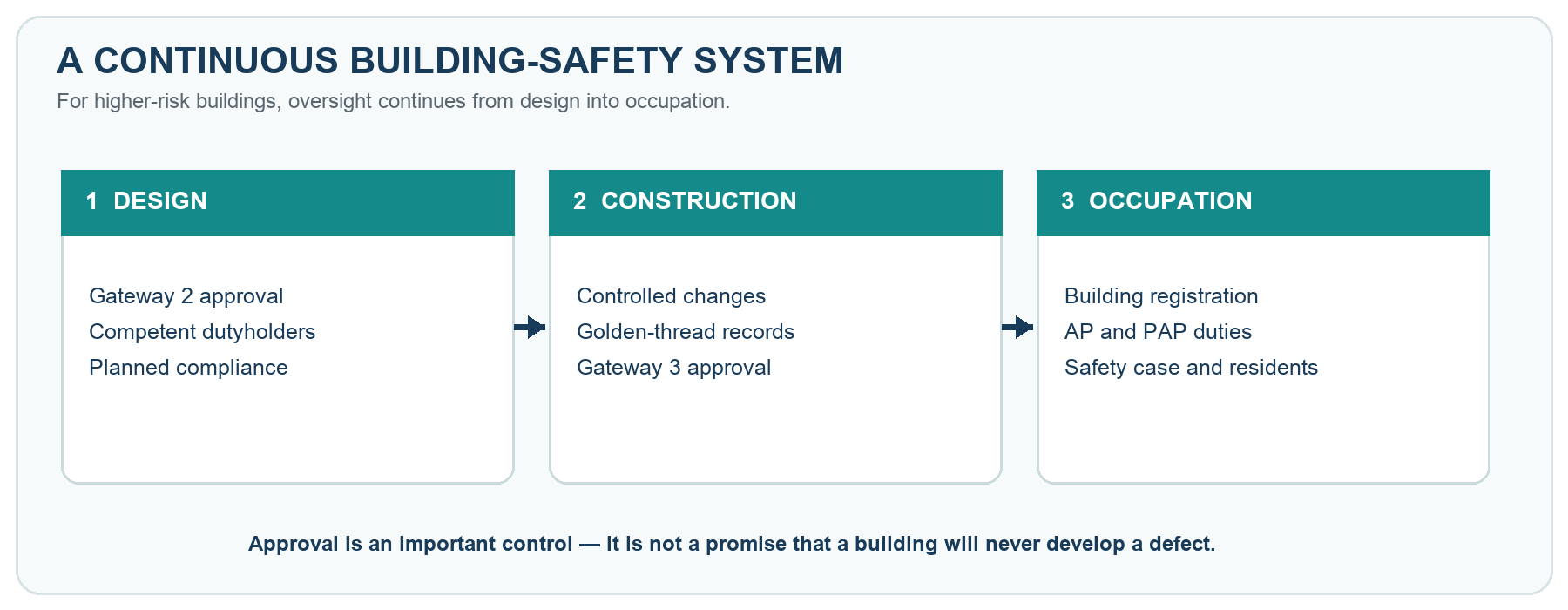
The Building Safety Regulator is the building-control authority for higher-risk building work. A developer cannot simply appoint a private building-control provider for that role. Before relevant work starts, the project must pass Gateway 2, where the regulator considers whether the design and proposed management arrangements demonstrate compliance with the Building Regulations.
During construction, important changes must be recorded and some require regulatory approval before they are made. Dutyholders must manage competence, report specified safety occurrences and maintain reliable information about the building. At Gateway 3, completion approval is required before a new higher-risk building—or the relevant completed part—can be occupied. The residential building must also be registered with the regulator before residents move in.
What is the golden thread?
The golden thread is the accurate, accessible and up-to-date information needed to understand how a building was designed, constructed and should be managed safely. It is intended to prevent important decisions, product details and changes from disappearing between project teams and the people responsible after handover.
A buyer should not expect to receive every technical record personally. Some information is held and managed by dutyholders, and access depends on the legal regime and the nature of the document. The important point is that those responsible for the building should have usable evidence rather than having to reconstruct its history years later.
Who is responsible after residents move in?
An occupied higher-risk building must have one or more Accountable Persons. The Principal Accountable Person has the lead role. These organisations or individuals must assess and manage building-safety risks concerning the spread of fire and structural failure, maintain required information, operate arrangements for residents and report relevant occurrences.
The Principal Accountable Person prepares and maintains the safety case report, which explains the risks and the measures used to control them. The regulator's approach to assessing occupied buildings continues to develop, but the legal duties to manage risk, keep information current and engage residents remain ongoing responsibilities—not a one-off exercise completed when a certificate is issued.
What should a buyer ask before exchanging contracts?
Your conveyancer should tailor enquiries to the building and lease. For a new apartment in a higher-risk building, useful points to establish include:
- Whether the building falls within the higher-risk regime and, if so, whether it is registered with the Building Safety Regulator.
- Whether the required completion approval has been issued for the part of the building that will be occupied.
- Who the Accountable Person and Principal Accountable Person are and how residents contact them.
- What resident engagement, complaints and emergency-information arrangements will operate.
- What the lease says about service charges, building-safety management, access and alterations.
- The first-year budget, reserve arrangements and any known significant safety or remediation work.
- Which new-home warranty applies and what building-control, fire-safety and handover documents will be supplied.
Do not treat the regulator's involvement as a replacement for legal enquiries, a warranty or an appropriate inspection. Each serves a different purpose.
Will stronger regulation increase the price of a new apartment?
It can add cost. Developers of affected schemes may face more detailed design work, competence and record-keeping requirements, regulatory charges, controlled-change procedures and longer approval programmes. The Building Safety Levy is due to apply to certain residential development in England from 1 October 2026. Its application, exclusions, calculation and collection depend on the detailed regulations and the timing and circumstances of the project.
Some of those costs may influence land values, construction budgets or sale prices, while the ongoing management of a complex building can influence service charges. The effect is not uniform and a buyer cannot reliably identify a separate 'Building Safety Act premium' in an asking price. The corresponding benefit is substantial: clearer accountability and better information should make serious risks easier to prevent, identify and manage.
Service charges and remediation costs are not the same thing
The Act contains important protections for certain leaseholders against some costs of correcting historical building-safety defects. Those protections are detailed and depend on matters such as the building, defect, lease, ownership history and qualification rules. They are not a blanket promise that every leaseholder is protected from every safety-related cost.
Routine management, inspection, insurance, maintenance and compliance costs may still be recoverable under a lease and the general service-charge rules. Before buying, ask your conveyancer to explain the lease, the current budget and any known works. Do not assume that protection from a historical remediation bill means there can be no future increase in normal building-management costs.
What if the apartment block is not a higher-risk building?
A lower building is not outside the safety system. It must still comply with the Building Regulations, building-control requirements and the applicable fire-safety and housing law. Its developer, designers and contractors still have duties, while the freeholder or managing organisation will have continuing responsibilities under other legislation and the lease. What changes is the additional higher-risk regime, not the underlying need to build and manage safely.
Alterations after you move in
An apartment owner should never assume that work inside the flat is purely private. Penetrating a compartment wall, changing a fire door, altering ventilation, moving services or disturbing a fire-stopping detail can affect the building's safety strategy. The lease may require consent, Building Regulations approval may be needed and work to a higher-risk building may engage the regulator's building-control process.
Start with the lease and resident alteration procedure. Use competent professionals and preserve approvals, drawings and product information. Cosmetic ownership does not remove the shared consequences of changes to fire separation or structure.
Can a snagging inspection confirm Building Safety Act compliance?
No. A snagging inspection can identify visible defects within the apartment and, where access and the inspection scope permit, visible concerns in common areas. It cannot certify the fire strategy, structural safety case, golden thread, regulatory approvals or compliance of concealed construction. Those matters require documents and specialist expertise.
This does not make snagging unimportant. It simply means the buyer should combine a suitable inspection with conveyancing enquiries, warranty information and confirmation of the building's regulatory status.
Common misunderstandings
“The Building Safety Act applies only to existing cladding cases”
It introduced wider duties and regulatory changes, with additional requirements for higher-risk buildings.
“Every apartment building is treated as a higher-risk building”
The legal definitions and duties depend on building characteristics and the relevant part of the regime.
“Stronger regulation adds cost without buyer benefit”
Compliance can affect design and administration costs, but the central purpose is safer buildings and clearer accountability.
Frequently asked questions
Does Building Safety Regulator approval mean the building is defect-free?
No. Approval is a significant statutory control, but it does not promise perfection or remove the developer's, warranty provider's and building manager's responsibilities. Visible finishes and individual defects still need to be checked and reported.
Can people move into a new higher-risk building before completion approval?
The relevant completion approval and registration requirements must be satisfied before occupation. Large schemes may use approved partial-completion arrangements, so your solicitor should confirm that the legal approvals cover the particular apartment and part of the building being handed over.
Will every leaseholder be protected from a cladding or remediation bill?
No automatic assumption should be made. Statutory protections can be extensive, but eligibility and the type of cost matter. Obtain property-specific legal advice and the required leaseholder and landlord information before committing to a purchase.
Does the Act give residents a role?
Yes. Higher-risk building arrangements include resident information, engagement and complaints. Residents must also avoid damaging safety equipment and cooperate with lawful measures used to manage building-safety risks.
Key takeaways
- The Act created stronger accountability across building design, construction and occupation in England.
- The enhanced regime applies to many apartment buildings at least 18 metres or seven storeys high, but detailed definitions should be checked.
- Gateway approvals, controlled changes, golden-thread information and registration provide important safeguards for new higher-risk buildings.
- The Accountable Person and Principal Accountable Person manage specified fire-spread and structural risks after occupation.
- Regulatory approval does not replace conveyancing, a warranty or a suitable snagging inspection.
- Leaseholder protections for historic defects are important but are not a blanket exemption from all service charges or future costs.
Explore further
Explore the CheckSure Homeowner Knowledge Base for related guidance on buying, inspecting and looking after a new home.
Related Knowledge Base articles
- Building Regulations explained: an overview for builders and homeowners
- Are new-build homes worth it? The honest pros and cons
- New-home warranties explained: what buyers need to know
- Part M Building Regulations: access to and use of new homes
- Streetlights on a new-build development
Sources & References
Building Safety Act 2022. Primary legislation.
GOV.UK — building control approval for higher-risk buildings. Current England guidance on definitions, the regulator, approvals and registration.
GOV.UK — review of the definition of higher-risk buildings. Government explanation of gateways and the occupation regime.
GOV.UK — leaseholder protections on building-safety costs. Official overview of qualifying protections and limitations.
GOV.UK — Building Safety Regulator assessment approach. July 2026 update on occupied-building assessment while continuing duties remain.
Independent new-home inspections
Need help with your new home?
If you are approaching completion, have recently moved in or are dealing with unresolved concerns, CheckSure can help you choose the appropriate inspection for your stage.
Important information
The Knowledge Base provides general information for homeowners in the UK. It is not a substitute for advice about an individual property and should not be treated as legal, financial, insurance, structural or other specialist advice. Requirements and warranty terms can vary according to location, construction date, provider, contract and the circumstances of the particular home.
Copyright and permitted use. © 2026 CheckSure Ltd. All rights reserved. Website content may not be reproduced without permission, except as permitted by law. See our Content Use and Copyright Policy.