

Homeowner Knowledge Base
Other new-home warranty providers explained
NHBC, LABC Warranty and Premier Guarantee are not the only names a new-home buyer may encounter. The warranty company tells you where to start, but the certificate, schedule and policy wording determine the dates, cover, exclusions and route for raising a problem.
CheckSure’s Homeowner Knowledge Base draws on practical experience of building, inspecting and resolving defects in new homes. Our aim is to explain what homeowners should reasonably expect, what may require further investigation and what steps they can take next.
This article gives general consumer guidance for homes bought within roughly the last two years. It does not interpret an individual insurance contract, confirm mortgage acceptability or replace advice from a conveyancer, insurer or other appropriately qualified adviser.
Why there are several warranty providers
The UK market contains more structural-warranty schemes than the three names most often seen on large housing developments. Some operate nationally across houses, flats, conversions and mixed-use schemes. others may be used by particular developers, brokers or project types. Provider names, trading styles, insurers and product names can also change over time.
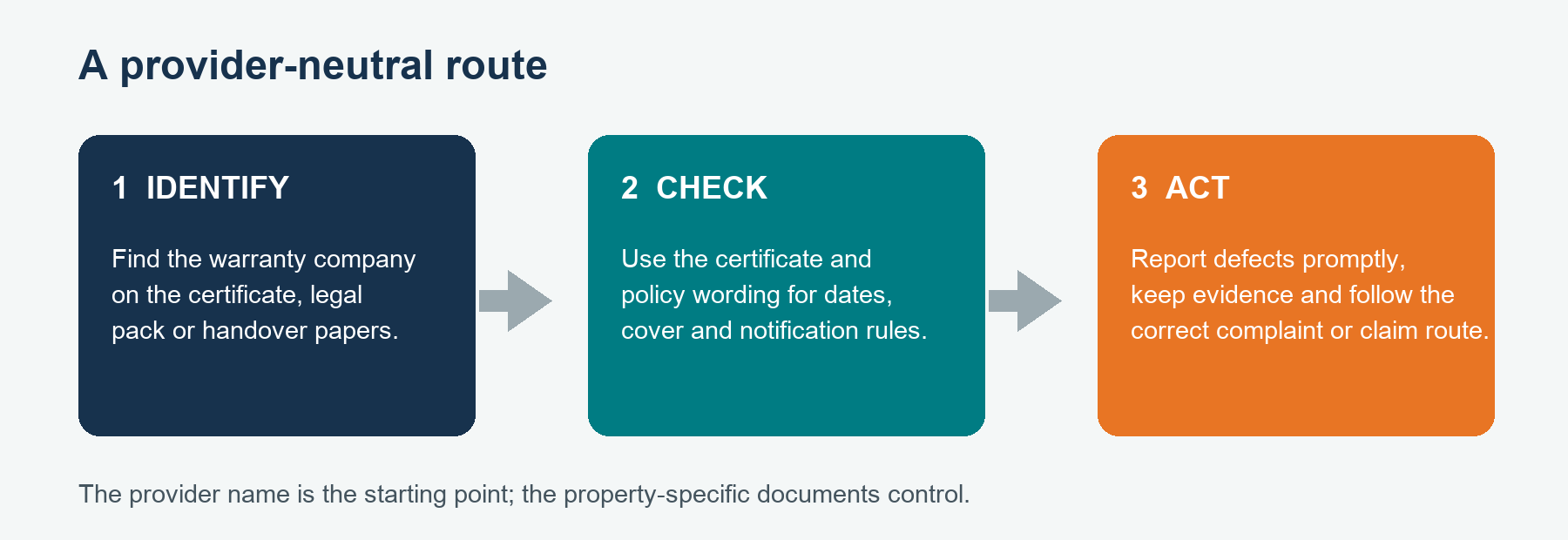
For a homeowner, the provider’s name is the starting point for finding the correct documents, contact details and process for reporting a problem. The warranty certificate, schedule and applicable policy wording then explain the dates, protections and conditions that apply to the particular home.
Knowing the provider does not, on its own, confirm that a defect is covered. It also does not guarantee that every mortgage lender will accept the warranty, as lender requirements can differ and change over time.
Names a recent buyer may encounter
Alongside NHBC, LABC Warranty and Premier Guarantee, current public information shows other names in the new-home structural-warranty market, including:
- Build-Zone — structural warranties for residential and other development types, with public homebuyer and insurance-product information.
- ICW — new-home warranties supported by public homeowner guidance, policy documents and claims information.
- Protek — structural warranties for new homes, conversions, mixed-use and other residential projects.
- Advantage Home Construction Insurance (Advantage HCI) — structural-defects warranty products and a public consumer section.
- ABC+ Warranty — a structural-warranty brand with a Trading Standards-approved consumer code for qualifying homes.
Other names may also be valid. UK Finance confirms that there is no single central list of warranties accepted by every mortgage lender: each lender records its own requirements. A scheme named by one lender, or accepted at one point in time, should not be presented as universally recognised or permanently acceptable.
The examples above are not a complete list. Provider names and products can change, so always use the company named on the documents for your own home rather than relying on a general online list or on the warranty used at another development.

How to identify your warranty provider
The provider is normally named on the warranty certificate or cover note supplied with your legal completion or handover documents. You may also find it in your conveyancer’s report, reservation information or mortgage paperwork.
If you cannot find the name, ask the developer or conveyancer. Do not assume that your home uses the same provider as another phase, a neighbouring development or one of the developer’s previous sites.
At this stage, the company name is usually enough to identify the correct starting point. If a question later depends on cover, use the certificate, schedule and policy wording issued for your particular home.
Company, product and insurer are not always the same
Your documents may name a warranty administrator, a branded warranty product and an insurer. Keep all three details: the correct contact and claims route may depend on which role each organisation performs.
A document pack may show several organisations. Keeping their roles separate prevents avoidable confusion:
- The warranty provider or administrator operates the scheme and is normally the first organisation to identify.
- The product or scheme name identifies the particular form of cover. It may matter when checking a claim or complaint, even though the provider name is normally enough when first seeking guidance.
- The insurer or underwriter carries the insured risk and may be a different legal entity from the brand on the front of the documents.
- The developer normally remains the first contact for defects during the initial builder-responsibility or after-sales period, subject to the documents.
- A consumer code or the New Homes Ombudsman may provide a separate complaints route. It is not the structural-warranty policy itself.
What the provider name does not tell you
Two homes carrying the same provider name can have different cover. The property-specific certificate, schedule, endorsements and applicable policy wording may determine:
- the start and end dates of cover and any separate developer-responsibility period;
- which home, plot, block, common parts or external works are included;
- the insured events, exclusions, excesses, minimum claim values and financial limits;
- the correct developer, administrator, insurer and contact route;
- notification deadlines, evidence requirements and steps that must be completed before a claim;
- special conditions, endorsements or variations applying to the site or plot.
“Ten-year warranty” is therefore only a broad description. Cover commonly changes after the initial period, and ordinary snagging, appearance issues, maintenance, wear, condensation or damage caused after occupation may be treated differently from qualifying structural damage. Never infer the outcome of a claim from the length or brand name alone.
Insurer strength and provider failure
A warranty brand may administer cover on behalf of a separate insurer. Because structural cover can run for many years, keep the certificate and schedule showing the insurer as well as the provider. A company name or financial-strength rating does not, by itself, confirm whether compensation protection would apply if a business failed.
If a provider or insurer has stopped trading, the homeowner should check the current position with the policy administrator, insurer, conveyancer and, where relevant, the Financial Services Compensation Scheme. Eligibility for compensation depends on the regulated entity, policy and circumstances. it must not be assumed from a brand name or an old provider list.
A practical route during the first two years
1. Notify the developer promptly
Report defects in writing through the developer’s stated after-sales process. Give the location, symptoms, date first noticed and the practical effect. Ask for a reference number and proposed timescale.
2. Preserve evidence
Keep dated photographs, inspection reports, correspondence, appointments and records of changes. Urgent safety or water-ingress issues should be reported immediately; take reasonable steps to limit further damage without concealing the original condition.
3. Check the documents before a deadline passes
Use the certificate and policy documents to confirm who must be notified and when. A developer complaint, warranty notification, insurance claim and consumer-code complaint can be different processes. Starting one does not necessarily preserve time under another.
4. Escalate through the route that applies
If the developer does not resolve the issue, follow its formal complaints procedure and the applicable warranty or dispute-resolution route. Where the reservation and developer fall within the New Homes Quality Code, the New Homes Ombudsman may be available. otherwise a warranty-linked consumer code may apply. Eligibility must be checked rather than assumed.
5. Use the correct ombudsman route
The New Homes Ombudsman considers eligible complaints about registered developers under the New Homes Quality Code. The Financial Ombudsman Service may consider eligible complaints about how a regulated financial business handled a building-warranty matter, normally after the business has received a formal complaint. These are different jurisdictions and neither route should be described as an automatic appeal against every defect decision.
Resale homes, alterations and separate insurance
A structural warranty will commonly continue with the home when it is sold, but the buyer should obtain the certificate and current policy documents through conveyancing and confirm any assignment or notification requirement. Developer after-sales rights may not transfer in the same way, and their timing can relate to the original completion or purchase rather than the resale date.
Later extensions, conversions or other alterations are not automatically covered by the original new-home warranty and may affect a claim. Homeowners should notify the relevant parties before material work and keep approvals, designs, invoices and guarantees.
A new-home structural warranty is also different from ordinary buildings and contents insurance. Fire, storm, escape of water, theft and accidental damage are normally questions for the applicable household policy, not proof of a latent-defects claim.
Professional Consultant’s Certificates
Some smaller developments may use a Professional Consultant’s Certificate where a lender permits it. A certificate records professional monitoring and creates a different legal route. it is not a structural-warranty insurance policy and does not reproduce a provider’s initial defects service. Lender acceptance is property- and lender-specific, so the conveyancer must check the current UK Finance instructions and the exact certificate.
How your inspection relates to the warranty
Your CheckSure report identifies the warranty provider you supplied and records the location, condition and evidence for each observed issue. This can help you describe the problem clearly when contacting the developer, warranty provider or another responsible party.
Where relevant technical guidance is available, the report may refer to the provider’s terminology or construction requirements. If provider-specific guidance is not publicly available, the inspection can still describe the observed condition and refer to appropriate good practice or regulatory requirements.
A technical manual can help explain how the home was expected to be built, but it is not necessarily the insurance contract. Your certificate, schedule, endorsements and policy wording determine whether a particular problem is covered. The warranty provider or insurer—not the inspector—makes the decision on a claim.
How this compares with NHBC, LABC Warranty and Premier Guarantee
The same core questions apply across providers:
- Who issued or administers the warranty for this plot?
- When did the relevant cover and developer-responsibility periods begin?
- Which structures, common parts and external works are included?
- What must be reported to the developer, provider or insurer, and by when?
- Which consumer code or ombudsman route applies to the reservation and developer?
If your home is covered by NHBC, LABC Warranty or Premier Guarantee, you can also read the separate Knowledge Base guide for that provider. Whichever company is named, check your own documents because terminology, dates, exclusions and claim requirements can differ.
Common misunderstandings
“If a lender accepts the provider, every lender will.”
No. UK Finance states that acceptance is decided by individual lenders. The conveyancer should check the current lender-specific instructions for the actual transaction.
“A warranty inspection is the same as an independent snagging inspection.”
No. Warranty providers use risk-based technical assessment and inspection processes for their own scheme purposes. That is not a room-by-room quality inspection commissioned for the buyer.
“The provider name proves all defects are covered.”
No. Eligibility depends on the property documents, timing, cause, exclusions and notification requirements. An inspection can record useful evidence, but the provider or insurer decides claims under the contract.
“The first two years are identical under every scheme.”
No. Many schemes place significant responsibility on the developer during an initial period, but the wording, dates, thresholds and escalation routes vary.
Frequently asked questions
What if I do not know my provider?
Check your legal completion and handover documents or ask the developer or conveyancer. Do not guess from the warranty used on another home or one of the developer’s previous sites.
What if I have a provider that is not named in this article?
That does not necessarily mean the warranty is invalid. Use the company named on your certificate and check the current policy documents. Your conveyancer or mortgage lender can confirm any requirements relevant to your purchase.
Do I need to know the product or policy edition immediately?
Usually not when first identifying where to seek help. However, if you need to understand cover or make a claim, use the actual certificate, schedule and policy wording issued for your home.
My home is less than two years old. Am I definitely still in the initial period?
Not necessarily. The relevant period may run from a date defined in the policy or certificate rather than the date you moved in or bought on resale. Check the documents promptly.
Does the warranty cover communal areas of a flat development?
It may, but the scope, responsible policyholder and notification route can differ from the individual flat. Check the block and common-parts documentation and involve the managing agent or freeholder where appropriate.
Key takeaways
• NHBC, LABC Warranty and Premier Guarantee are not the only providers you may encounter.
• Find the provider named on your warranty certificate, legal completion pack or handover documents.
• The certificate, schedule, endorsements and policy wording control the property-specific cover.
• Report defects promptly to the developer, preserve evidence and check every applicable notification deadline.
• Lender acceptance, consumer-code protection and structural-warranty cover are related but separate questions.
• An independent inspection can identify and evidence defects, but it cannot promise that a provider or insurer will accept a claim.
Explore further
Explore the CheckSure Homeowner Knowledge Base for related guidance on buying, inspecting and looking after a new home.
Related Knowledge Base articles
- New-home warranties explained: what buyers need to know
- NHBC Standards and Buildmark explained: how technical requirements support warranty cover
- LABC Warranty explained: what does it mean for a new-home buyer?
- Premier Guarantee explained: what protection does a buyer receive?
Sources & References
UK Finance Mortgage Lenders’ Handbook — warranty-provider acceptance FAQ: https://lendershandbook.ukfinance.org.uk/faq/what-warranty-providers-are-acceptable-mortgage-lenders — confirms that individual lenders decide which providers they accept.
UK Finance — New Build Warranty Guidance (October 2025): https://www.ukfinance.org.uk/system/files/2025-10/Warranty%20Guidance%20FINAL.pdf — industry guidance on risk assessment, insurers, consumer codes, endorsements and notification of material changes.
New Homes Quality Board — homebuyer information: https://www.nhqb.org.uk/homebuyer/ — explains the New Homes Quality Code and Ombudsman eligibility for registered developers.
Build-Zone — homebuyer guide: https://www.build-zone.com/wp-content/uploads/2023/09/BZ-Homebuyers-guide-No-IPID.pdf — public explanation of the initial defects period and later structural cover.
ICW — homeowners: https://i-c-w.co.uk/homeowners — public homeowner guidance, documents and claims starting points.
Protek — new-home warranty: https://www.protekwarranty.co.uk/new-home-warranty/ — public information on new-home, conversion and mixed-use structural warranties.
Advantage HCI — consumer section: https://ahci.co.uk/consumer-section/ — public consumer information for structural-defects warranty customers.
Chartered Trading Standards Institute — ABC+ Warranty code: https://approvedcode.tradingstandards.uk/our-codes-of-practice/abcplus-warranty/ — scope of the approved consumer code for qualifying ABC+ homes.
Financial Ombudsman Service — building warranties: https://www.financial-ombudsman.org.uk/consumers/complaints-can-help/insurance/home-insurance/building-warranties — official explanation of eligible building-warranty complaints and the formal-complaint route.
HomeOwners Alliance — new-build home warranties: https://hoa.org.uk/advice/guides-for-homeowners/i-am-buying/new-home-warranties-cover/ — independent consumer overview of what new-home warranties may and may not cover.
Independent new-home inspections
Need help with your new home?
If you are approaching completion, have recently moved in or are dealing with unresolved concerns, CheckSure can help you choose the appropriate inspection for your stage.
Important information
The Knowledge Base provides general information for homeowners in the UK. It is not a substitute for advice about an individual property and should not be treated as legal, financial, insurance, structural or other specialist advice. Requirements and warranty terms can vary according to location, construction date, provider, contract and the circumstances of the particular home.
Copyright and permitted use. © 2026 CheckSure Ltd. All rights reserved. Website content may not be reproduced without permission, except as permitted by law. See our Content Use and Copyright Policy.