

Homeowner Knowledge Base
Approved Document 7 explained: materials, workmanship and quality
The short answer: Regulation 7 requires building work to use suitable materials that are properly prepared and applied, and to be carried out in a workmanlike manner. It is a legal baseline for construction quality, but it does not mean that every cosmetic imperfection is automatically a Building Regulations breach.
CheckSure’s Homeowner Knowledge Base draws on practical experience of building, inspecting and resolving defects in new homes. Our aim is to explain what homeowners should reasonably expect, what may require further investigation and what steps they can take next.
When you buy a new home, it’s important to understand one key principle from the very beginning:
Building Regulations come first.
Approved Document 7 is part of the Building Regulations. That means it applies before any inspections by warranty providers such as NHBC, LABC or Premier Guarantee. It is not optional, and it does not depend on whether a developer is registered with a warranty scheme.
Whether a builder is constructing:
- A large housing development, or
- A single one-off house
The work must comply with the Building Regulations.
In simple terms, the law requires that every new home is built using proper materials and good workmanship—before anyone else even inspects it.
What Regulation 7 requires
Regulation 7 of the Building Regulations applies to building work in England. It requires materials to be appropriate for where and how they will be used, and it requires building work to be carried out with adequate skill and care. Approved Document 7 gives guidance on ways of meeting those requirements.
This is a legal construction baseline. It matters to a homeowner, but it is not a promise that every painted surface, sealant line or small visual variation will be perfect.
Materials must be suitable
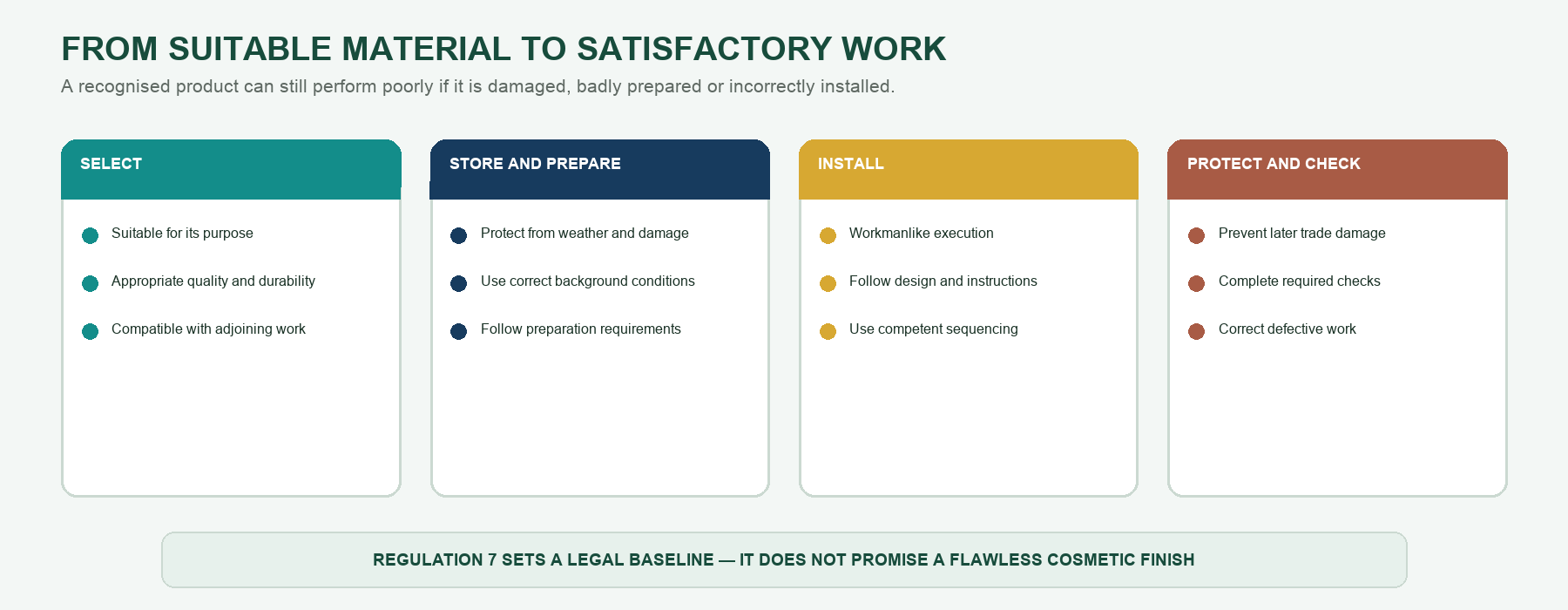
A material is not suitable simply because it is new, expensive or made by a familiar manufacturer. It must be right for its intended location, compatible with adjoining materials, correctly stored and prepared, and installed in line with the relevant instructions.
What suitable means in practice
- Insulation must be the correct type and fitted so that avoidable gaps do not reduce performance.
- External products must be able to withstand the moisture, temperature and exposure they are likely to experience.
- Components such as fixings, membranes and sealants must be compatible with the materials around them.
- Products must be protected from damage or contamination before they are installed.
A premium product installed badly may perform worse than a modest product installed correctly. Regulation 7 is therefore concerned with both selection and use.
Workmanship must be appropriate
Workmanship is about how the construction is carried out. The correct method, reasonable accuracy and competent installation all matter. Finished work should be secure, functional and capable of delivering the performance expected from the design.
How this appears in a finished home
A homeowner may see the result in doors that operate properly, fittings that are secure, surfaces completed to an acceptable standard and services that work as intended. Some important workmanship is hidden behind finishes, so drawings, test results, commissioning records and inspections also form part of the evidence.
Legal compliance and snagging are different tests
A snagging inspection can record incomplete, damaged or poorly finished work even where the issue is not a Building Regulations breach. Conversely, a technical compliance concern may not be obvious from appearance alone. The contract, warranty technical standards, manufacturer’s instructions and recognised tolerances may all be relevant, depending on the issue.
This distinction prevents two common mistakes: treating every cosmetic mark as unlawful, or dismissing defective work merely because a completion certificate has been issued.
Variation is not the same as a defect
Homes are assembled on site by many trades and include natural materials that dry and move. Small variations can occur without affecting safety, durability or use. A defect is more likely where work is incomplete, damaged, insecure, outside an applicable tolerance or unable to perform its intended function.
Fine drying cracks and minor junction gaps are common examples that may need routine making good. Water entry, loose components, significant unevenness, failed seals or systems that do not operate need more prompt attention.
What building control and warranty inspections do
Building control considers compliance with the Building Regulations using plans, evidence and site inspections. It does not continuously supervise every activity or certify that the home is cosmetically perfect. A completion certificate is important evidence that the statutory process has concluded, but it is not a guarantee that no defect exists.
A structural warranty performs a different role. Its technical requirements and cover depend on the provider and policy. Developer aftercare and any consumer code add further routes for raising concerns. These arrangements overlap, but they are not interchangeable.
What a homeowner can reasonably check
- Does the item work safely and as the handover information describes?
- Is anything loose, damaged, incomplete or visibly allowing water or air to pass where it should not?
- Is the concern getting worse, recurring after repair or affecting another part of the home?
- Do photographs, dates and measurements show the issue clearly?
Avoid opening up construction or carrying out a repair that could hide evidence or affect warranty cover. Record the concern and report it through the developer’s stated process.
When to seek further help
Urgent safety risks, active leaks, electrical concerns, unstable components and significant movement should be reported immediately and made safe by an appropriate professional. For other concerns, a clear written record and an independent inspection can help identify whether the issue is cosmetic, contractual, warranty-related or potentially regulatory.

Common misunderstandings
“Regulation 7 guarantees a flawless finish”
It addresses the suitability of materials and workmanship. Cosmetic expectations may also be governed by contracts, warranty standards and reasonable tolerances.
“A branded material is automatically suitable”
A product must be appropriate for its intended use and installed in accordance with its specification.
“Building control checks every item”
Building control uses a risk-based inspection process and does not continuously supervise every trade or finishing detail.
Frequently asked questions
Does Approved Document 7 apply to new homes?
Yes. Regulation 7 applies to building work, including new-home construction, subject to the relevant legal framework.
Can poor workmanship be raised as a snag?
Yes. Work that is incomplete, damaged or below the applicable standard can be recorded and reported to the developer.
Who decides whether work complies?
Building control determines regulatory compliance, while contractual and warranty disputes may involve other parties and evidence.
Key takeaways
- Materials must be suitable for their location and intended use.
- Correct installation is as important as product selection.
- Building Regulations, warranty standards and contractual finish requirements perform different roles.
If you would like an independent assessment of your new home, CheckSure provides professional new-home inspections supported by clear, photographic reporting. Learn more on our inspection services page.
Explore further
Explore the CheckSure Homeowner Knowledge Base for related guidance on buying, inspecting and looking after a new home.
Related Knowledge Base articles
- Building Regulations explained: an overview for builders and homeowners
- The hidden problems with new-build homes—and how to avoid them
- NHBC Standards and Buildmark explained: how technical requirements support warranty cover
- Scratches on windows: how perfect should the glass be in a new home?
- Electrical snagging: safe visual checks and documents
Sources & References
GOV.UK: Material and workmanship — Approved Document 7 — official source.
Independent new-home inspections
Need help with your new home?
If you are approaching completion, have recently moved in or are dealing with unresolved concerns, CheckSure can help you choose the appropriate inspection for your stage.
Important information
The Knowledge Base provides general information for homeowners in the UK. It is not a substitute for advice about an individual property and should not be treated as legal, financial, insurance, structural or other specialist advice. Requirements and warranty terms can vary according to location, construction date, provider, contract and the circumstances of the particular home.
Copyright and permitted use. © 2026 CheckSure Ltd. All rights reserved. Website content may not be reproduced without permission, except as permitted by law. See our Content Use and Copyright Policy.