

Homeowner Knowledge Base
Premier Guarantee explained: what protection does a buyer receive?
The short answer: Premier Guarantee provides structural warranty products for new homes, but “ten-year warranty” is only a shorthand description. Responsibility and cover change over the policy term, so buyers must read their schedule, certificate, wording and endorsements rather than assume every defect is insured.
CheckSure’s Homeowner Knowledge Base draws on practical experience of building, inspecting and resolving defects in new homes. Our aim is to explain what homeowners should reasonably expect, what may require further investigation and what steps they can take next.
Your developer tells you that your new home comes with a ten-year Premier Guarantee warranty. That sounds reassuring, but what does it actually mean?
A structural warranty can provide valuable protection if serious construction problems appear after completion. It does not, however, promise that the home will be perfect. It also does not replace the developer’s obligations, Building Control approval, home insurance or an independent snagging inspection.
Understanding these differences before you move in can prevent confusion if you discover a problem later.
Who provides the warranty?
Premier Guarantee has provided structural warranties for more than 25 years. It is a trading name of MD Insurance Services Limited and is part of HSB, a specialist insurer within the Munich Re group.
Premier Guarantee arranges warranties for different types of development, including private new homes, social housing, build-to-rent properties, commercial buildings and major projects. Its policies are underwritten by insurers such as HSB and AXA.
The name of the insurer responsible for a particular home should be shown in its policy documents. This is worth checking because “Premier Guarantee” is the warranty brand and scheme administrator, while the underwriter is the insurance company carrying the financial risk.
Premier Guarantee is not a government body, and it is only one of several structural warranty providers operating in the UK. NHBC and LABC Warranty are other examples, alongside other recognised structural-warranty providers. The developer usually selects and pays for the warranty scheme before construction begins.
Why do new homes have structural warranties?
Most mortgage lenders expect a newly built home to have an acceptable structural warranty. This gives the lender and homeowner some protection against serious defects that may not be apparent when the property is first purchased.
These are sometimes called latent defects. “Latent” simply means hidden. A defect might originate in the design, materials or workmanship but remain unnoticed until it causes damage months or years later.
A badly decorated wall is easy to see. A problem with a foundation, roof detail or waterproof part of the external wall may not become obvious until cracking, movement or water penetration occurs.
This is the kind of risk that a structural warranty is intended to address. It is not designed to pay for every fault found in a new home.
What does “ten years of cover” mean?
The phrase describes an overall period, not ten identical years. Early concerns are usually handled differently from later structural claims, so confirm the applicable stage before deciding whom to contact.
The phrase can be misleading because the same organisation is not necessarily responsible for repairs throughout the entire ten years.
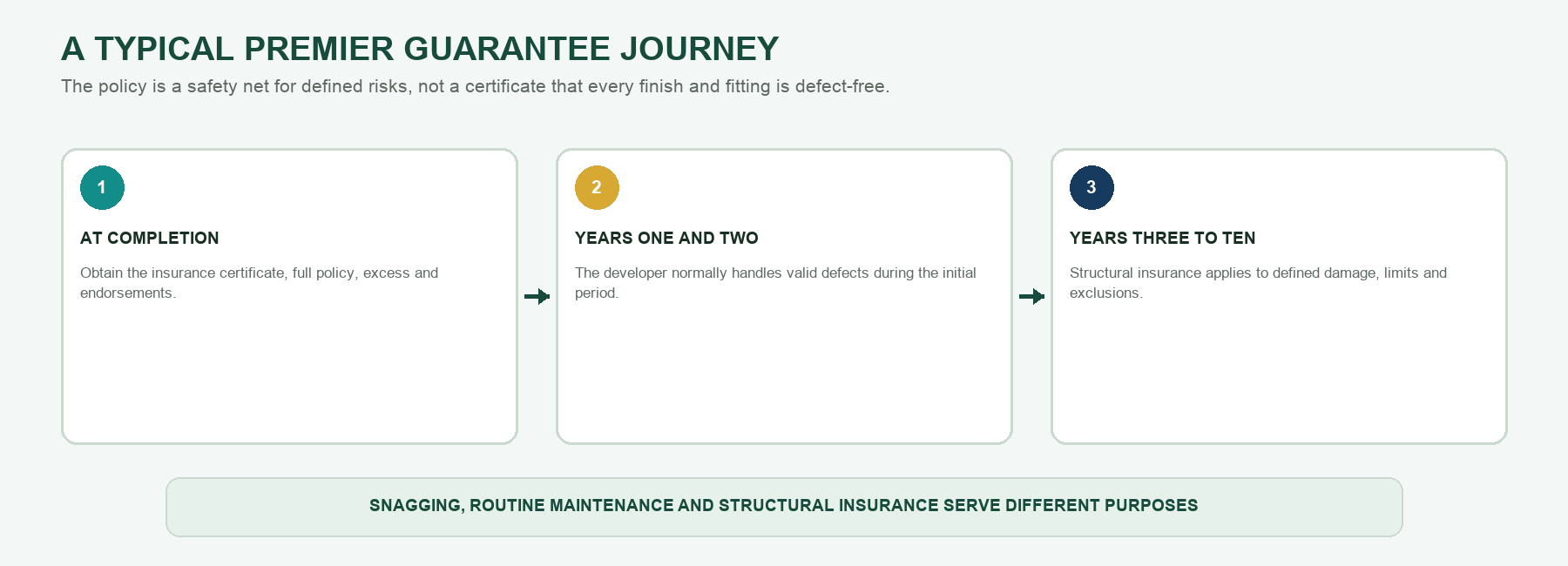
Premier Guarantee’s New Homes Warranty is normally divided into two main stages.
The developer or Defects Insurance Period – usually the first two years
Premier Guarantee's New Homes Warranty commonly provides a Defects Insurance Period during the initial part of the policy, usually the first two years. The Certificate of Insurance, applicable policy edition and endorsements determine the actual dates and terms.
During this period, the developer is generally responsible for correcting qualifying defects caused by a failure to meet Premier Guarantee's technical requirements. Most routine snags and defects start – and usually end – with the developer's after-sales team. Developers generally want to put matters right and keep customers satisfied, so Premier Guarantee involvement is not normally required for a minor issue while the developer is responding. Report the problem to the developer promptly and in writing.
Premier Guarantee may be able to assist through its dispute-resolution service if the developer is unable, unwilling, unresponsive or failing to progress a qualifying repair after being given a reasonable opportunity.
This service is not a general complaints scheme for every disagreement with a builder. The problem must come within the terms of the warranty and the applicable technical standards.
Years three to ten: structural insurance
The remaining eight years are generally known as the Structural Insurance Period.
At this stage, the policy is focused more closely on qualifying structural damage. Premier Guarantee identifies a number of building elements that may be protected, including:
- Foundations
- Load-bearing walls, floors, ceilings, roofs and staircases
- Certain non-load-bearing partition walls
- Chimneys and flues
- Roof coverings
- External render and other surfaces needed to keep the building watertight
- Floor decking and screeds
- Wet-applied plaster
- External double or triple-glazed panes
Finding damage to one of these items does not automatically make it an insured claim. The problem must satisfy the definitions, conditions and damage thresholds in the policy.
Some Premier Guarantee policies may also include cover for contaminated land or inherent defects in certain mechanical and electrical equipment. Machinery cover may apply to items such as boilers, lifts and air-conditioning systems for a specified period.
Not every home receives every available section of cover. Deposit protection, for example, may be an optional extension. The Certificate of Insurance shows which sections apply to the individual property.
When does the ten-year period begin?
The policy begins on the date shown on the Certificate of Insurance—not necessarily the date on which you exchange contracts, collect the keys or move into the property.
This distinction matters. If a property has stood completed for some time before being sold, part of its warranty period may already have passed.
Before buying, ask your conveyancer to obtain:
- The Certificate of Insurance
- The complete policy wording
- The Insurance Product Information Document
- Details of the policy excess
- Any endorsements, exclusions or special conditions
Do not rely solely on a sales brochure or a verbal statement that the home has “a ten-year guarantee”.
How is the home assessed during construction?
Developers registered with Premier Guarantee are expected to build in accordance with its Technical Manual. This contains standards and guidance for matters such as ground conditions, foundations, walls, floors, roofs, drainage, waterproofing, insulation, ventilation and building services.
Premier Guarantee also carries out risk-management inspections during construction. Their purpose is to identify technical risks, reduce the likelihood of major defects and decide whether the property is acceptable for warranty cover.
That is useful oversight, but its limitations must be understood.
A construction-stage warranty visit is not the same as commissioning a detailed survey of your completed home. The warranty surveyor is working as part of the insurer’s risk-management process. The visit is not carried out solely on behalf of the eventual buyer, and it should not be assumed that every item in every property has been examined.
Building Control approval has a different purpose again. It considers compliance with the Building Regulations. It does not guarantee that a property has no defects or confirm that every finish meets the buyer’s expectations.
Is a defect the same as a snag?
No—and this is one of the most important distinctions for a buyer.
Premier Guarantee describes a structural defect as an issue resulting from a failure to comply with its technical standards. To become an insured problem, it may need to cause, or be expected to cause, major physical damage to the structure or waterproof external envelope of the home.
A snag is normally a smaller defect, an unfinished item or visible damage. Examples include:
- Scratched glass
- Chipped or marked walls
- Missing hinges or fittings
- Poor decoration
- Doors or drawers that do not operate correctly
- Incomplete sealant
- Damaged kitchen units or sanitary fittings
These issues still matter, but they are not normally claims under the structural warranty. They should be recorded and reported directly to the developer.
Premier Guarantee specifically advises buyers to identify marks, chips, scratches, scuffs and staining during the handover inspection. If this damage is not recorded at the time, it may be more difficult to establish that it existed before the buyer moved in.
What should you inspect at handover?
Premier Guarantee’s homeowner handbook includes a basic snagging list. It suggests checking plasterwork, decoration, flooring, wall tiles, kitchen units, bathrooms, windows, doors, glazing, electrical fittings, radiators and loft insulation.
Externally, buyers are encouraged to look at fences, gates, paths, drives, gutters, downpipes, drainage, roof coverings and lead flashings.
These are sensible starting points, but the handbook makes clear that its list is only a guide. It is not a complete inspection procedure.
A buyer may be able to spot a scratched worktop or a door that will not close, but construction defects are not always so obvious. Incomplete insulation, faulty ventilation, moisture problems, poorly formed roof details and gaps around windows can require technical knowledge or specialist equipment to identify.
The issue is not whether the property has been inspected at all. It is whether it has been inspected in sufficient detail, in its completed condition, by someone whose sole purpose is to protect the buyer’s interests.
That is the role of an independent professional snagging inspection.
Why arrange an independent inspection?
An independent inspector can examine the individual property rather than relying on general checks made across the development. A professional should understand common new-build defects and know how different parts of the building are meant to work together.
They may inspect:
- The quality and consistency of finishes
- Floors, walls and ceilings for excessive unevenness
- Doors and windows for alignment and weather sealing
- Roof coverings, flashings and rainwater goods
- Visible insulation and loft areas
- Extract fans and ventilation systems
- Plumbing for leaks or poor installation
- External ground levels and drainage
- Signs of damp, water penetration or abnormal cracking
Where appropriate, the inspector may use thermal imaging, moisture meters, levels or other equipment.
A good inspection report should separate cosmetic snags from more serious technical concerns. It should also explain which issues should be referred to the developer, the warranty provider, Building Control, the homeowner’s insurer or a maintenance contractor.
What happens if you discover a problem?
During the applicable developer or Defects Insurance Period, contact the developer promptly and in writing. Describe the problem clearly, include dated photographs and state when it was first noticed.
Keep a complete record of:
- Reports sent to the developer
- Replies and proposed repair dates
- Visits by contractors
- Work carried out
- Recurring or worsening damage
- Any occasions when agreed work was not completed
If the developer does not resolve a qualifying defect, use its formal complaints process where appropriate and notify Premier Guarantee promptly through the route stated in the policy. Do not assume that correspondence with the developer counts as notification to Premier Guarantee, and do not wait for the Defects Insurance Period to expire.
The developer's after-sales or contractual warranty, Premier Guarantee's resolution or insurance arrangements and an applicable consumer-code complaint or Ombudsman process may overlap. An issue excluded from one route is not automatically excluded from every other contractual or legal route, and starting one process may not preserve another deadline.
During the Structural Insurance Period, a suspected structural claim should be reported to Premier Guarantee through its claims process. The provider will assess whether the damage falls within the policy. An excess, financial limit or exclusion may apply.
Problems caused by storms, accidental damage, fire or an escape of water may need to be reported to the homeowner’s buildings insurer instead. Routine maintenance and ordinary wear and tear remain the homeowner’s responsibility.
Protecting the warranty during the first two years
- Register supplied appliances and manufacturer guarantees.
- Keep commissioning certificates, servicing records, invoices and evidence of reported defects and repairs.
- Follow servicing requirements and maintain seals, gutters, drainage and external finishes.
- Obtain advice before alterations or extensions that could affect the warranty.
- Record significant evidence before it is obscured or repaired, except where urgent mitigation is necessary.
The warranty is a safety net—not a quality certificate
A Premier Guarantee warranty can offer important financial protection if a qualifying defect causes serious damage. It can also help make a new home acceptable to mortgage lenders.
What it cannot do is confirm that every part of the property has been completed correctly.
For the buyer, the strongest approach is to use every available layer of protection: obtain the warranty documents, understand the cover, inspect the property carefully, commission an independent snagging survey and report problems without delay.
A ten-year structural warranty is valuable, but identifying defects before they become damage is better than relying on an insurance claim years later.
Common misunderstandings
“Ten years means every problem is covered for ten years”
The nature of protection changes between the initial developer period and later structural insurance, with exclusions and limits applying.
“A warranty inspection is a full survey for the buyer”
Warranty inspections support the provider’s risk assessment and do not replace an independent inspection of the completed home.
“All Premier Guarantee policies are identical”
Products, editions, endorsements and plot-specific details can differ. The homeowner’s own documents take priority.
Frequently asked questions
What should I keep after completion?
Keep the policy schedule or certificate, summary, full wording, endorsements and evidence of reported defects and repairs.
Who handles defects in the first two years?
The developer will commonly have the primary role, subject to the specific policy and consumer-code arrangements.
What happens after the initial period?
Later cover is generally insurance for defined structural damage or other specified risks, not a continuation of general snagging cover.
Key takeaways
- Read the policy documents instead of relying on the phrase “ten-year warranty”.
- Report defects promptly during the developer period.
- Independent snagging and routine maintenance remain important.
If you would like an independent assessment of your new home, CheckSure provides professional new-home inspections supported by clear, photographic reporting. Learn more on our inspection services page.
Explore further
Explore the CheckSure Homeowner Knowledge Base for related guidance on buying, inspecting and looking after a new home.
Related Knowledge Base articles
- New-home warranties explained: what buyers need to know
- What is a pre-completion inspection?
- Building Regulations explained: an overview for builders and homeowners
- The hidden problems with new-build homes—and how to avoid them
- Getting snags fixed: developer aftercare, complaints and escalation
Sources & References
Premier Guarantee: Homeowners – official source | Premier Guarantee: Homeowner's Handbook – official source | applicable New Homes Warranty policy wording and Certificate of Insurance | Premier Guarantee dispute-resolution and claims information.
Independent new-home inspections
Need help with your new home?
If you are approaching completion, have recently moved in or are dealing with unresolved concerns, CheckSure can help you choose the appropriate inspection for your stage.
Important information
The Knowledge Base provides general information for homeowners in the UK. It is not a substitute for advice about an individual property and should not be treated as legal, financial, insurance, structural or other specialist advice. Requirements and warranty terms can vary according to location, construction date, provider, contract and the circumstances of the particular home.
Copyright and permitted use. © 2026 CheckSure Ltd. All rights reserved. Website content may not be reproduced without permission, except as permitted by law. See our Content Use and Copyright Policy.