

Homeowner Knowledge Base
Scratches on windows: how perfect should the glass be in a new home?
The short answer: new glazing should be of a good standard, but it is not assessed by placing your face against the pane and searching under a torch. Industry guidance uses controlled viewing conditions. A fine mark may be acceptable if it is not obtrusive from the specified distance. a prominent scratch, crack, chip, sealed-unit failure or safety concern should not be dismissed as a cosmetic tolerance.
CheckSure’s Homeowner Knowledge Base draws on practical experience of building, inspecting and resolving defects in new homes. Our aim is to explain what homeowners should reasonably expect, what may require further investigation and what steps they can take next.
Why brand-new glass is not judged at touching distance
A newly completed home often contains many square metres of glazing. Buyers naturally expect it to look pristine, particularly after removing labels and protective film. Under close inspection, however, most manufactured surfaces reveal tiny variations. The practical quality question is whether an imperfection materially affects the normal view through the glass when it is assessed under the agreed conditions.
This avoids two unhelpful extremes. A developer should not reject every complaint simply because glass can contain minor imperfections, but a buyer should not create an artificial failure by circling a mark, shining a phone torch across it and then inspecting from a few centimetres away. The applicable warranty standard, glass specification and recognised glazing guidance provide the starting point.
Use the correct viewing conditions
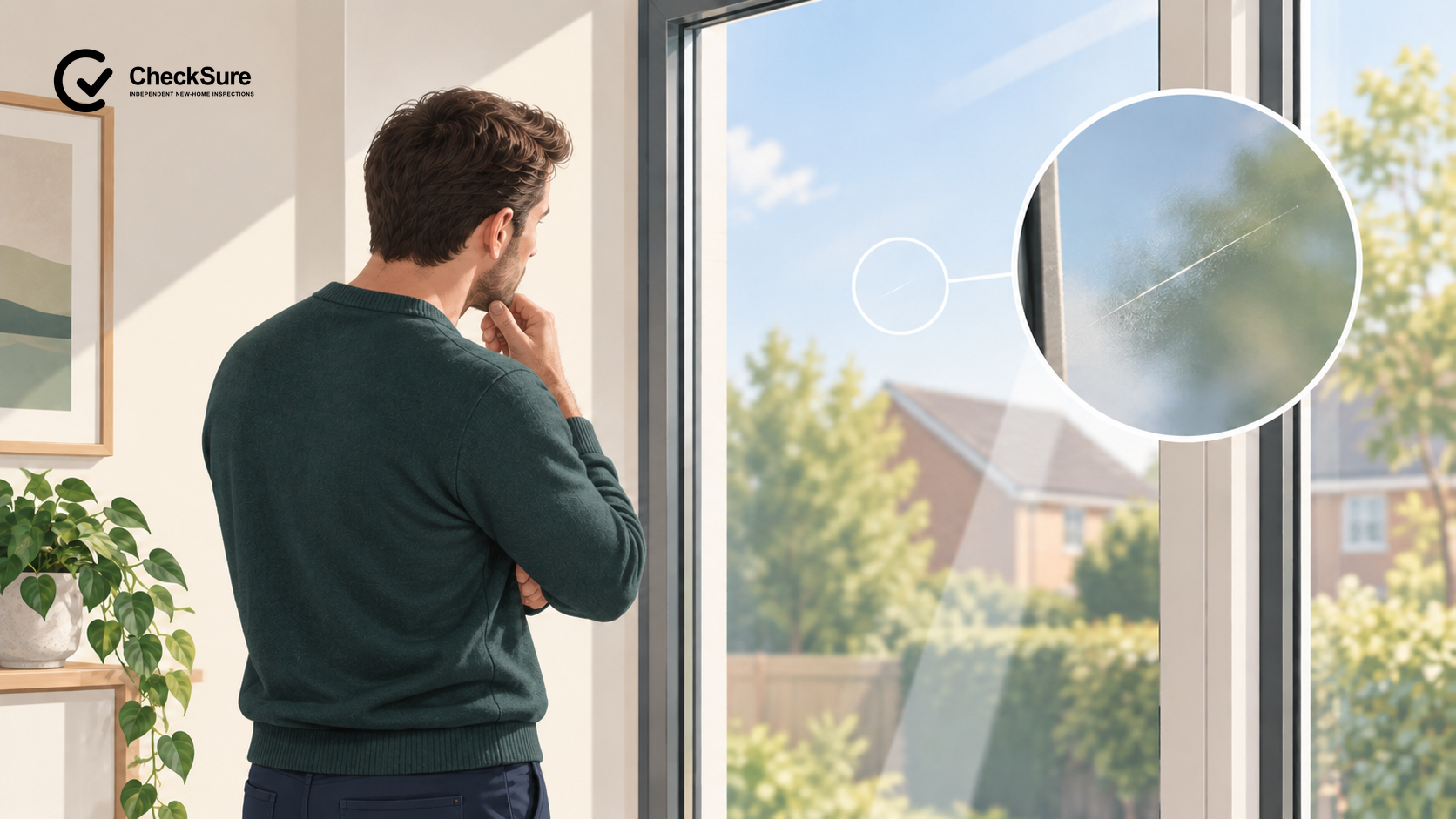
NHBC guidance states that glass should be checked in daylight from inside the room and from a minimum distance of 2 metres. For toughened, laminated or coated glass, the stated minimum distance is 3 metres. The Glass and Glazing Federation similarly explains that obtrusiveness should be judged in natural daylight, not direct sunlight, while looking through the glass rather than concentrating on its surface.
Stand approximately square to the pane and use normal vision. Clean both faces first where safely accessible, because residue can resemble damage. Do not use a strong lamp, magnifying device or grazing sunlight to search for marks. If tape is used to locate a concern, remove it before deciding whether the mark is visible from the correct viewing distance.
What may be acceptable?
NHBC's published finishes guidance lists bubbles or blisters, hairlines or blobs, minute particles and fine scratches no longer than 25mm as potentially acceptable where they are not obtrusive or bunched. This is not permission for unlimited damage. The words ‘not obtrusive or bunched’ matter: several marks concentrated in the main viewing area may be unacceptable even where each one appears small in isolation.
Minor scratching close to the pane edge can also be treated differently. Older NHBC guidance notes an allowance within 6mm of the edge, while insulating-glass-unit guidance divides a pane into a central viewing area and less visually critical edge zones. The precise criterion depends on the relevant standard and product. A blanket claim that every scratch near a frame is acceptable would therefore be too simplistic.
When is a scratch likely to be a defect?
A scratch deserves rectification where it remains readily visible from the correct viewing distance and lighting, particularly in the main vision area. Length is only one factor. Depth, width, contrast, location, number and grouping all affect obtrusiveness. A deep score that catches a fingernail or produces a bright line in ordinary daylight is different from a faint surface hairline that disappears when viewed normally.
Damage caused after manufacture or installation should not automatically be treated as a manufacturing tolerance. Scraping cement, render or weld spatter from glass with an unsuitable blade can create arcs of fine scratches. Abrasive cleaning pads and contaminated cloths can cause similar damage. Establishing when the damage occurred may affect who is responsible, but it does not change the need to assess the finished pane properly.
Some visible effects are characteristics of the glass
Modern new homes use different glass products for safety and energy performance. Toughened glass can show roller-wave distortion or coloured stress patterns—sometimes called anisotropy or ‘leopard spots’—under polarised light. Laminated glass contains an interlayer. Low-emissivity coatings can produce a slight tint or haze, and double or triple glazing creates multiple reflections. These effects are not necessarily scratches or defects.
They are not automatically acceptable in every degree either. Excessive optical distortion, coating damage, mismatched units or a conspicuous visual difference between adjacent panes may require specialist assessment against the product standard. Photographs can help record the concern, but reflections and camera processing often exaggerate or conceal what the eye sees.
Cracks, chips and failed sealed units are different
A crack is not assessed as a minor cosmetic scratch. Cracked glass can have safety implications and should be reported immediately. avoid operating a door or window where movement could worsen the break. Edge chips may also affect strength, particularly in safety glass, and need competent assessment rather than polishing by an unqualified person.
Condensation, misting or deposits between the panes indicate that the insulating glass unit may have lost its seal. That is a performance issue, not an acceptable surface blemish. Likewise, damage to a low-emissivity coating inside the sealed unit cannot be cleaned from the room side. These faults will commonly require replacement of the sealed glass unit rather than the whole frame.
Safety glass and permanent markings
Scratches are not the only glazing issue a new-home inspection should consider. Approved Document K identifies ‘critical locations’ where human impact is more likely. These normally include glazing in a door up to 1500mm above finished floor level, glazing beside a door within 300mm of the door opening up to the same height, and low-level glazing in walls or windows up to 800mm above the floor. The design may use glazing that breaks safely, sufficiently robust glass, suitably small panes or permanent protection, depending on the circumstances.
Toughened and laminated safety glass are common solutions. Toughened glass is heat treated so that, when it breaks as intended, it fragments into relatively small pieces. Laminated glass uses an interlayer that helps retain broken fragments. The correct choice and impact classification depend on pane size, location and design. the word ‘toughened’ on its own is not a complete specification.
Safety glass in a critical location should normally carry a permanent, legible mark that remains visible after installation. Industry guidance expects the mark to identify the manufacturer, merchant or installer, the relevant product standard—such as BS EN 12150 for toughened glass or BS EN 14449 for laminated glass—and the impact classification under BS EN 12600. Marks are commonly etched or fired into a corner of the pane.
People often call any such symbol a ‘Kitemark’, but the BSI Kitemark is a particular third-party certification mark. A pane can carry other valid conformity and product markings, so the absence of the familiar heart-shaped Kitemark does not by itself prove that the glass is non-compliant. However, a missing, partly concealed or illegible permanent safety-glass mark in a critical location should be recorded and referred back to the developer for product evidence and confirmation.
Should scratched glass be repaired or replaced?
Specialist glass polishing can remove some surface damage by taking away a very small amount of glass. It can be practical for a large or difficult-to-replace pane and has less environmental impact than replacement. The repair must not leave unacceptable optical distortion or compromise the product. Deep scratches, extensive damage, coating defects, cracks and some safety-glass issues are more likely to require a new sealed unit.
The developer should propose the remedy and, where polishing is offered, use a competent specialist. The repaired pane should then be reassessed in the normal viewing conditions. A repair is not satisfactory merely because the scratch feels smoother if a conspicuous lens or distorted patch has been created.
How to record glazing concerns at a new home
- Clean the pane carefully using the manufacturer’s recommended method before assessing it.
- Record the room, window reference and whether the mark is on the inner face, outer face or within the sealed unit.
- Photograph the whole pane from the normal viewing position, then take a closer supporting image without claiming the close-up is the acceptance test.
- Note the weather, lighting, viewing distance and whether the glass is ordinary, toughened, laminated or coated.
- Report cracks, chips, loose glazing, failed seals and safety concerns immediately rather than waiting for a cosmetic-defects list.
- Check critical locations for a visible permanent safety-glass marking and record any missing or illegible mark.
- Do not attempt abrasive cleaning, scraping or polishing before the developer has inspected the mark.
What should a snagging inspection do?
A pre-completion inspection should assess glazing from the appropriate distance and under reasonable daylight, then record marks that appear obtrusive. It should distinguish a suspected surface scratch from dirt, residue, an internal sealed-unit fault or an optical characteristic of processed glass. Where the glass type is unknown, the inspector should avoid a definitive tolerance claim until the specification is confirmed.
The report should be proportionate: identify the pane clearly, describe the concern and recommend cleaning, specialist assessment, repair or replacement as appropriate. A coin, ruler or removable marker may be useful in a close-up evidence photograph, but it should not be left on the pane during the normal-distance assessment.
Common misunderstandings
“Any visible mark means the glass must be replaced”
Glass is assessed under defined viewing conditions and reasonable tolerances, not by extreme close-up inspection.
“All scratches are only cosmetic”
Some damage, edge defects or concerns involving safety glass may require specialist assessment.
“A Kitemark proves the pane is flawless”
Markings help identify conformity and safety-glass information; they do not certify that no handling damage exists.
Frequently asked questions
Is every visible scratch a defect?
No. Fine scratches up to the stated guidance length may be acceptable where they are not obtrusive or grouped and are assessed under the correct conditions. A visible mark should still be recorded if it remains conspicuous from the applicable distance.
Why does the developer keep asking me to stand farther back?
Because visual-quality standards judge the normal view through the glass rather than microscopic surface perfection. The correct distance must still be paired with natural daylight, an appropriate viewing angle and the right criterion for that glass type.
Can I use a phone torch to demonstrate the scratch?
A torch may help locate or photograph a mark, but it is not normally the acceptance condition. Strong directional light can reveal imperfections that are invisible in ordinary use.
Who decides if there is a dispute?
Start with the developer's complaints process and the applicable warranty standard. Where the glass type, cause or severity remains disputed, an independent glazing specialist can assess visual quality and advise whether repair or replacement is appropriate.
Does every window need a safety-glass mark?
No. The requirement is driven by the glazing location, design and means of protection. A permanent mark is especially relevant where safety glass is used to satisfy the impact requirements in a critical location. Ask for the glazing schedule or product evidence if the location appears critical but the pane cannot be identified.
Key takeaways
- Assess clean glass from inside in natural daylight, looking through the pane rather than hunting for marks on its surface.
- NHBC guidance uses at least 2m for ordinary glass and 3m for toughened, laminated or coated glass.
- A fine scratch may be acceptable only where it is not obtrusive or bunched; position and visibility matter as well as length.
- Cracks, significant chips, failed sealed units and safety concerns are not minor cosmetic tolerances.
- Glazing in critical impact locations should follow Approved Document K; safety glass used there should normally have a visible permanent product and classification mark.
- Specialist polishing can repair some scratches, but replacement is preferable where repair would impair visual quality or performance.
If you would like an independent assessment of your new home, CheckSure provides professional new-home inspections supported by clear, photographic reporting. Learn more on our inspection services page.
Explore further
Explore the CheckSure Homeowner Knowledge Base for related guidance on buying, inspecting and looking after a new home.
Related Knowledge Base articles
- Windows and doors: seasonal adjustment in a new-build home
- The hidden problems with new-build homes—and how to avoid them
- Windows and doors: installation defects or seasonal adjustment?
- Approved Document 7 explained: materials, workmanship and quality
- What is a pre-completion inspection?
Sources & References
NHBC — A consistent approach to finishes, section 9.1.6 (https://nhbc-standards.co.uk/downloads/nhbc2018-9.pdf). Published viewing distances and examples of glazing imperfections that may be acceptable where not obtrusive or bunched.
Glass and Glazing Federation — Glazing Manual. Industry guidance on visual quality, toughened glass and inspection conditions.
Glass and Glazing Federation — visual quality for insulating glass units. Inspection method, viewing zones and limitations on artificial aids.
Glass and Glazing Federation — repairing surface damage. Overview of specialist repair and circumstances where replacement may be preferable.
GOV.UK — Approved Document K. Statutory guidance for England on critical glazing locations and protection against impact.
Glass and Glazing Federation — Window and Door Good Practice Guide. Industry guidance on permanent safety-glass markings, product standards and impact classification.
Independent new-home inspections
Need help with your new home?
If you are approaching completion, have recently moved in or are dealing with unresolved concerns, CheckSure can help you choose the appropriate inspection for your stage.
Important information
The Knowledge Base provides general information for homeowners in the UK. It is not a substitute for advice about an individual property and should not be treated as legal, financial, insurance, structural or other specialist advice. Requirements and warranty terms can vary according to location, construction date, provider, contract and the circumstances of the particular home.
Copyright and permitted use. © 2026 CheckSure Ltd. All rights reserved. Website content may not be reproduced without permission, except as permitted by law. See our Content Use and Copyright Policy.