

Homeowner Knowledge Base
What is an EPC and how do you understand it?
The short answer: an Energy Performance Certificate (EPC) is a standardised assessment of a home’s energy efficiency. It gives the property a score and a band from A to G, together with estimated energy use, typical costs and possible improvements. It is useful for comparing homes, but it is a model based on standard assumptions—not a prediction of your exact bills or proof that every energy-saving feature has been installed perfectly.
CheckSure’s Homeowner Knowledge Base draws on practical experience of building, inspecting and resolving defects in new homes. Our aim is to explain what homeowners should reasonably expect, what may require further investigation and what steps they can take next.
What is an EPC?
Think of an EPC as a standardised comparison, not a prediction of your exact bill. It describes the assessed property and uses set assumptions so that one home can be compared with another.
An EPC is the coloured energy label supplied when a home is built, sold or rented. In England and Wales, a domestic EPC normally remains valid for ten years unless a newer certificate is produced. It must be prepared by an appropriately accredited energy assessor and lodged on the official Energy Performance of Buildings Register.
For a newly constructed home, the certificate is produced by an accredited on-construction energy assessor. The assessment uses information about the completed design and specification, including the building fabric and fixed services. The person responsible for construction must obtain the EPC when the home is completed and provide it to the owner under the applicable rules.
Scotland and Northern Ireland operate separate regulatory systems and registers. The broad purpose is similar, but the format, procedure and legal requirements may differ. This article focuses mainly on domestic certificates in England and Wales.
How the A-to-G rating works
The certificate shows a numerical energy-efficiency score and places it within a band. A is the highest band and G is the lowest. A higher score generally indicates that the home should require less energy—or incur lower modelled fuel costs—under the assessment’s standard assumptions.
Figure 1. Current domestic EPC energy-efficiency bands and score ranges. The presentation and methodology may change under future reforms, so check the current official certificate and register.
Many recently built homes achieve a B rating, but a new home is not guaranteed to be A or B merely because it is new. The result depends on the applicable standards, design, heating and hot-water systems, fuels, renewable technologies and the information used in the assessment. Official statistics for January to March 2026 show that most new dwellings lodged in England were in band B, rather than band A.
What information does the certificate contain?
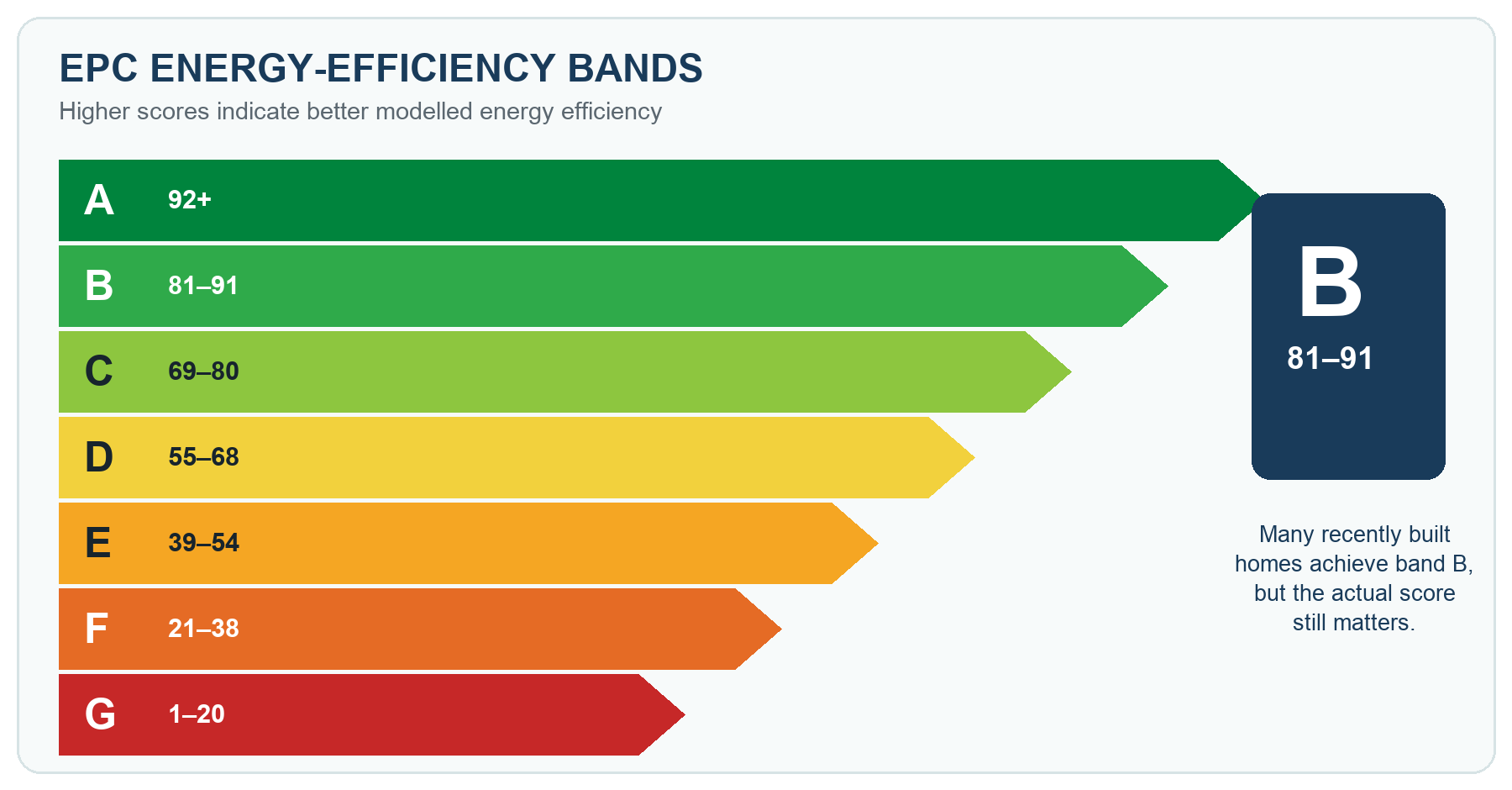
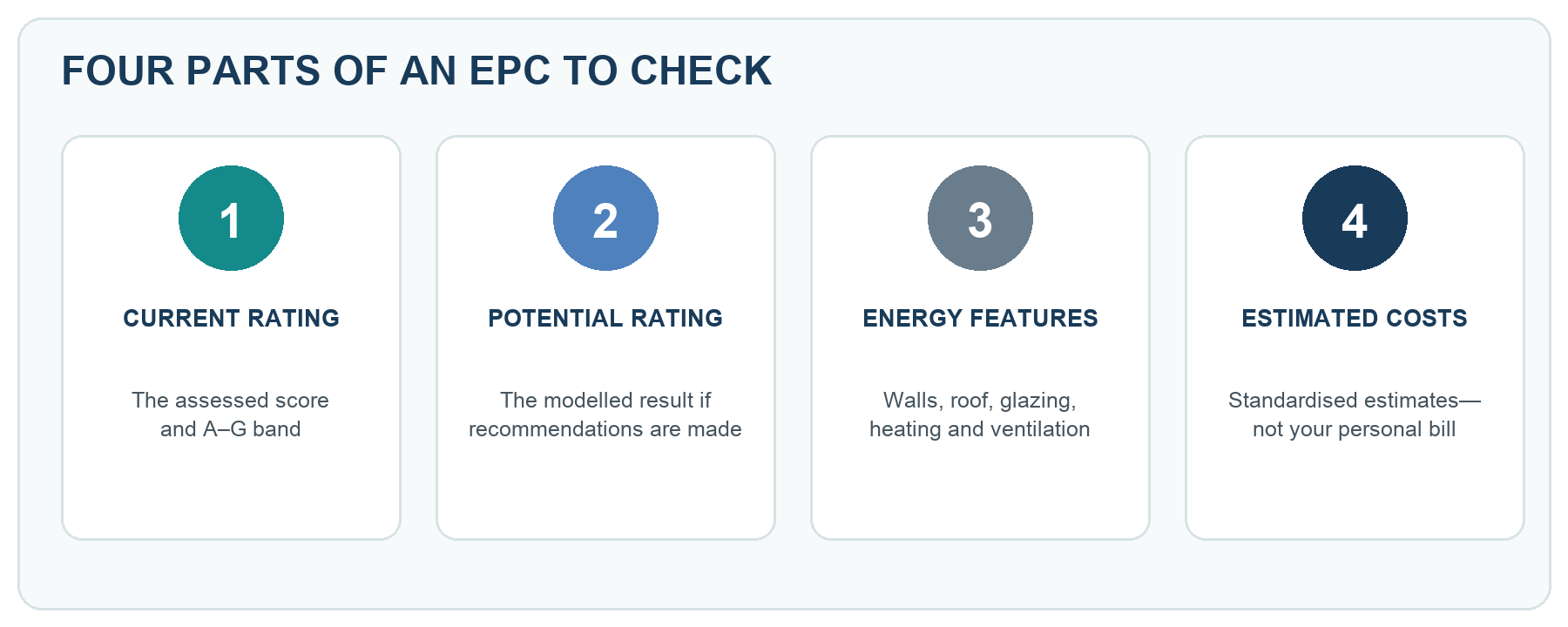
Figure 2. The four main parts of an EPC to check.
Current and potential ratings
The current score represents the property as assessed. A potential score may show what could be achieved if the listed recommendations were completed. A new home may have few recommendations because its efficient features have already been included in the as-built calculation.
Estimated energy use and costs
The certificate provides modelled figures based on standard occupancy, heating patterns, temperatures and other assumptions. They allow broad comparison between properties, but they are not a personalised forecast. Your bills will depend on household size, thermostat settings, hot-water use, appliances, energy tariffs, weather and how the home is operated.
The property’s energy features
The EPC records or rates features such as walls, roof, floor, windows, heating, hot water, lighting and renewable-energy systems. Descriptions such as ‘good’ or ‘very good’ refer to modelled energy performance. They do not certify condition, safety, workmanship or correct commissioning.
Recommendations
Recommendations may include insulation, heating controls, low-energy lighting, solar panels or other measures. Indicative costs and savings are estimates, not quotations or guarantees. Before carrying out work, check warranties, planning requirements, Building Regulations, ventilation implications and the suitability of the measure for the actual home.
How is a new home assessed?
An existing home is usually assessed through an inspection using the reduced-data method that applies at the time. A new home follows an on-construction process using detailed design and as-built information. Work under the 2021 Part L edition normally uses SAP 10.2. For the Future Homes Standard introduced by the 2026 edition, SAP 10.3 is currently the approved method; the government intends to introduce the Home Energy Model alongside it later.
The assessor considers the specified construction, insulation, glazing, airtightness, thermal bridging, heating, hot water, ventilation, lighting and renewable technology. The completed calculation supports Part L compliance and generation of the EPC. Transitional provisions can mean that two similar homes on the same development follow different Part L editions because their plot-specific approval and commencement dates differ.
The EPC therefore tells you how the recorded, completed home performs within the approved calculation method. It is not a room-by-room survey and the assessor may rely on plans, specifications, test results, evidence supplied during construction and approved defaults.
What an EPC does not tell you
A high rating is positive, but it should not be treated as a complete quality certificate. An EPC does not normally:
- predict the exact energy bill for your household;
- test whether the boiler, heat pump or ventilation system is safe or correctly commissioned;
- confirm that insulation is continuous and free from installation gaps;
- identify draughts, thermal bridges or air leakage in every part of the home;
- replace a snagging inspection, survey, airtightness result or thermal-imaging assessment;
- guarantee comfort, indoor air quality or freedom from condensation; or
- prove that the home complies with every part of the Building Regulations.
This distinction matters because the calculation describes expected performance from recorded characteristics. Real performance can be affected by workmanship, commissioning, controls and occupant use.
How to read your new home’s EPC
1. Confirm that it belongs to your home
Check the address, property type, total floor area, certificate date and reference number. On developments with similar plots, make sure you have not been given the certificate for a neighbouring property or an earlier house type.
2. Check the current score—not just the letter
Two homes can share a band while having different scores. A home at the top of band B is closer to A than one at the bottom. The number therefore gives more detail than the band alone.
3. Compare the recorded features with the home
Look at the listed heating system, hot-water system, glazing, ventilation, solar panels and other important features. Compare them with the plot specification, signed as-built BREL report and construction evidence. If the description does not match what was installed, ask the developer or assessor to explain it.
4. Read the assumptions and recommendations
An assumed feature or default can affect the result. Recommendations should be read as modelled options rather than instructions. A recommendation that seems inconsistent with a brand-new specification may indicate that information needs checking.
5. Verify the certificate online
In England and Wales, use the official Find an Energy Certificate service to view or download the lodged certificate. A document that has not been validly lodged by an accredited assessor is not a valid EPC.
When should you ask questions?
Ask the developer to confirm the Part L edition and energy specification for your plot, and request the signed as-built BREL report and construction photographs. Ask the developer, conveyancer, building-control contact or energy assessor for clarification if:
- the address, floor area or property description appears wrong;
- the EPC omits a heat pump, solar panels or another installed system;
- the heating, hot-water or ventilation description does not match the handover information;
- the certificate cannot be found on the official register;
- the rating is materially lower than marketing information led you to expect; or
- actual comfort or energy use appears poor and there may be a defect or commissioning problem.
An unexpectedly high bill does not by itself prove that the EPC is wrong. Start by comparing tariffs, meter readings, heating settings and occupancy, then investigate the building and systems where the figures remain unexplained.
Common misunderstandings
“The EPC is an energy-bill guarantee”
It is a standardised assessment based on assumptions, not a prediction of one household’s exact costs.
“Every recommendation is automatically suitable”
Recommendations are indicative and should be assessed against the home, warranty and technical constraints.
“A high rating proves there are no defects”
The rating does not replace inspections of insulation, ventilation, heating or workmanship.
Frequently asked questions
How long is an EPC valid?
In England and Wales, it is normally valid for ten years unless a newer certificate is produced. A valid certificate does not automatically update when improvements are made.
Is an EPC the same as Building Regulations approval?
No. The EPC communicates modelled energy performance. Building Regulations cover a much wider range of requirements, and the completion process is separate even though energy calculations support Part L compliance.
Does a B-rated home always cost less to run than a C-rated home?
Not necessarily for a particular household. The B-rated home performs better within the standard model, but actual costs depend on energy prices, fuels, household behaviour, size and weather.
Can I challenge an EPC?
Raise the issue with the assessor first. If it is not resolved, contact the assessor’s accreditation scheme using the details on the certificate. Keep photographs and specification documents that support the concern.
Key takeaways
- An EPC is a standardised comparison tool, not a personalised bill forecast.
- A higher score is generally better, but the number is more informative than the band alone.
- Check that the address and recorded systems match the home you bought.
- A high rating does not certify workmanship, safety or real-world performance.
- Use the official register and question material inconsistencies promptly.
Explore further
Explore the CheckSure Homeowner Knowledge Base for related guidance on buying, inspecting and looking after a new home.
Related Knowledge Base articles
- Why new-build homes are more energy efficient
- Part L Building Regulations: what new-home buyers need to know
- The benefits of loft insulation in a new-build home
- Are new-build homes worth it? The honest pros and cons
Sources & References
UK Government — Energy Performance Certificates when selling a home. Current overview of when EPCs are required, the A-to-G scale and validity period.
UK Government — Guide to EPCs for the marketing, sale and let of dwellings. Detailed England and Wales guidance on content, assessment and limitations.
UK Government — Find an Energy Certificate. Official register access for England, Wales and Northern Ireland, with a separate route for Scotland.
UK Government — Approved Document L, Volume 1: Dwellings, 2021 edition incorporating 2023 amendments, and the 2026 edition. As-built energy calculations, evidence and owner information for new dwellings in England.
UK Government — Standard Assessment Procedure. Current government position on SAP 10.2, SAP 10.3 and the delayed Home Energy Model.
UK Government — EPC statistics, January to March 2026, and Office for National Statistics — Energy efficiency of housing in England and Wales. Current rating context and explanation of standardised rather than household-specific energy use.
Independent new-home inspections
Need help with your new home?
If you are approaching completion, have recently moved in or are dealing with unresolved concerns, CheckSure can help you choose the appropriate inspection for your stage.
Important information
The Knowledge Base provides general information for homeowners in the UK. It is not a substitute for advice about an individual property and should not be treated as legal, financial, insurance, structural or other specialist advice. Requirements and warranty terms can vary according to location, construction date, provider, contract and the circumstances of the particular home.
Copyright and permitted use. © 2026 CheckSure Ltd. All rights reserved. Website content may not be reproduced without permission, except as permitted by law. See our Content Use and Copyright Policy.