

Homeowner Knowledge Base
Extension leads and multi-socket adaptors: using them safely after moving home
The short answer: an extension lead can be useful while you unpack and decide where furniture will go, but it should be treated as a temporary way to reach a socket—not as a permanent substitute for enough correctly positioned wall outlets. Check the lead's rating, add together the demand of everything connected to it, never connect one extension lead to another and fully unwind a cable reel before use.
CheckSure’s Homeowner Knowledge Base draws on practical experience of building, inspecting and resolving defects in new homes. Our aim is to explain what homeowners should reasonably expect, what may require further investigation and what steps they can take next.
Why extension leads appear so quickly after a move
A new home may have been designed with more socket outlets than an older property, but the locations will not suit every household. On moving day, a router may need to sit near a network point, a desk may still be temporary and lamps, chargers or a television may be waiting for their final position. Multi-socket extension leads can bridge that gap safely when they are suitable, undamaged and used within their rating.
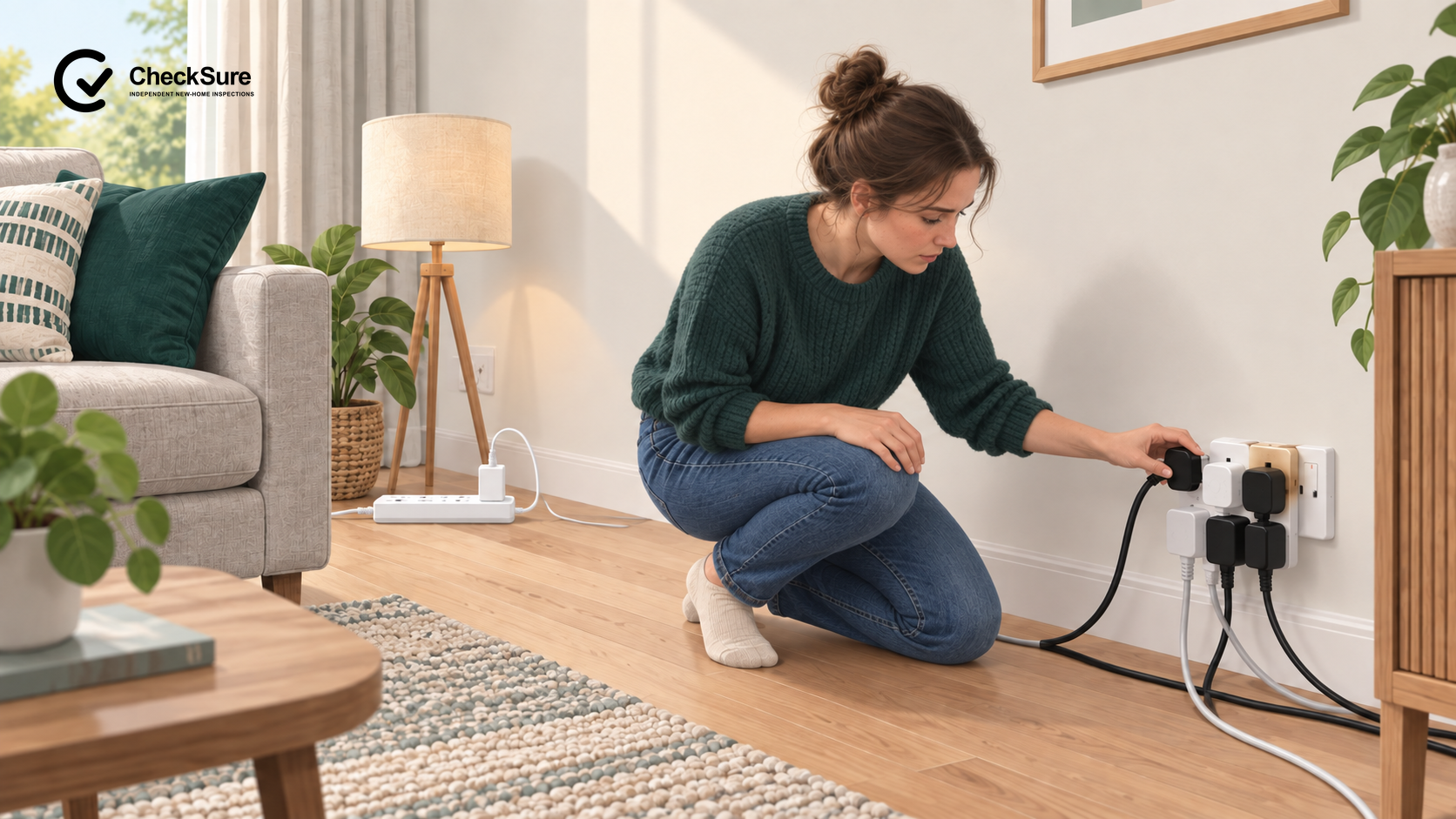
The risk develops when a temporary arrangement becomes part of the room. An extension is hidden behind furniture or beneath a rug, another adaptor is added and a high-powered appliance is plugged into the remaining outlet. Because everything may continue to work at first, the shared load and heat can be easy to overlook.
Four outlets do not mean four full-power supplies
A multi-socket adaptor shares one plug, cable and wall socket. Adding more outlets does not increase the amount of electrical load that the lead and socket can safely carry.
A multi-socket lead takes its supply through one plug and one wall socket. Its marked current rating applies to the extension as a whole. Many modern household extension leads are rated at 13 amps, while some products—particularly older or lighter-duty leads—may be rated at 10 amps or less. Always read the label or moulded marking rather than assuming.
At a nominal UK supply of 230 volts, 13 amps is roughly 3,000 watts and 10 amps roughly 2,300 watts. These figures are useful for understanding scale, but the product's stated maximum load and the appliance manufacturers' instructions are the controls to follow. Add together the wattage of all appliances that could operate at the same time. The number of unused outlets tells you nothing about the capacity remaining.
High-powered appliances need particular care
Portable heaters, kettles, irons, hairdryers, tumble dryers and some cooking appliances draw much more power than a router, lamp or phone charger. Combining high-demand appliances on one extension can approach or exceed its maximum load very quickly. London Fire Brigade specifically warns against placing appliances such as kettles, toasters and microwaves on the same extension, and identifies heaters and tumble dryers among the items that can readily contribute to overloading.
Wherever practicable, connect a portable electric heater or dehumidifier directly to a suitable wall socket and follow its instructions. A dehumidifier's power demand varies by model, so check the rating plate rather than assuming it is low. Keep heaters away from curtains, boxes and furniture, and never cover either appliance. Do not use an extension lead where the appliance manufacturer says it must be connected directly to a socket.
Why cable reels should be fully unwound
Current flowing through a cable produces heat. When a reel remains tightly coiled, that heat cannot dissipate as effectively and the temperature inside the coil can rise. Electrical Safety First states that cable reels must be unwound to achieve their current rating and should be fitted with a thermal cut-out. The Health and Safety Executive likewise advises fully extending drums or coils to reduce the risk of overheating and fire.
Unwind the entire reel before connecting a significant load, even if only a short length is needed. Check the rating shown for coiled and fully unwound use, because they may differ. If the reel is not clearly marked, is damaged or does not identify a thermal cut-out, do not use it.
Never daisy-chain extension leads
Daisy-chaining means plugging one extension lead or adaptor into another. It does not create additional capacity: every connected appliance still draws through the first plug, lead and wall socket. The arrangement also introduces more connections that may loosen, become damaged or be concealed. Use only one extension device from a wall socket and never add another lead to gain extra outlets or distance.
Plug-in cube adaptors are also a poor choice. The weight of several plugs and cables can strain the adaptor and wall socket, potentially creating a loose connection that overheats. A properly rated fused trailing socket bar is generally preferable, but it must still be used within its total rating.
Position cables where they cannot be damaged
Moving boxes and unsettled furniture make trailing leads a trip hazard. Route them where people will not walk, wheel chairs or place furniture over them. Do not run a lead beneath a carpet or rug: repeated pressure can damage it, while the covering hides deterioration and restricts heat loss. Keep leads away from water, hot surfaces, sharp edges and doorways where they can be trapped.
Do not tightly bundle surplus cable or trap the extension behind a bed, sofa or cabinet where ventilation is poor. Make sure the plug and wall switch remain accessible so the supply can be disconnected quickly if anything goes wrong.
Check the extension before every use
- Confirm the marked amp or watt rating and make sure the planned combined load stays within it.
- Use a fused extension lead bought from a reputable retailer; avoid an unbranded product with unclear markings.
- Inspect the plug, sockets and full cable for cracks, cuts, loose parts, bent pins or exposed conductors.
- Make sure the cable grip is secure and the lead has not been crushed by furniture or a door.
- Use one extension device per wall socket and keep cable reels fully unwound.
- Stop using the lead if a plug or socket becomes unusually warm, smells of hot plastic, buzzes, sparks or shows discolouration or scorch marks.
Do not rely on a fuse or circuit breaker to manage everyday loading
Protective devices are essential, but they are not permission to load an extension carelessly. A fuse is intended to protect against excessive current. it cannot correct a loose contact, damaged flex, trapped cable or heat building inside a coil. An RCD can reduce the risk of serious electric shock in certain fault conditions, but it does not prevent every electrical hazard and does not replace correct use.
Repeated tripping, blown fuses, flickering, buzzing, heat or burning smells require attention. Switch off and unplug if it is safe to do so, stop using the equipment and seek advice from a competent electrician. Do not keep resetting a protective device without finding the reason it operated.
When temporary use becomes a permanent socket problem
If an extension is needed every day in the same position, the safer long-term answer may be an additional wall socket or a change to the room layout. Electrical Safety First recommends considering extra sockets where a household regularly relies on extensions and adaptors. Any alteration to the fixed electrical installation should be designed, installed and tested by a suitably qualified, registered electrician.
For a new home, first check the drawings, specification and electrical handover information. A missing socket that was contracted or shown on an agreed plan should be raised with the developer. A request for an extra socket based only on personal furniture placement is normally an alteration rather than a defect. Before arranging work, check the builder and warranty procedures, particularly during the initial defects or warranty period.
Can a snagging inspection identify electrical concerns?
A pre-completion or snagging inspection can record visibly damaged, loose or poorly finished socket outlets and compare their apparent positions with the agreed specification where that information is available. It should not encourage the use of plug-in adaptors as a remedy for missing contracted work. Formal inspection and testing of the fixed installation is a specialist electrical activity and is separate from a general visual snagging inspection.
Common misunderstandings
“A fused extension lead cannot be overloaded”
The fuse protects against some faults, but the lead, socket and connected appliances still have safe loading limits.
“Every appliance can share a multi-socket adaptor”
High-power heating and drying appliances may be unsuitable for shared extensions and should follow manufacturer guidance.
“A coiled cable is safe if it feels cool initially”
A loaded cable can heat over time; reels should be used within their stated coiled and uncoiled ratings.
Frequently asked questions
Is a four-way extension safe?
It can be when it is correctly rated, fused, undamaged and the combined load of all connected appliances remains within the marked limit. Four outlets do not mean four high-powered appliances can be used together.
Can I plug an extension lead into another extension lead?
No. Move the equipment, use one suitable lead of the correct length or ask an electrician about adding sockets. Daisy-chaining increases risk without increasing the capacity of the original wall socket.
Can I use an extension lead with a heater or dehumidifier?
Direct connection to a suitable wall socket is preferable for high or sustained loads. Check the appliance instructions and rating plate. If the manufacturer prohibits extension use, follow that instruction. Never share a lead with other appliances if doing so would approach or exceed its rating.
Is a warm plug normal?
A plug may not remain completely cold under load, but noticeable or increasing heat, a hot-plastic smell, discoloration, buzzing, sparks or scorch marks are warning signs. Switch off, unplug if safe and stop using the equipment until it has been checked.
Key takeaways
- Treat extension leads as temporary equipment, not a substitute for sufficient permanent sockets.
- Check the marked rating and add together the load of everything that may run at the same time.
- Use only one extension device from each wall socket and never daisy-chain leads.
- Fully unwind cable reels and confirm that they have suitable markings and a thermal cut-out.
- Keep cables visible, ventilated and protected from water, heat, crushing and foot traffic.
- Stop using anything that is damaged, unusually hot, discoloured, sparking or giving off a burning smell.
- Arrange permanent additional sockets through a registered electrician if extensions are needed routinely.
Explore further
Explore the CheckSure Homeowner Knowledge Base for related guidance on buying, inspecting and looking after a new home.
Related Knowledge Base articles
- Changing light fittings in a new-build home: safety, fixings and warranties
- Maintaining your new-build home: a practical homeowner schedule
- Electrical snagging: safe visual checks and documents
- Which snags need urgent attention?
- Wi-Fi dead spots in new-build homes: causes and practical solutions
Sources & References
Electrical Safety First — extension leads, cable reels and block adaptors. Consumer guidance on total ratings, daisy-chaining, cable reels, thermal cut-outs and warning signs.
London Fire Brigade — cables, fuses and leads. Fire-safety guidance on high-powered appliances, fused inline extensions and fully unwinding reels.
Health and Safety Executive — work using electrically powered equipment. General guidance on ratings, safe supplies and RCD limitations.
Health and Safety Executive — Electrical safety for entertainers. Guidance explaining why drums and coils should be fully extended and warning against overloaded adaptors.
Independent new-home inspections
Need help with your new home?
If you are approaching completion, have recently moved in or are dealing with unresolved concerns, CheckSure can help you choose the appropriate inspection for your stage.
Important information
The Knowledge Base provides general information for homeowners in the UK. It is not a substitute for advice about an individual property and should not be treated as legal, financial, insurance, structural or other specialist advice. Requirements and warranty terms can vary according to location, construction date, provider, contract and the circumstances of the particular home.
Copyright and permitted use. © 2026 CheckSure Ltd. All rights reserved. Website content may not be reproduced without permission, except as permitted by law. See our Content Use and Copyright Policy.