

Homeowner Knowledge Base
Roads and pavements around your new home
The short answer: roads, footways and shared spaces on a new development do not all have the same owner or maintenance arrangements. Some are intended to become public highway. others remain private and are maintained through an estate-management arrangement. A road can also be safe and usable before it receives its final surface. Delaying the finishing layer can protect it from construction damage and allow a longer, more consistent section to be laid—but incomplete must not mean hazardous or inaccessible.
CheckSure’s Homeowner Knowledge Base draws on practical experience of building, inspecting and resolving defects in new homes. Our aim is to explain what homeowners should reasonably expect, what may require further investigation and what steps they can take next.
The road outside your home may not yet belong to the council
A new road does not become a publicly maintained highway simply because people are living beside it. Until formal adoption is complete, the land will normally remain in private ownership and responsibility for maintenance will usually rest with the developer, landowner or another party identified in the legal documents. Even where adoption is planned, it may take place well after the first homes are occupied.
The everyday word pavement can also cause confusion. Highway documents usually use “footway” for the pedestrian route beside a carriageway and “footpath” for a route that is not beside a road. A development may contain adopted footways, privately managed paths, shared-surface streets and plot-specific drives within a short distance of one another.
Three common ownership and maintenance positions
Responsibility can sit with the developer, a management company or the highway authority, and it may change as the development progresses. Establish the current owner before reporting a defect or assuming the council must act.
| Status | Who normally maintains it? | What the homeowner should check |
|---|---|---|
| Adopted highway | The highway authority, using public funds. | Confirm the adopted extent; private drives, parking courts and landscaped margins may sit beside it. |
| Offered for adoption | Usually the developer or landowner until the final adoption certificate. | Ask whether a Section 38 agreement and bond are in place, what remains outstanding and the expected programme. |
| Private or estate-managed | The owner, residents’ management company or appointed managing agent under the property documents. | Read the transfer or lease, service specification, estate-charge budget and rights of access. |
The boundary between these areas is not always obvious from the appearance on site. Matching block paving, kerbs or streetlights do not prove who owns or maintains them. The transfer plan, lease, title documents, highway-adoption plan and management-company information are more reliable than assumptions based on the surface finish.
What does road adoption mean?
In England, the common route for adopting a new estate road is an agreement under section 38 of the Highways Act 1980. The agreement is made between the developer or landowner and the local highway authority. It sets the standards, works, inspections and other conditions that must be satisfied before the authority accepts the road as highway maintainable at public expense. Local requirements and procedures vary.
A Section 38 agreement may be supported by a bond or financial security. This is intended to protect the authority and future residents if the developer fails to complete qualifying highway works. It is still important to ask whether an agreement has actually been signed: a road described as “to be adopted” is not the same as one already adopted, and an intention stated in sales material is not a final adoption certificate.
Once the work reaches the authority’s required stage, there is commonly a maintenance period during which the developer remains responsible for defects and remedial work. Adoption normally follows only after inspections, corrections and a final certificate. A planning permission, Building Regulations completion certificate or council-tax bill does not by itself prove highway adoption.
Why might the road look unfinished when you move in?
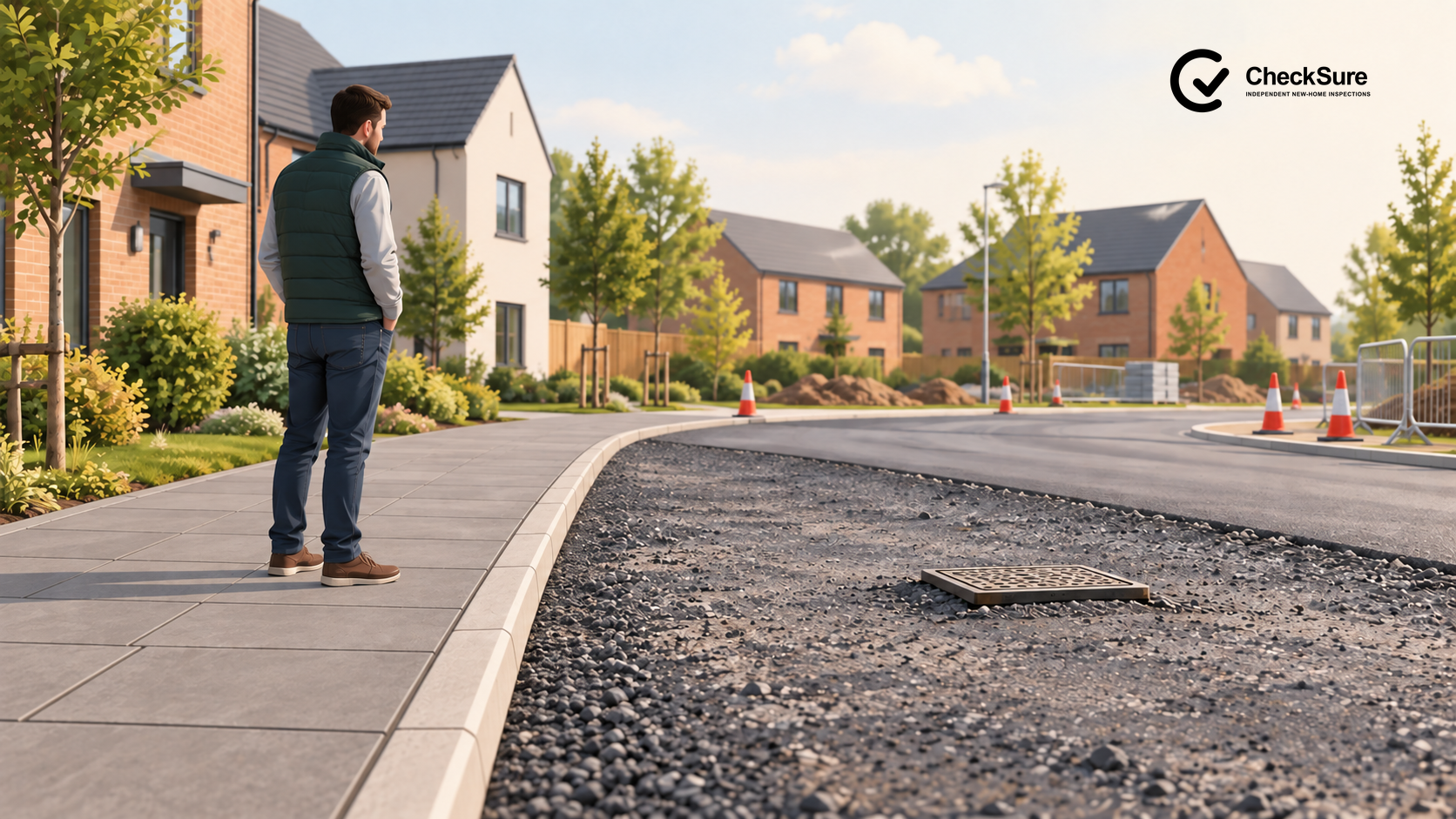
Estate roads are built in layers. The lower construction and an intermediate asphalt layer can provide a firm route while plots are completed, with the final surface course laid later. Highway authorities may permit or require occupation once defined interim works are complete—for example a suitable carriageway layer, completed pedestrian provision, drainage and operational lighting—without requiring the final surface to have been laid. The exact threshold is local and site-specific.
There are sound practical reasons for leaving the surface course until heavy construction has reduced. Excavators, concrete wagons, cranes and repeated deliveries can scar a finished road. Utility connections may require openings, ironwork may need adjustment and damaged kerbs may need replacement. Laying the final course across a longer prepared section can also reduce avoidable joints and patchwork, producing a more consistent finished surface.
This does not give a developer an unlimited right to leave access in poor condition. It explains why a visually unfinished road is not automatically defective. The important questions are whether the temporary stage is suitable for its use, whether hazards are controlled, whether the agreed programme is progressing and who currently has responsibility for maintenance.
What should be safe and usable before occupation?
There is no single national appearance test for every occupied development. Requirements can come from the Section 38 agreement, planning conditions, approved drawings, construction-management arrangements and the developer’s duties for site safety. However, people should be able to reach an occupied home without being exposed to avoidable danger.
- The carriageway should be firm and suitable for the vehicles expected to use it, without dangerous potholes, abrupt level changes or uncontrolled loose material.
- A reasonably safe pedestrian route should be available, with crossings, barriers or diversions where active works create conflict.
- Kerbs, service covers and temporary edges should not create unmarked or unmanaged trip hazards.
- Drainage routes and gullies should function sufficiently to avoid foreseeable hazardous ponding or flooding.
- Access needed by emergency services, refuse vehicles and residents should be maintained or managed through a clear temporary arrangement.
- Lighting, signs and guarding should reflect the risks and any site-specific approval or occupation requirement.
- Mud, debris and construction damage should be monitored and dealt with rather than allowed to create an unsafe route.
Unfinished is different from unsafe
A visible difference in colour between asphalt phases, recessed ironwork awaiting adjustment, temporary kerb details or a road without its final surface can be part of a legitimate construction sequence. By contrast, a loose cover, deep pothole, unsupported edge, severe rocking paving, missing guarding or an obstructed pedestrian route may require prompt action. The distinction is based on risk and suitability, not simply whether the area looks complete.
Minor local repairs do not necessarily mean the finished road will be laid as a collection of patches. Defects in the lower layers, drainage, kerbs or utility trenches may need correction before the final surface is applied. The adopting authority will normally inspect work at stages and can require remedial work before certification.
What if the roads will remain private?
Some roads, parking courts, paths, lighting, drainage features and landscaped areas are intentionally excluded from public adoption. They may be retained by a freeholder, transferred to a residents’ management company or managed by a specialist estate-management company. The cost can then form part of an estate charge or service charge paid by homeowners.
Private does not mean unregulated or ownerless, but the highway authority will not ordinarily take on routine maintenance merely because the area is open to residents or visitors. The property documents should identify maintenance obligations, access rights, cost-sharing arrangements and enforcement mechanisms. Buyers should understand whether the budget covers roads and paths, lighting, drainage, winter treatment, inspections, insurance and reserves for eventual resurfacing.
Where adopted and private areas meet, responsibility for a defect can be disputed. Record the precise location and check the adoption plan or title plan before assuming the council, developer or managing agent is responsible.
Questions to ask before exchange or completion
- Which roads, footways, paths, parking courts, verges, lighting and drainage features will be adopted, and which will remain private?
- Is a Section 38 agreement completed and supported by a bond, or is adoption only intended?
- Which authority is expected to adopt the highway, and can the current adoption plan be provided?
- What work remains before substantial completion and final adoption, and what is the indicative programme?
- Who deals with defects and emergencies while the highway remains unadopted?
- What access or construction restrictions are likely while later phases continue?
- For private areas, what do the transfer or lease, management specification, first-year budget and reserve arrangements say?
- Will residents pay estate charges for roads or paths as well as council tax, and how can those charges change?
How to raise a problem
Start by identifying the location, current status and nature of the problem. Give the developer or managing agent photographs, dates and a clear description of the risk. A report such as “loose cover at the crossing outside plot 24 moves under foot” is more useful than “the roads are unfinished”. Ask for a reference number, the responsible party and a target response date.
If the road has been adopted, use the highway authority’s reporting service. If it is under a Section 38 process, the authority may be able to confirm status and inspect matters affecting its agreement, but the developer will normally retain maintenance responsibility until adoption. Planning enforcement may be relevant where a clear planning condition is not being met. Immediate danger should be reported through the appropriate emergency route.
Should a snagging inspection cover nearby roads and pavements?
A snagging inspection should consider the plot and external areas included within its agreed scope. It may record a damaged access, unsafe trip point, defective paving or drainage issue connected with the home. It is not normally a full technical audit of estate roads, a Section 38 compliance inspection or a legal determination of ownership. Those wider matters require the approved drawings, agreements and highway authority’s inspection process.
Where construction makes the route unsafe, the inspection should be coordinated with the developer or carried out at an appropriate time. An inspector should not enter restricted highway works or an active construction area merely to extend the snagging list.
Common misunderstandings
“Every road must be adopted by the council”
Some roads and footpaths remain private and are maintained through estate-management arrangements.
“An unfinished surface is automatically unsafe”
Final surfacing may be delayed to avoid construction damage, but access routes should remain safe and usable.
“Adoption happens as soon as homes are occupied”
Technical approvals, remedial work and maintenance periods can make adoption a lengthy process.
Frequently asked questions
Does paying council tax mean the road is adopted?
No. Council tax and highway adoption are separate matters. Ask the highway authority or examine the relevant adoption records and plans.
Can people legally use an unadopted road?
Often they can because owners and visitors have access rights, but the legal position depends on the title, agreements and status of the route. Unadopted means it is not yet maintained at public expense. it does not automatically mean there is no right of access.
How long should adoption take?
There is no reliable universal timescale. Phasing, outstanding works, utility activity, inspections, remedial work, maintenance periods and legal matters can all affect it. Ask for the current stage and remaining actions rather than relying only on an estimated date.
Is a patch or joint always a defect?
No. Some joints and reinstatements are unavoidable and can perform correctly. The relevant standards, workmanship and location matter. Highway authorities may nevertheless prefer final surfacing to be laid in suitably long sections to improve consistency and reduce unnecessary joints.
Key takeaways
- A new estate road is not publicly maintained until formal adoption is complete.
- Some roads and paths are deliberately private and funded through estate-management arrangements.
- Final surfacing may be delayed to protect it from construction traffic and create a better continuous finish.
- An interim surface can be acceptable, but occupied homes still need suitable and safely managed access.
- Ownership, adoption and maintenance boundaries should be confirmed from documents and plans—not appearance.
- Ask for the Section 38 position, bond, programme and responsible contact before relying on a promise of adoption.
- A snagging inspection can identify plot-specific access defects but does not replace the highway-adoption process.
Explore further
Explore the CheckSure Homeowner Knowledge Base for related guidance on buying, inspecting and looking after a new home.
Related Knowledge Base articles
- Builders’ traffic on an occupied development: what residents should expect
- Streetlights on a new-build development
- Below the grass: how builders should prepare a new-build garden
- New-home warranties explained: what buyers need to know
- Exterior and weatherproofing checks for a new-build home
Sources & References
Department for Transport — adoption of roads by highway authorities. National guidance for England on road adoption under the Highways Act 1980 and questions for prospective purchasers.
Cambridgeshire County Council — highways development. Example of occupation-stage works, interim surfacing, certification and maintenance before adoption.
City of Doncaster Council — creation of new public highways. Explains developer responsibility before adoption and why adoption may follow completion of a larger development.
Lancashire County Council — estate-road adoption. Illustrates design, inspection, maintenance-period and final-adoption requirements.
Hertfordshire County Council — highways development management. Confirms that maintenance remains with the developer, owner or residents until adoption.
New Homes Quality Board — New Homes Quality Code. Current consumer-code framework for registered developers; the applicable version depends on reservation date.
Independent new-home inspections
Need help with your new home?
If you are approaching completion, have recently moved in or are dealing with unresolved concerns, CheckSure can help you choose the appropriate inspection for your stage.
Important information
The Knowledge Base provides general information for homeowners in the UK. It is not a substitute for advice about an individual property and should not be treated as legal, financial, insurance, structural or other specialist advice. Requirements and warranty terms can vary according to location, construction date, provider, contract and the circumstances of the particular home.
Copyright and permitted use. © 2026 CheckSure Ltd. All rights reserved. Website content may not be reproduced without permission, except as permitted by law. See our Content Use and Copyright Policy.