

Homeowner Knowledge Base
Broadband in a new-build home: arranging your new connection
The short answer: do not assume broadband will work simply because the home has a fibre socket. The developer is responsible for the infrastructure and, where the current English requirements apply, a qualifying network connection subject to defined limits. The buyer still needs to order and pay for a retail broadband service—and a newly registered address may not appear on every provider’s systems immediately.
CheckSure’s Homeowner Knowledge Base draws on practical experience of building, inspecting and resolving defects in new homes. Our aim is to explain what homeowners should reasonably expect, what may require further investigation and what steps they can take next.
Ask about broadband before exchange, not on moving day
Treat the connection as a short process with three separate questions: what physical network reaches the plot, which providers sell a service on it, and when your chosen service can be activated.
Broadband has become an essential household service, particularly for home working, security systems, television and app-controlled heating. Yet it is often treated like a utility that will simply be live at handover. On a new development, several organisations and databases must align: the developer, the network builder, retail providers, the addressing authority and sometimes Openreach or an alternative full-fibre network.
A show home may have a working demonstration connection while later phases are still being built. A sales adviser may also use ‘fibre available’ to describe the planned development rather than a service that can be ordered at your exact plot today. Ask for the network operator, the connection type and the date on which your specific address is expected to accept retail orders.
What must a developer provide in England?
Approved Document R Volume 1 supports the Building Regulations requirements for new dwellings in England. Requirement RA1 concerns gigabit-ready physical infrastructure: the ducts, chambers, access points and in-building route needed for a future gigabit-capable connection. Requirement RA2 requires a functional gigabit-capable network connection, subject to a developer cost cap of £2,000 per dwelling.
If a gigabit-capable connection cannot be secured within the cost cap, the developer must pursue the next fastest connection available within that cap. The gigabit-ready physical infrastructure requirement continues even where a live gigabit connection cannot be provided, helping to avoid disruptive retrofitting later. Current guidance also uses a connectivity plan to document the proposed infrastructure, operator and any reliance on the cost-cap provisions.
These rules do not mean the developer must buy the homeowner an internet package or pay the monthly bill. Nor should they be applied retrospectively without checking scope and transitional arrangements: some developments approved or started under earlier provisions may follow a different requirement. The article therefore distinguishes what is required under the current regime from what a particular plot was contractually promised.
Connection is not the same as service
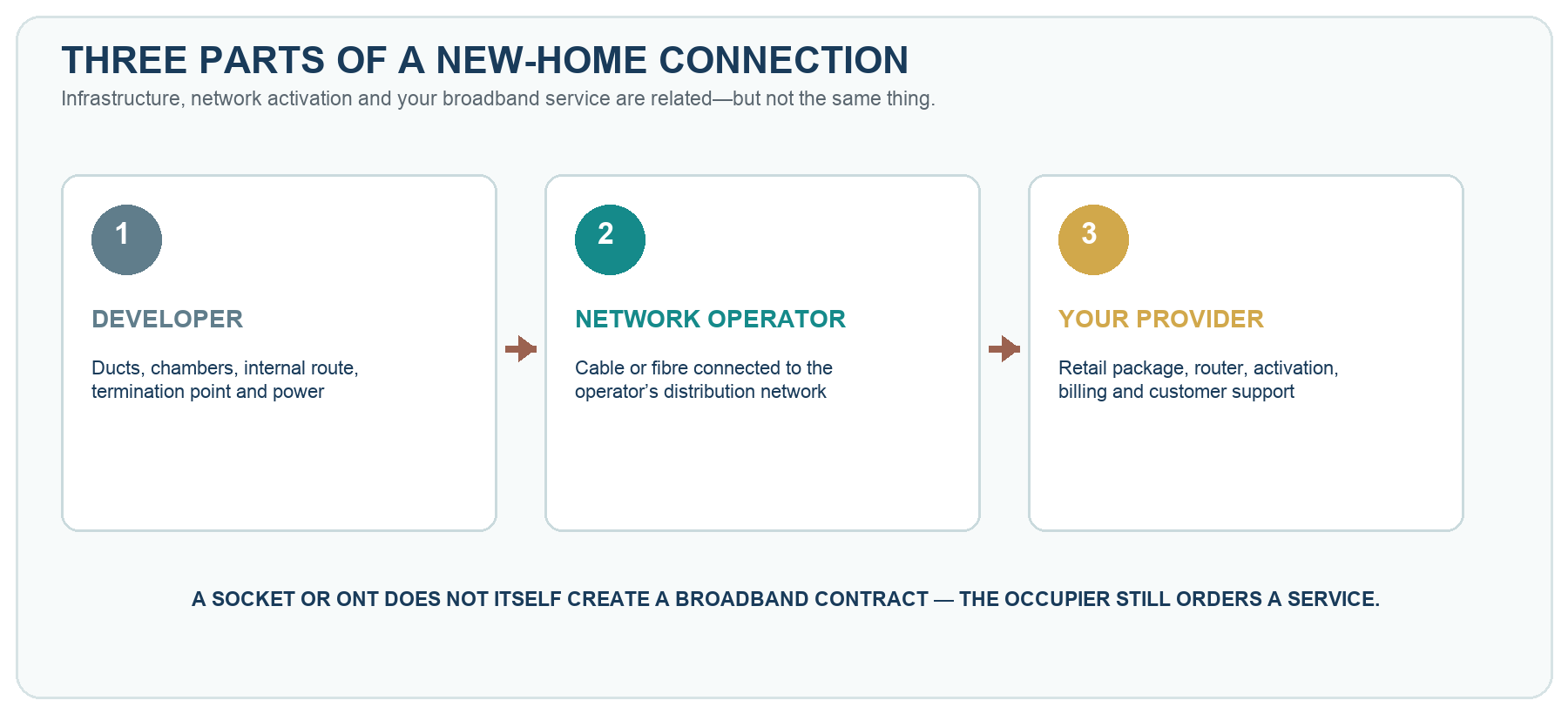
A physical connection links the home to a public electronic communications network. A retail service is the contract under which an internet service provider activates access, supplies or authorises a router, bills the customer and handles faults. Approved Document R expressly separates these: the developer's network obligation does not require it to secure an ongoing internet service for the occupier.
Figure 1. A new home can contain completed infrastructure before a chosen internet service provider is able to accept an order.
Should you keep your existing broadband provider?
Start by asking the existing provider to check the exact new address—not merely the postcode or development name. If it can supply the address at a suitable speed and price, transferring the service may be convenient and may avoid early termination charges. Confirm the activation date, whether an engineer is required, whether the existing router is compatible and whether a new minimum contract period will begin.
Do not agree to a home move until the provider confirms that the plot is orderable. A provider that serves nearby established streets may not yet have access to the development's chosen network. If it cannot offer the service you need, ask what cancellation charge applies. Ofcom advises movers to check what the current provider can offer at the new address. providers do not all treat early termination in the same way.
One network can support several providers—but not always
Openreach builds a wholesale network used by many retail providers, so an Openreach full-fibre connection may allow a choice of companies once the address is live in their systems. Other developments use Virgin Media, CityFibre, Hyperoptic, Gigaclear or a smaller network. Some network operators sell directly. others use selected retail partners. The presence of full fibre therefore tells you about the technology, not necessarily the list of suppliers available on completion day.
A developer is not generally required by Part R to install multiple network connections. It may choose to do so, and another operator may build into the estate later. Ask whether wayleaves, ducts or agreements exist for a second network, but treat future deployment dates as plans rather than guarantees until that operator confirms the address is ready for service.
How to check which providers are available
- Use the Ofcom broadband checker for an independent indication of networks and predicted speeds at the exact address.
- Check the infrastructure operator's own availability tool, such as the Openreach fibre checker, because new addresses can appear there before wider databases update.
- Enter the full plot address on the retail provider's website and ask its new-build or address-matching team if the result is missing.
- Ask the developer for the network operator, connectivity plan or handover contact, the installed equipment and the plot activation status.
- Ask neighbouring occupied plots which providers have successfully activated service, while remembering that a different phase or cabinet can produce a different result.
- Repeat the checks shortly before completion: availability data and operator build status can change during construction.
Why a brand-new address may not appear
Providers rely on address databases as well as network records. A new street name, postcode or unit number may take time to move through local-authority, Royal Mail, Ordnance Survey, network and retail systems. Ofcom notes that its checker base data is updated periodically, so a missing property does not necessarily mean no service exists.
Report the mismatch rather than trying a neighbouring plot number. Ask the developer to confirm the official postal address and Unique Property Reference Number, then ask the network operator to correct its records. Ordering against the wrong address can create failed engineer visits, duplicate network records and later problems when switching provider.
What should be inside the home?
The termination point may be a fibre Optical Network Terminal, often called an ONT, or another network socket. A full-fibre ONT normally needs a nearby power supply and connects to the provider's router by an Ethernet cable. Do not remove, paint over or relocate network equipment without permission. some equipment belongs to the network operator and fibre can be damaged by tight bends.
Check that the unit is secure, accessible, powered and not hidden where the router's Wi-Fi will be unnecessarily restricted. The legal infrastructure requirement does not guarantee good wireless coverage throughout the home. Router position, internal data cabling and mesh Wi-Fi are separate subjects addressed in CON-002.
Plan for a gap in service
Even where the infrastructure is complete, the retail activation date can slip because of address matching, final network commissioning or an engineer appointment. If internet access is essential, arrange a temporary mobile-data or fixed-wireless option before moving. Check signal and data limits first. mobile coverage on a newly developed site can also vary.
Avoid cancelling the old service too early if you still occupy the previous home. A switch at the same address can use Ofcom's One Touch Switch process, but a home move involves a new service location and should be coordinated directly with the providers. Confirm cancellation, activation and any overlap in writing.
What if no adequate fixed service is available?
First establish whether the issue is an unfinished development connection, an address-record error or genuine lack of network availability. Your retail provider is responsible for progressing an order and fault with its network operator. If the developer's equipment is incomplete or damaged while it remains on site, the developer should also engage with the chosen network operator.
The broadband Universal Service Obligation gives eligible UK homes and businesses a right to request a connection meeting at least 10 Mbit/s download and 1 Mbit/s upload, subject to technical, eligibility and affordability rules. It is a safety net rather than the normal standard expected of a modern fibre-ready development, and it should not be confused with the developer requirements in Part R.
Questions to ask the developer
- Which network operator is connected to my plot, and is the connection live for retail orders now?
- Is the service full fibre to the premises, cable, copper-based broadband, fixed wireless or another technology?
- Does this plot fall within the current Approved Document R requirements or transitional arrangements?
- Where are the termination point, power socket and internal data outlets shown on the drawings?
- Has the development address been registered correctly with the network operator and retail providers?
- Are other networks contracted or expected to connect in a later phase, and who can confirm that timetable?
- Who should the buyer contact if the provider says the address cannot be ordered?
Can a snagging inspection check broadband?
A pre-completion inspection can confirm that visible equipment shown in the specification is present, secure and apparently undamaged, that required power is available and that obvious ducts or internal outlets have not been covered. It may record an ONT's indicator lights if the unit is energised, but those lights do not prove that a retail account can be activated or that the contracted speed will be achieved.
Orderability and performance should be checked separately with the provider. The inspector should avoid unplugging fibre, opening network equipment or promising Wi-Fi coverage from a visual inspection.
Common misunderstandings
“The developer must offer every broadband provider”
Developers and network operators may arrange infrastructure, but availability from individual retail providers can vary.
“Keeping the same provider guarantees a seamless transfer”
A new address may use different infrastructure and may not yet appear correctly in provider databases.
“A socket in the home proves the service is live”
Internal equipment can be installed before the network, activation or account is ready.
Frequently asked questions
Does the developer have to give me free broadband?
No. The current English rules address infrastructure and a qualifying network connection; the occupier chooses and pays for the retail internet service.
Can I assume my current provider will transfer the contract?
No. Check whether it sells service over the network installed at the exact plot. Also confirm charges, equipment, timescale and whether the transfer starts a new minimum term.
Why can my neighbour order but I cannot?
Plots may be released in batches, use different network routes or have different address records. Give the provider your exact address and ask for a new-build address investigation rather than relying on the postcode alone.
Will full fibre guarantee good Wi-Fi in every room?
No. Full fibre describes the connection to the home. Indoor Wi-Fi depends on router location, layout, building materials, interference and the equipment used.
Key takeaways
- Ask whether the exact plot is live and orderable; planned fibre across the development is not enough.
- Current English rules require gigabit-ready infrastructure and, subject to a £2,000 developer cost cap, a gigabit-capable or next-fastest available connection.
- The developer's connection obligation does not include the homeowner's monthly broadband service.
- Check the current provider, alternative networks and the exact address before arranging a home move or cancellation.
- A missing new-build address is often a database problem, but it must be corrected before a reliable order can proceed.
- Keep a temporary connectivity plan for completion week if internet access is essential.
Explore further
Explore the CheckSure Homeowner Knowledge Base for related guidance on buying, inspecting and looking after a new home.
Related Knowledge Base articles
- Wi-Fi dead spots in new-build homes: causes and practical solutions
- Poor mobile reception on new-build developments: what buyers should check
- Building Regulations explained: an overview for builders and homeowners
- Builders’ traffic on an occupied development: what residents should expect
Sources & References
GOV.UK — new-build connectivity information for developers. Summary of England's gigabit-ready infrastructure, connection and cost-cap requirements.
GOV.UK — Approved Document R Volume 1. Statutory guidance on physical infrastructure, functional connections and connectivity plans for new dwellings.
Ofcom — broadband checker information. How availability data is compiled and why a new address or provider may be missing.
Ofcom — moving-home connectivity advice. Consumer guidance on checking coverage and arranging service before a move.
Ofcom — broadband Universal Service Obligation. Eligibility and minimum service characteristics for the UK broadband safety net.
Openreach — broadband in new-build homes. Practical routes where development equipment is incomplete, an address cannot order or an existing order has a problem.
Independent new-home inspections
Need help with your new home?
If you are approaching completion, have recently moved in or are dealing with unresolved concerns, CheckSure can help you choose the appropriate inspection for your stage.
Important information
The Knowledge Base provides general information for homeowners in the UK. It is not a substitute for advice about an individual property and should not be treated as legal, financial, insurance, structural or other specialist advice. Requirements and warranty terms can vary according to location, construction date, provider, contract and the circumstances of the particular home.
Copyright and permitted use. © 2026 CheckSure Ltd. All rights reserved. Website content may not be reproduced without permission, except as permitted by law. See our Content Use and Copyright Policy.