

Homeowner Knowledge Base
Windows and doors: seasonal adjustment in a new-build home
The short answer: windows and doors can feel different as temperature, moisture and the building itself change. Modern uPVC systems normally include adjustable hardware, but there is no universal ‘summer mode’ or ‘winter mode’. The correct setting depends on the exact profile, hinges, locks, keeps, seals and installation. In a new home, report persistent stiffness, rubbing, draughts or water entry to the developer before altering the hardware yourself.
CheckSure’s Homeowner Knowledge Base draws on practical experience of building, inspecting and resolving defects in new homes. Our aim is to explain what homeowners should reasonably expect, what may require further investigation and what steps they can take next.
Why can operation change with the seasons?
Every material responds to its environment. uPVC expands as it warms and contracts as it cools. Aluminium, glass, gaskets and the surrounding building materials also move, but not by identical amounts. Direct sunlight can heat a dark-coloured frame or door leaf well above the outdoor air temperature, so a south- or west-facing opening may behave differently from one in shade.
New homes add another influence. Timber, plaster, screeds and other materials dry after completion, while the building experiences normal early movement and settlement. A door or opening sash that was correctly aligned at handover may therefore need a modest commissioning adjustment after it has been used through a change of season.
This does not mean every change is acceptable. Hardware should operate without excessive force, locks should engage correctly, external doors should be secure and weather seals should make appropriate contact. The aim of adjustment is balanced operation and sealing—not the greatest possible compression.
What does ‘seasonal adjustment’ actually mean?
Depending on the product, a competent installer may be able to adjust a sash or door leaf vertically, horizontally or in depth. align hinges or rollers; reposition locking keeps; or alter how locking points engage with the frame. These settings can compensate for small changes and restore smooth operation and even gasket contact.
Online advice sometimes describes rotating mushroom-shaped locking cams to create a winter or summer setting. That is an oversimplification. Some mechanisms have adjustable locking points, some require a tool and a specified orientation, and others should not be altered in that way at all. Excessive compression can make a handle difficult to lift, distort or prematurely flatten seals, strain the gearbox and interfere with drainage or correct closing.
Use the operation and maintenance instructions for the exact installed system. If these were not handed over, ask the developer for the manufacturer, product reference, hardware details and homeowner guide.
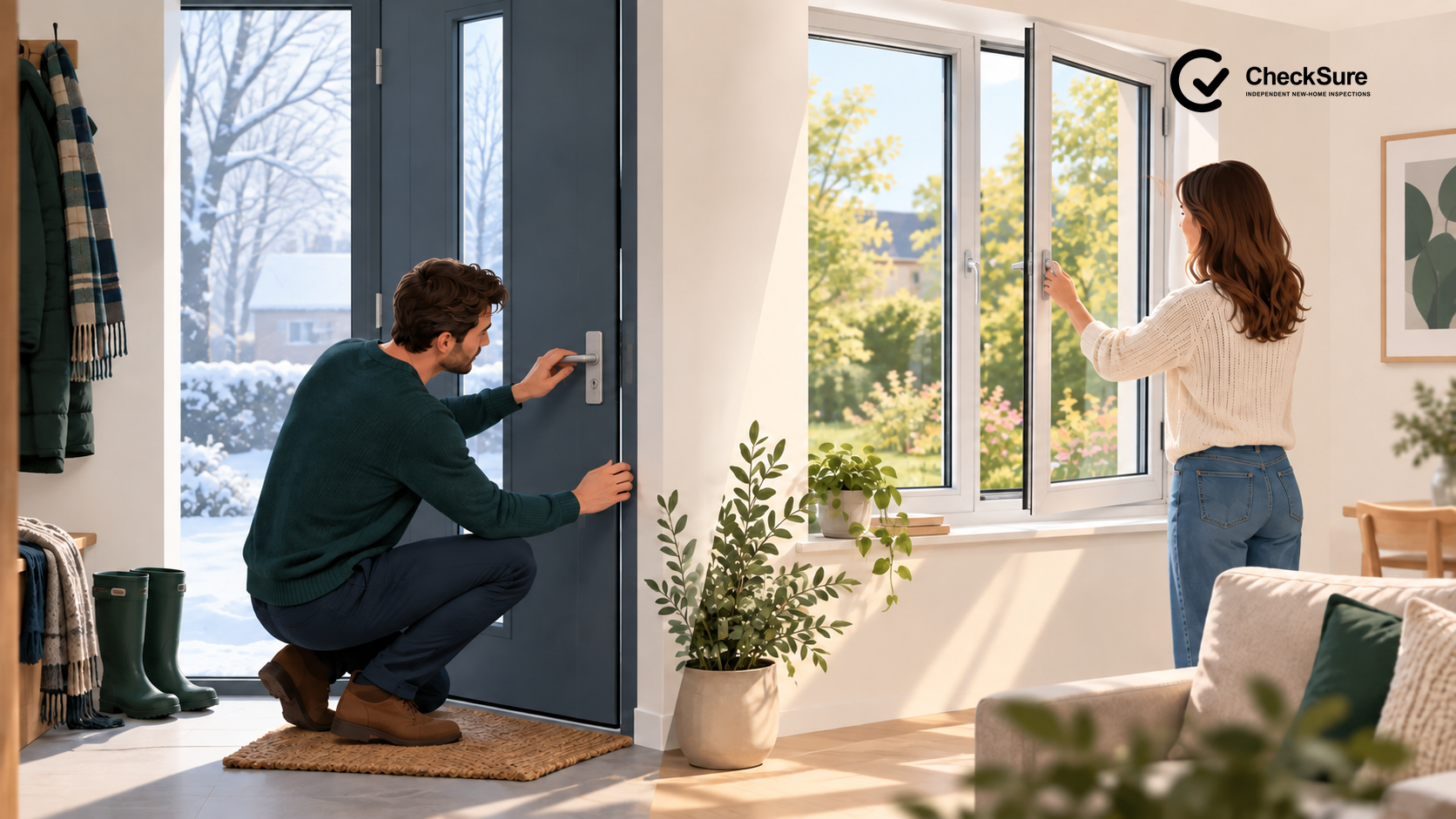
Signs that an inspection or adjustment may be needed
A seasonal change should still be small. Repeated sticking, damaged seals, water entry, a sash that will not stay in position or a lock that needs force should be reported rather than accepted as normal weather movement.
Common symptoms include a sash rubbing the frame, a door dropping slightly at the handle side, a key or multi-point lock becoming difficult to operate, uneven gaps, a local draught, a gasket that does not contact evenly, or a window that will not stay in its intended operating position. A problem that appears only in strong sunshine or very cold weather is useful diagnostic information.
Do not repeatedly force a handle, key or door leaf. This can turn a simple alignment issue into damaged locking hardware. If an external door will not lock securely, treat it as urgent and report it immediately.
Safe checks a homeowner can make
Start with observation rather than tools. Open and close the unit slowly and note exactly where resistance occurs. Check that tracks, drainage routes and frame rebates are free from grit, packaging, plaster and other debris. Look for folded, loose or damaged gaskets, but do not pull them out. Clean frames and seals using the method stated in the care guide. harsh or abrasive products can damage finishes and rubber components.
Record the affected window or door, the date, approximate temperature, whether direct sunlight was present and whether the problem changes during the day. Clear photographs or a short video can help the developer or installer diagnose an intermittent fault.
Routine homeowner maintenance may include cleaning and, where the manufacturer permits it, applying the specified lubricant to moving parts and closure points. Do not use an unsuitable spray, oil or grease: products can attract dirt, attack seals or contaminate finishes.
When should adjustment be left to a specialist?
Adjustment should normally be handled by the developer's window-and-door contractor while the new home remains within its aftercare period. Specialist involvement is particularly important for heavy entrance doors, large glazed leaves, tilt-and-turn windows, sliding or bi-fold systems, fire doors, restricted openings and any component affecting safety or security.
Manufacturers' maintenance information commonly reserves adjustment, replacement of worn parts and removal or refitting of sashes for qualified service personnel. A heavy glazed leaf can move unexpectedly, and an incorrect hinge or keep adjustment can reduce engagement of locking points or leave the unit unsafe.
Before arranging independent work, check the developer and warranty process. An unauthorised alteration may complicate responsibility for a later defect. If the developer asks you to make an adjustment, request the exact product instruction rather than relying on generic advice.
Airtightness, draughts and weather seals
Modern windows and external doors contribute to the airtightness and energy performance of a new home. When closed and locked, gaskets and hardware work together to limit unintended air leakage. Correct adjustment should create consistent contact without making the unit unreasonably difficult to operate.
A local draught is not automatically proof that a locking cam needs tightening. Air may be entering through a displaced gasket, an opening between frame and surrounding construction, an unsealed trim, a threshold detail, a trickle ventilator or another intended ventilation route. Smoke pencils and specialist air-leakage equipment can help locate a path. homeowners should not use flames to investigate draughts.
Water on the inside of glass can be condensation rather than penetration. Water appearing around a frame during rainfall, staining, repeated wetting of finishes or moisture below a threshold should be documented and reported. Adjustment cannot correct defective perimeter sealing, blocked drainage, inadequate falls or an installation problem.
New-home handover and aftercare
At handover, operate every window and external door, including locks, restrictors and ventilation controls. Ask for keys and product care information. Record any stiffness, rubbing, visible misalignment, damaged seals or difficulty locking. If weather conditions make a fault intermittent, record it again when the symptom occurs.
A pre-completion inspection can check visible condition and basic operation without dismantling or altering the hardware. A satisfactory result on one mild day cannot prove how the unit will behave at every seasonal extreme, so the aftercare route remains important. Any adjustment made by the developer should be recorded, particularly if the same fault returns.
What may indicate more than normal seasonal movement?
Repeated or large adjustment, a frame that appears bowed or out of square, cracking around the opening, loose fixings, failed seals, persistent water entry, a threshold that moves, damaged hardware or a door that cannot be secured may point to installation, product or building-movement issues. These deserve investigation rather than repeated adjustment.
Where a fire door is involved—commonly at certain flat entrances or between a house and an integral garage—do not treat it as an ordinary uPVC adjustment task. Its self-closing action, clearances, seals, glazing and ironmongery form part of a tested fire-resisting assembly and should be assessed by a competent person.
Common misunderstandings
‘Every uPVC window has a winter setting’
No. Hardware varies considerably. Product-specific instructions determine whether compression is adjustable and how it should be set.
‘The tighter the seal, the better’
No. Too much compression can overload hardware and seals. Correct, even engagement is the goal.
‘A draught always means the window needs adjustment’
No. The source may be the gasket, frame perimeter, threshold, drainage detail or intended ventilation. Diagnose the air path first.
‘If it worked at handover, it cannot be a defect later’
No. Temperature and early building movement can reveal alignment or installation issues. Report the evidence promptly through aftercare.
Frequently asked questions
Should I adjust the windows and doors twice a year?
Not as a routine unless the product manufacturer specifically instructs it. Smooth, secure and weather-resistant units should be left alone apart from the stated cleaning, inspection and lubrication regime.
Can I lubricate a stiff lock?
Only with the lubricant and method specified for that mechanism. First check alignment and debris; lubrication will not correct a dropped sash or misaligned keep.
Who should I contact first in a new home?
Normally the developer's customer-care team. Provide the plot address, affected opening, symptom and supporting photos or video, and ask that the installer identifies and adjusts the exact system.
Key takeaways
- Temperature, sunlight, moisture and early movement can change the feel of windows and doors.
- There is no universal summer/winter setting for all uPVC products.
- Clean, observe and document the symptom before considering adjustment.
- Do not force handles or locks, and report any security problem urgently.
- Use product-specific care guidance and qualified personnel for hardware adjustment.
- Draughts and water entry require diagnosis; adjustment is not always the remedy.
- In a new home, use the developer's aftercare process before authorising independent alterations.
If you would like an independent assessment of your new home, CheckSure provides professional new-home inspections supported by clear, photographic reporting. Learn more on our inspection services page.
Explore further
Explore the CheckSure Homeowner Knowledge Base for related guidance on buying, inspecting and looking after a new home.
Related Knowledge Base articles
- Scratches on windows: how perfect should the glass be in a new home?
- Windows and doors: installation defects or seasonal adjustment?
- Condensation in new-build homes: causes, prevention and practical steps
- Maintaining your new-build home: a practical homeowner schedule
- Timber-frame homes: how do they differ from masonry construction?
Sources & References
Reynaers at Home — Operation, Care and Maintenance Manual. Manufacturer guidance covering cleaning, inspection, lubrication and specialist adjustment of window and door mechanisms.
Reynaers at Home — homeowner care and maintenance downloads. Current manufacturer download page for product and homeowner guidance.
Glass and Glazing Federation — doors guidance. Industry consumer information on door materials, complete doorsets, maintenance and installation.
GOV.UK — Approved Document L, conservation of fuel and power. Official England guidance relevant to the energy performance of windows and doors.
GOV.UK — Approved Document F, ventilation. Official England guidance relevant to ventilation provision, including background ventilators.
Independent new-home inspections
Need help with your new home?
If you are approaching completion, have recently moved in or are dealing with unresolved concerns, CheckSure can help you choose the appropriate inspection for your stage.
Important information
The Knowledge Base provides general information for homeowners in the UK. It is not a substitute for advice about an individual property and should not be treated as legal, financial, insurance, structural or other specialist advice. Requirements and warranty terms can vary according to location, construction date, provider, contract and the circumstances of the particular home.
Copyright and permitted use. © 2026 CheckSure Ltd. All rights reserved. Website content may not be reproduced without permission, except as permitted by law. See our Content Use and Copyright Policy.