

Homeowner Knowledge Base
The New Homes Quality Code: what it means for buyers
The short answer: the New Homes Quality Code gives buyers of qualifying new homes a clearer set of protections from reservation through to two years after legal completion. It covers how a registered developer sells the home, explains costs, handles the reservation, offers a pre-completion inspection, completes the property, provides after-sales support and deals with complaints. If the developer cannot resolve a qualifying complaint, the buyer may have access to the independent New Homes Ombudsman Service.
CheckSure’s Homeowner Knowledge Base draws on practical experience of building, inspecting and resolving defects in new homes. Our aim is to explain what homeowners should reasonably expect, what may require further investigation and what steps they can take next.
Why this Code matters
Buying a new home is unusual. The customer may reserve from drawings, commit substantial money before construction is finished and rely on the developer for information that cannot easily be checked independently. The relationship also continues after completion because finishing issues, defects and questions about the development may emerge only after occupation.
Consumer codes for new homes existed before the New Homes Quality Board. The important development here is the attempt to bring detailed customer-service requirements, a public register, a standard pre-completion inspection process and access to an independent Ombudsman into one coherent framework. It is therefore better described as a significant strengthening and clarification of consumer protection—not as the first protection new-home buyers have ever had.
Version 2 of the Code applies to qualifying homes reserved from 2 March 2026. Version 1 remains relevant to earlier qualifying reservations. The correct version depends on the reservation date, so buyers should not assume that the newest document automatically governs an older purchase.
The three organisations and documents buyers should distinguish
A quick way to avoid confusion is to separate the code that sets service requirements, the board that oversees the scheme and the ombudsman service that can consider eligible unresolved complaints.
The New Homes Quality Board
The New Homes Quality Board, usually shortened to NHQB, oversees the framework and maintains the Register of Developers. A developer completes registration, training and implementation steps before becoming active. Registration is therefore more than displaying a logo: active developers commit to follow the Code and the Ombudsman arrangements.
The New Homes Quality Code
The Code of Practice sets the standards registered developers agree to meet. Its ten guiding principles are fairness, safety, quality, service, responsiveness, transparency, independence, inclusivity, security and compliance. The detailed requirements are organised around selling. legal documents, information, inspection and completion; after-sales and complaints; and solvency and legal rights.
The New Homes Ombudsman Service
The New Homes Ombudsman Service, or NHOS, is the independent dispute-resolution route associated with the Code. It is not the developer’s own complaints team and it is not the warranty provider. A customer normally gives the developer the opportunity to resolve the issue first. If the complaint remains unresolved and meets the scheme rules, the Ombudsman can investigate it without charging the customer.

Are all new homes covered?
No. Coverage should always be checked rather than assumed. The developer—or the relevant subsidiary or legal entity—must have active status on the NHQB Register of Developers, and the customer must have reserved on or after the registration start date shown for that developer. A pending registration does not provide Code protection. If a developer later becomes deactivated, customers who reserved during its active period may remain protected for the applicable period.
The scheme is primarily for individual consumers buying a new home, not commercial purchasers. It also has defined exclusions and jurisdiction rules. Some matters may belong with the structural warranty provider, building control, another regulator, an insurer or the courts. Before relying on the Code, check the register, the reservation date, the identity on the Reservation Agreement and the current Ombudsman scheme rules.
The Code supplements legal rights; it does not remove or replace them. Building Regulations, planning requirements, contract law, consumer law and the new-home warranty continue to have their own roles.
What should change during the buying process?
Clearer selling and fewer pressure tactics
Marketing and sales information should be clear, accurate and not misleading. Developers must not use high-pressure selling techniques. Buyers should receive meaningful information about the home, its size and specification, tenure, price, parking, likely completion timing, warranty, energy performance, mobility adaptations and important exclusions. If flooring, turf or another expected feature is not included, that should be clear before the buyer commits.
A more informative Reservation Agreement
The Reservation Agreement must be written in clear and fair language, signed by both parties and supplied to the customer. It includes a cooling-off period of at least 14 days, during which the customer can cancel and receive the full reservation fee back. It should explain the property, price, reservation period, cancellation arrangements, tenure, warranty and anticipated ongoing costs.
Version 2 places particular emphasis on the costs associated with owning and managing the home. An Affordability Schedule should identify costs the developer can reasonably anticipate over the first five years, including relevant management charges, ground rent where applicable, estate costs and certain maintenance obligations. Estimates are not guarantees, but they help expose commitments that might otherwise appear late in the legal process.
Independent legal advice
The buyer should appoint an independent legal adviser. A developer may identify firms familiar with the development, but the customer remains free to choose. The independence principle is important because the conveyancer acts for the buyer, checks the contract and title information and explains legal obligations that a sales representative cannot advise on independently.
Better information before completion
The Code requires information to be provided at defined stages, including matters affecting the purchase and occupation of the home. Material changes should be communicated. The developer must also operate its own final quality-assurance process and, for relevant nations, provide a schedule of known incomplete work or defects and the expected timescale for dealing with them.
Completion should mean a home that is complete
The Code does not treat completion as permission to hand over a substantially unfinished home. It defines when a house or apartment is complete, while recognising that limited decorative work, minor corrections or work to some shared areas may remain if the home can be occupied safely without significant disruption. At handover, the buyer should also receive practical documents, certificates, warranties and instructions relevant to operating and maintaining the home.
The right to a pre-completion inspection
One of the most valuable practical protections is the opportunity to inspect the home before completion or appoint a suitably qualified inspector to do so. The inspection uses the NHQB’s standard Pre-Completion Inspection Checklist. Separate versions exist for houses and apartments, reflecting differences in external areas and common parts.
The inspection is non-invasive and non-disruptive. It considers visible finishes, fixtures, fittings and services in broadly normal use. It is not a structural survey, a destructive investigation or a replacement for building-control inspection or warranty-provider checks. Access, weather, incomplete services and safety conditions may limit what can be examined, and those limitations should be recorded.
The checklists provide a disciplined framework for looking at the property. They include prescribed approaches to visual finish, measurements and tolerances, and they require clear information about the property, date, inspector, limitations and items requiring attention. A house inspection extends into relevant external areas such as paths, drives, boundaries, drainage and the garden where safely accessible. An apartment inspection normally considers the apartment and the common routes and areas an occupier would ordinarily use, not every technical or restricted part of the block.
Why use a professional snagging inspector?
A buyer is permitted to carry out the checklist personally, and a careful homeowner may identify many obvious issues. However, the NHQB’s own checklist explains that it was designed to be used by a suitably qualified professional and warns that someone without residential surveying knowledge may overlook or misinterpret requirements or standards.
The strongest reason to appoint a professional is not that a professional receives greater legal rights. They do not. Nor should buyers be promised that a developer will automatically accept every item because it appears on a professional report. The benefit is the quality, structure and independence of the evidence.
An experienced inspector should approach the home systematically rather than being distracted by the excitement and pressure of moving day. They are more likely to understand the applicable checklist, normal viewing conditions, common industry tolerances and the difference between a cosmetic snag, a potentially more significant defect, a maintenance issue and an item outside the inspection scope. They can describe location and consequence precisely, add useful photographs and produce a schedule that is easier for both buyer and developer to work through.
A good report can also reduce unhelpful arguments. Vague entries such as “wall looks bad” are difficult to assess. A clear entry identifies the room, surface, issue, viewing condition and requested action. This does not guarantee agreement, but it gives the discussion a more objective starting point and creates a dated record for follow-up.
Professional inspection is especially valuable where the buyer has limited construction knowledge, the property is large or technically complex, the buyer cannot attend, or access time is short. Apartments may present additional questions about common entrance routes, fire doors and communal finishes. houses add roofs, elevations, drainage, drives and gardens. Even then, the commission must be realistic: a pre-completion inspection cannot verify every concealed component or certify full legal compliance.
Choosing an inspector carefully
The March 2026 checklist says a suitably qualified inspector should belong to a recognised professional association experienced in surveying residential property, follow the association’s inspection guidance and hold relevant, adequate professional indemnity insurance. The checklist gives examples of professional bodies, but membership alone is not a substitute for relevant experience and a clear service scope.
Before appointing someone, ask whether they use the current NHQB checklist, what areas and tests are included, how limitations are reported, whether external areas and accessible common parts are covered, how quickly the report will be supplied and whether they offer follow-up support. Confirm qualifications, insurance and terms in writing. Avoid claims that promise to find “everything” or imply that the inspection replaces building control, a structural warranty or specialist testing.
Timing and access matter
The inspection must be arranged within the developer’s completion process, when the home is sufficiently finished and safe to inspect. Buyers should ask early about the permitted date, duration, attendance rules and how the completed checklist must be submitted. If services are not operational, rooms are locked or external conditions prevent safe access, the report should identify what could not be inspected and what further check is recommended.
The same judgement applies to fragile external finishes. For example, newly laid turf may not yet be rooted and walking over it can leave deep impressions. An inspector should not damage a new lawn simply to complete a checklist. the limitation can be recorded and an appropriate later inspection recommended.
What happens to snags after they are reported?
Registered developers should aim to hand over homes without snags or defects. In practice, finishing issues can still arise. The Code requires the after-sales service to cover snags and defects during the first two years after completion, and the buyer should report concerns promptly through the stated channel.
The developer should acknowledge after-sales issues as soon as possible. In most situations, an issue should be settled within 30 days. Where there is a significant reason for delay, the developer should explain it and provide updates at least monthly until resolution. An item does not necessarily become a formal complaint merely because it has been placed on a snagging list. if the buyer is dissatisfied with the response or delay, they can use the formal complaints procedure.
Keep the original report, photographs, emails, appointment dates and completion evidence. Update the schedule rather than repeatedly starting new lists. Mark what has been accepted, attempted, completed or disputed, and photograph repairs where condition or finish may later be questioned.
The formal complaints timetable
The Code gives the complaint process defined milestones. The developer must send a written acknowledgement no later than five days from the first business day after receiving the complaint. A Path to Resolution Letter follows no later than 10 days from the complaint start date. A Complaint Assessment and Response Letter is due no later than 30 days, addressing each part of the complaint and explaining outcomes, work or further investigation.
If the complaint is still open, the developer must issue an Eight-Week Letter no later than 56 days from the complaint start date, summarising action, outstanding matters, reasons and expected next steps. Updates for unresolved matters must continue at the required intervals. The customer can generally refer an eligible dispute to the New Homes Ombudsman Service after 56 days, subject to the Ombudsman’s scheme rules.
Customers have two years from reservation or completion, whichever is later, to make a complaint under the developer’s procedure and refer it if unhappy with the outcome. A complaint that arose within the first two years after completion may be capable of referral after the 56-day point even if that referral itself falls later, but it should be referred as soon as possible and eligibility is ultimately determined under the NHOS scheme rules.
The Code also says a developer must cooperate with an appropriately qualified professional adviser appointed to help settle a complaint, subject to data-protection, confidentiality and health-and-safety requirements. This reinforces the legitimate role of a professional inspector or surveyor without implying that their opinion is automatically decisive.
What the Code does not do
The Code is important, but it is not a quality guarantee and does not make defects impossible. It does not replace the structural warranty, Building Regulations approval, planning enforcement, manufacturer guarantees, insurance or independent legal advice. A pre-completion checklist is not a structural survey. Ombudsman access also depends on coverage, time limits, subject matter and scheme rules.
Some problems need urgent or specialist treatment. A safety emergency should be reported immediately through the developer’s emergency arrangements and, where appropriate, to the relevant authority or emergency service. Suspected structural movement, serious water ingress, electrical danger, fire-safety concern or gas issue should not wait for an ordinary snagging appointment.
A practical buyer action plan
- Search the NHQB Register for the exact developer or subsidiary named in your purchase documents.
- Compare the registration start date with your reservation date and save evidence of the result.
- Keep the Reservation Agreement, Affordability Schedule, specification, drawings and all agreed changes.
- Use an independent conveyancer and ask questions before exchange rather than relying on sales explanations.
- Ask early how and when the pre-completion inspection can be arranged.
- Consider a suitably qualified, insured professional who uses the current NHQB checklist.
- Submit a precise, dated report and preserve photographs and correspondence.
- Use the developer’s stated after-sales channel and escalate formally if the response is unsatisfactory.
- Record the five-, 10-, 30- and 56-day complaint milestones.
- Check the current NHOS rules before referral and seek independent advice where the issue is complex or high value.
Common misunderstandings
“Every major developer and every plot is covered”
Not automatically. Check active registration, the correct legal entity and the reservation date. Different businesses within a group may have different arrangements or activation dates.
“The Code replaces the warranty”
No. The Code deals with customer treatment, processes and certain complaints. The warranty has separate cover, exclusions and dispute routes, particularly for structural matters.
“A professional snagging report must be accepted in full”
No. It is evidence, not a binding decision. Its value comes from competence, precision, independence and an appropriate inspection method. Disputed items may require further evidence, technical review, the complaints process or the Ombudsman.
“If a home passed building control, it cannot have snags”
Building-control approval and snagging have different purposes and scopes. A home can satisfy regulatory oversight yet still contain visible finishing issues or defects requiring correction.
Frequently asked questions
Can I inspect the home myself?
Yes, the NHQB provides customer versions of the checklist. However, the checklist itself says it was designed for a suitably qualified professional and warns that an unqualified person may miss or misinterpret requirements. Consider the complexity of the home and your own knowledge before deciding.
Does the developer have to allow my inspector in?
For a qualifying purchase, the Code requires an opportunity for the customer to visit before completion and allows a suitably qualified inspector to undertake the pre-completion inspection using the standard checklist. The visit remains subject to reasonable site access and safety arrangements, so organise it through the developer rather than arriving unannounced.
What if I find more snags after moving in?
Report them promptly through the after-sales service. The pre-completion inspection is not the only opportunity to report an issue. Keep records and distinguish routine maintenance from defects for which the developer may be responsible.
Is the Ombudsman free?
The NHQB describes the New Homes Ombudsman Service as free for eligible homebuyers. Eligibility and the matters it can consider are governed by the current scheme rules.
Does the Code apply across the UK?
The framework operates across the UK, but legal terminology and some completion requirements differ between England, Wales, Scotland and Northern Ireland. Buyers should use the version and guidance relevant to their transaction and nation.
Key takeaways
- Version 2 applies to qualifying reservations from 2 March 2026; earlier qualifying reservations use the earlier Code.
- Coverage depends on the developer’s active registration and the reservation date.
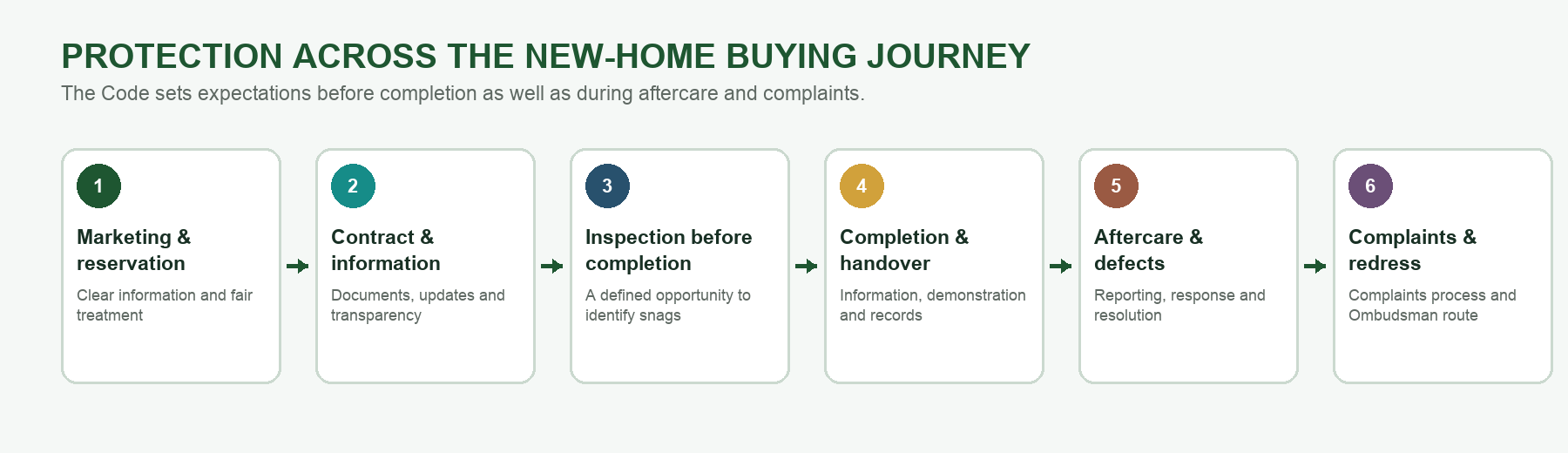
- The Code sets expectations from sales and reservation through completion and two years of aftercare.
- A pre-completion inspection is a major practical benefit, but its scope is visual and non-invasive.
- A competent professional can provide more systematic, precise and independent evidence than many buyers can produce alone.
- Professional status does not create extra legal rights or guarantee that every reported item will be accepted.
- The complaints timetable gives buyers clear escalation points and potential access to the independent NHOS.
- The Code adds to—not replaces—legal rights, warranties and regulatory protections.
Explore further
Explore the CheckSure Homeowner Knowledge Base for related guidance on buying, inspecting and looking after a new home.
Related Knowledge Base articles
- What is a pre-completion inspection?
- Which new-home inspection do I need?
- New-build handover checklist and documents
- The hidden problems with new-build homes—and how to avoid them
- Getting snags fixed: developer aftercare, complaints and escalation
- New-home warranties explained: what buyers need to know
Sources & References
New Homes Quality Code, Version 2 (March 2026). Primary Code applying to qualifying homes reserved from 2 March 2026.
NHQB Register of Developers. Official source for active status and registration dates.
NHQB Pre-Completion Inspection Checklist: House. Standard checklist and qualification requirements.
NHQB Pre-Completion Inspection Checklist: Apartment. Apartment-specific scope and inspection guidance.
New Homes Ombudsman Service. Current eligibility, scheme rules and referral information.
House of Commons Library — New-build housing: construction defects—issues and solutions (England), CBP-07665 (22 August 2022). Historical policy background only; current law, Code, warranty and redress information should be checked separately. https://commonslibrary.parliament.uk/research-briefings/cbp-7665/
Independent new-home inspections
Need help with your new home?
If you are approaching completion, have recently moved in or are dealing with unresolved concerns, CheckSure can help you choose the appropriate inspection for your stage.
Important information
The Knowledge Base provides general information for homeowners in the UK. It is not a substitute for advice about an individual property and should not be treated as legal, financial, insurance, structural or other specialist advice. Requirements and warranty terms can vary according to location, construction date, provider, contract and the circumstances of the particular home.
Copyright and permitted use. © 2026 CheckSure Ltd. All rights reserved. Website content may not be reproduced without permission, except as permitted by law. See our Content Use and Copyright Policy.