

Homeowner Knowledge Base
Poor mobile reception on new-build developments: what buyers should check
The short answer: a new home does not come with a guaranteed mobile signal. A development may be built in an area previously occupied by fields or low-density land, where existing networks were planned for fewer users. Coverage also differs between operators and can be weakened inside an energy-efficient building. Test the exact plot where possible, compare networks and avoid treating a proposed future mast as a confirmed solution until the operator and planning record support it.
CheckSure’s Homeowner Knowledge Base draws on practical experience of building, inspecting and resolving defects in new homes. Our aim is to explain what homeowners should reasonably expect, what may require further investigation and what steps they can take next.
Why a new development can expose an old coverage gap
Mobile networks grow around demand, geography, available sites, power and transmission links. A large development can introduce hundreds of homes and thousands of devices into an area whose nearest mast was designed before those residents arrived. The outdoor signal may be marginal at the site boundary, or network capacity may become strained as occupation increases.
Greenfield construction is not the only situation affected. Regeneration sites can sit behind existing buildings, below surrounding ground or beside trees and structures that shadow radio paths. The position of the plot within the estate matters: the show home, first phase and later phase may not experience the same signal.
The four networks will not perform identically
EE, O2, Three and Vodafone operate different combinations of sites, frequencies and network capacity. Companies that sell service under another brand normally use one of these underlying networks. A strong signal on one phone therefore does not prove that another household member’s provider will work equally well.
Ofcom’s Map Your Mobile checker compares predicted coverage by network and provides performance information based on real-user measurements at postcode-district level. It is a valuable starting point, not a plot guarantee. Ofcom explains that predictions may differ from experience because of buildings, trees, terrain, congestion, weather and the phone itself.
Outdoor coverage and indoor coverage are different
A phone that works on the pavement may lose service after the front door closes. External walls, metal window frames, reinforced concrete, foil-faced products, coated glazing and the number of walls between the phone and mast can reduce the signal. Ofcom deliberately provides separate indoor and outdoor predictions because building materials and position materially affect reception.
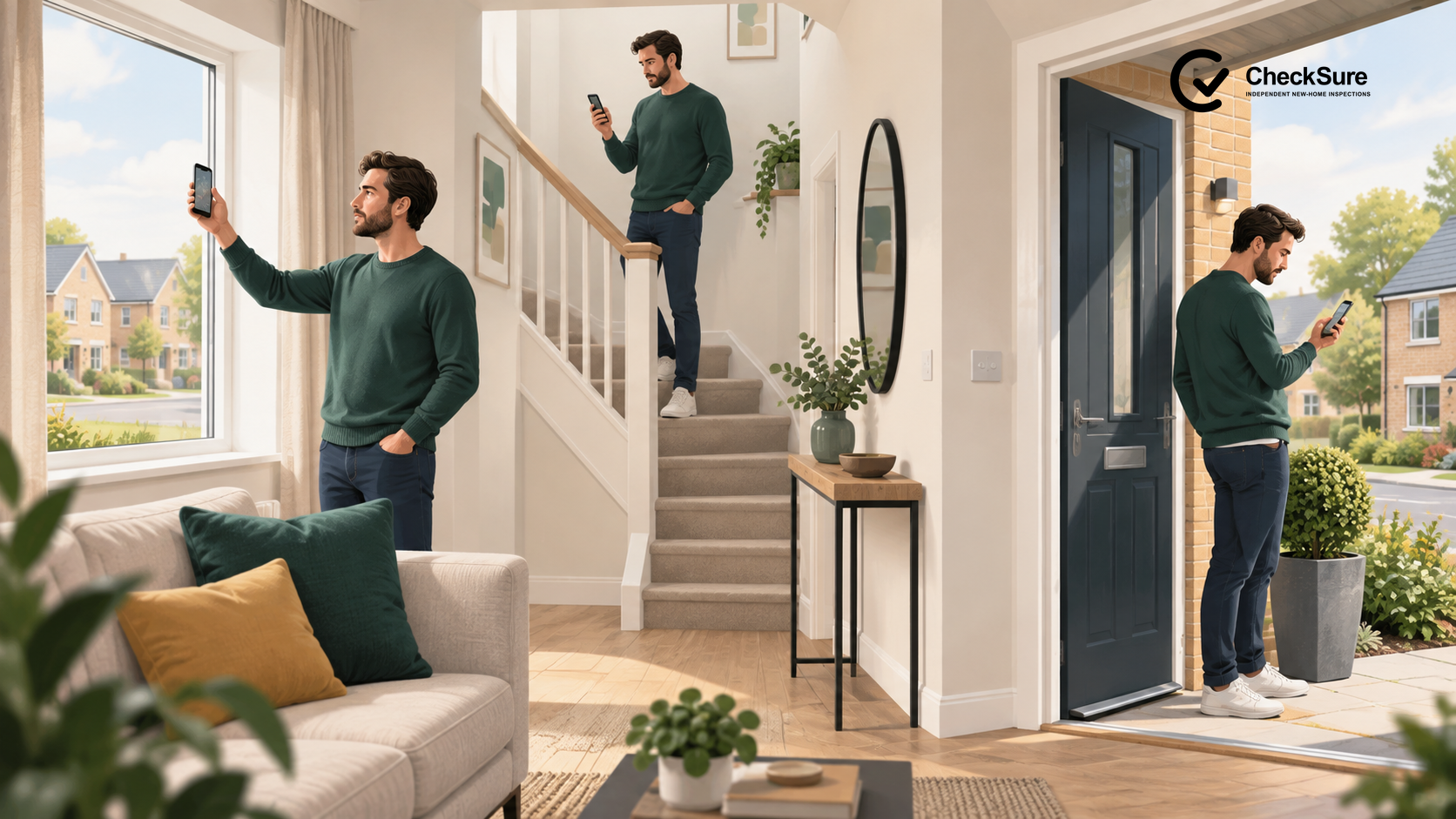
This does not mean an energy-efficient home is defective. Measures that reduce heat flow can incorporate materials that also affect radio waves, while older masonry and concrete buildings can have similar problems. Reception may improve near a window or upstairs and fall in a central ground-floor room. Test where calls and data will actually be needed.
Test before exchange and again before switching network
- Check the exact location on Ofcom’s Map Your Mobile tool and compare all four network operators.
- Use each operator’s own coverage and service-status tools as a second source.
- During site visits, test outside and inside the show home, but ask whether it is representative of your plot and construction phase.
- If safe access is permitted, test calls and mobile data in several rooms. Where possible, compare another network and repeat the test at a busy time.
- Try a low-cost pay-as-you-go or short SIM arrangement on an alternative underlying network before entering a long contract.
- Check calls, messages and data at different times. Signal bars alone do not measure congestion or usable performance.
What should you ask the developer?
- Has a mobile-connectivity assessment been undertaken for the development or planning application?
- Have residents or site staff reported particular network problems, and does experience vary by phase?
- Is any mast, rooftop equipment or small-cell installation proposed on or near the development?
- If future infrastructure is mentioned, which operator is responsible and is there a planning reference, land agreement or confirmed programme?
- Will reliable fixed broadband be available at occupation so Wi-Fi Calling can be used if required?
- Are there communal systems or landlord rules relevant to mobile equipment in an apartment building?
Treat future mast promises carefully
A sales adviser may be aware that an operator has explored a site or that land has been reserved for telecommunications equipment. That does not necessarily mean a mast has planning approval, a completed lease, power and fibre connections, construction funding or a live date. Operators choose and revise sites for technical and commercial reasons.
Ask for documentary evidence and check the local planning authority’s public register for applications or prior-approval notices. Some telecommunications development follows permitted-development procedures, while other proposals need fuller planning consideration. Even an approved mast can be delayed, altered or used by only some networks. Do not base an essential communication need on an informal timetable.
Wi-Fi Calling is often the most practical indoor solution
All main UK networks support calls and texts over Wi-Fi in some form, according to Ofcom, but the account, tariff and handset must be compatible and set up correctly. With reliable broadband and good indoor Wi-Fi, Wi-Fi Calling can provide service where the outdoor mobile signal is weak. Emergency-call location and behaviour during a power or broadband failure should be understood from the provider’s guidance.
Wi-Fi Calling depends on the quality of the home network. A router hidden by the incoming fibre point can create dead spots, so the broadband, router and mesh or access-point plan should be considered together. It is a workaround for indoor service, not proof that the local mobile network has improved outdoors.
What about repeaters and signal boosters?
A repeater receives an outdoor mobile signal and retransmits it indoors. Only compliant equipment meeting UK regulatory requirements should be used, and it still needs a usable donor signal. An unsuitable or poorly installed booster can interfere with networks. Seek advice from the mobile provider and use lawful, properly specified equipment rather than an unverified online product.
What if you have already moved in?
- Report the issue to the mobile provider and check for a local outage, maintenance or account problem.
- Enable Wi-Fi Calling and confirm that the phone, software, tariff and provider support it.
- Test near windows and on different floors to identify whether the problem is primarily indoor attenuation.
- Compare another underlying network using a temporary SIM before paying to leave an existing contract.
- Keep dated records of dropped calls and unusable data if the provider is investigating a persistent service problem.
- For emergency resilience, remember that Wi-Fi Calling will not work if broadband or power is unavailable unless backup arrangements exist.
Is poor mobile reception a snagging defect?
Usually not. A developer constructs the home but does not operate the public mobile network, and reception is influenced by external infrastructure, the chosen network, the handset and the building. A snagging inspector cannot certify mobile coverage or require the builder to provide a mast merely because a phone shows weak signal.
A specific contractual promise, a missing developer-provided internal system or damage to agreed telecommunications equipment is different and should be assessed against the sales documents. For most homes, the useful pre-purchase service is evidence gathering: test, compare networks and document what the developer has actually represented.
Common misunderstandings
“A show-home signal represents the whole development”
Coverage can vary between plots, floors, networks and construction stages.
“A new mast is guaranteed if reception is poor”
Network expansion depends on operators, permissions and commercial decisions.
“Wi-Fi calling fixes every problem”
It can help indoors but relies on compatible devices, provider support, broadband and suitable emergency-address settings.
Frequently asked questions
Why does my partner have signal when I do not?
The phones may use different networks, frequencies, tariffs or handset capabilities. Even where two brands appear different, check which underlying network each uses.
Will 5G fix the problem?
Not automatically. 5G availability, frequencies and indoor reach vary. A strong 4G service may be more useful than intermittent 5G, and voice service may use different network features.
Can the developer guarantee a new mast?
Only treat a timetable as reliable when supported by the relevant operator and formal project evidence. Planning approval alone does not guarantee activation, and one operator’s mast may not serve every network.
Key takeaways
- Compare networks at the exact development; nearby coverage is not enough.
- Check outdoor and indoor performance separately and test more than one room and time of day.
- Use Ofcom’s checker as a guide, then verify with real phones and temporary SIMs.
- Ask for evidence behind any promised future mast or network improvement.
- Reliable broadband and well-designed Wi-Fi make Wi-Fi Calling a valuable indoor fallback.
- Poor public mobile reception is not normally a construction snag unless a specific contractual system or promise is involved.
Explore further
Explore the CheckSure Homeowner Knowledge Base for related guidance on buying, inspecting and looking after a new home.
Related Knowledge Base articles
- Broadband in a new-build home: arranging your new connection
- Wi-Fi dead spots in new-build homes: causes and practical solutions
- Builders’ traffic on an occupied development: what residents should expect
- Are new-build homes worth it? The honest pros and cons
Sources & References
Ofcom — Map Your Mobile. Independent comparison of predicted coverage and measured performance by network.
Ofcom — improving mobile phone reception. Guidance on coverage checking, indoor factors, Wi-Fi Calling and trying another network.
Ofcom — mobile coverage checker FAQs. Limitations, data updates, indoor solutions and repeater information.
GOV.UK — Code of Practice for Wireless Network Development in England. Planning, consultation, siting and technical context for mobile infrastructure.
Independent new-home inspections
Need help with your new home?
If you are approaching completion, have recently moved in or are dealing with unresolved concerns, CheckSure can help you choose the appropriate inspection for your stage.
Important information
The Knowledge Base provides general information for homeowners in the UK. It is not a substitute for advice about an individual property and should not be treated as legal, financial, insurance, structural or other specialist advice. Requirements and warranty terms can vary according to location, construction date, provider, contract and the circumstances of the particular home.
Copyright and permitted use. © 2026 CheckSure Ltd. All rights reserved. Website content may not be reproduced without permission, except as permitted by law. See our Content Use and Copyright Policy.